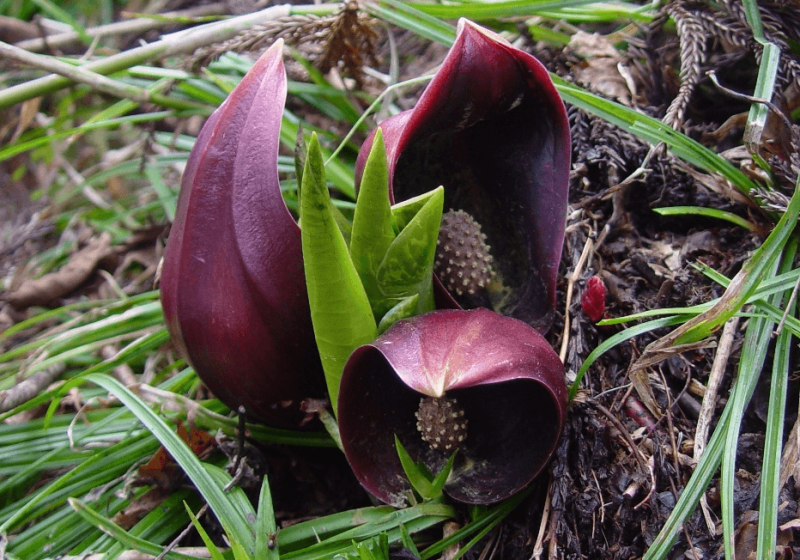
Not all flowers emit odors that are enticing to humans. Three types of flowering plants – Asarum simile, Eurya japonica, and Symplocarpus renifolius – smell like decaying meat or excrement, thanks to an enzyme, disulfide synthase. It’s the enzyme implicated in halitosis (bad breath) in humans and brings to mind Lynyrd Skynyrd’s classic “Ooh, that smell. The smell of death surrounds you.”
A new report in Science, from Yudai Okuyama and co-workers at the University of Tokyo, reveals how an initial change long ago in the enzyme altered floral odor in a way that opened a niche for novel pollinators.
From Kipling to Darwin
Stinky flowers provide another example of the “Just-So” stories that English journalist, novelist, and poet Rudyard Kipling published in 1902.
Kipling’s fanciful explanations of nature helped to hook me on science as a very young child. He famously explained “how the leopard got its spots,” “how the camel got his hump,” and “how the rhinoceros got his skin.”
Nowadays discoveries in genetics provide looks back in time to how traits arose and came to persist. DNA Science has covered several genetic just-so stories: How the Pangolin Got its Scales, How the Giraffe Got its Spots, How the Tabby Got its Stripes, and How the Human Lost its Tail.
Kipling’s tales inspired me to think like Darwin about how distinctive traits came to be. A new trait doesn’t arise from a purposeful action on the part of the leopard, camel, rhino, cat, or flowering plant. Instead, natural selection favors a beneficial inherited trait, perhaps due to a new mutation, leading to increased prevalence.
But how are certain traits beneficial? That’s where imagination comes in.
A leopard’s spots and tabby’s stripes? Camouflage.
A pangolin’s armored long nose? Shields and also protects against skin infection.
Our distant ancestors’ disappearing tails? Ability to stand upright and eventually walk.
Organic Chemistry Explains That Smell
The distinctive rotten-flesh odor of an Asarum flower arises from organic reactions – organic’s original meaning of carbon-containing compounds, not the co-opted popular term.
The molecule responsible for the floral stench is dimethyldisulfide (DMDS). It forms spontaneously during metabolism when a smaller molecule, methanethiol, (methane plus sulfur, the stuff of farts) links into doublets (dimerizes).
 Leaked European Commission document recommends softening EU regulations of gene edited crops and other products of New Genomic Techniques: “The current EU GMO regulation is not fit for purpose”
 ‘Disconnection, isolation, depression’: Long COVID has heightened our awareness of the critical role sense plays in life



What the researchers added was identifying an overactive gene in the flowers. The gene encodes a protein that binds the element selenium. In humans, the protein detoxes methanethiol (from the first step), releasing hydrogen peroxide, hydrogen sulfide, and formaldehyde in the process. People with mutations in this gene have a trait called cabbage breath.
But in plants, the biochemistry differs. Instead of emitting the trio of compounds like humans do, Asarum flowers release the extremely foul-smelling (to us) DMDS. Long, long ago, a distant shared ancestor of the three modern odoriferous species mutated in a way that tweaked metabolism to release DMDS. When certain pollinators found it delectable, those plants had a reproductive advantage, and came to persist.
The novel odor arose by a common mechanism in evolution – gene duplication. Like hanging onto an old laptop as a back-up when purchasing a new one, evolution sometimes “tries out” a new function in a duplicate gene without extinguishing the original gene’s activity.
CODA: Evolution Does Not Have a Purpose
Elegant experiments led to the explanation of how certain plants acquired an odor similar to cabbage, smelly feet, farts, and rotten flesh. Unfortunately, an accompanying Perspective from Lorenzo Caputi and Sarah E. O’Connor, of the Max Planck Institute for Chemical Ecology in Germany, makes the common errors in explaining evolution that feed the misconception that it is goal-oriented.
Evolution does not have a purpose. Would bacteria, worms, cacti, fungi, acquire novel characteristics because they simply wanted to?
Caputi and O’Connor also lapse into fanciful anthropomorphism, deeming the odor “a strategic deception in which insects that normally feed on decaying organic matter are tricked into paying a visit to these flowers, which results in inadvertent pollination by the insects. Hence, the inclusion of these sulfur-containing molecules has allowed the plants to hijack insect behaviors while offering nothing to the insects in return.”
The accompanying news release from Science isn’t much better: “Some plants lure pollinators not with sweet fragrances, but with the rank stench of decay. In a new study, researchers show how plants pull this off.” And we’re back to the just-so stories.
Mutations happen at random, a consequence of chemistry. If a genetic change provides a helpful trait variation – like a rotten odor delectable to certain insect pollinators – then it persists because those plants have a reproductive advantage. More insects visit them.
In these days of cuts to scientific research and to universities, it is more important than ever to communicate experimental findings using appropriate language – there’s no need to dumb down the science.
Ricki Lewis has a PhD in genetics and is a science writer and author of several human genetics books. She is an adjunct professor for the Alden March Bioethics Institute at Albany Medical College. Follow her at her website