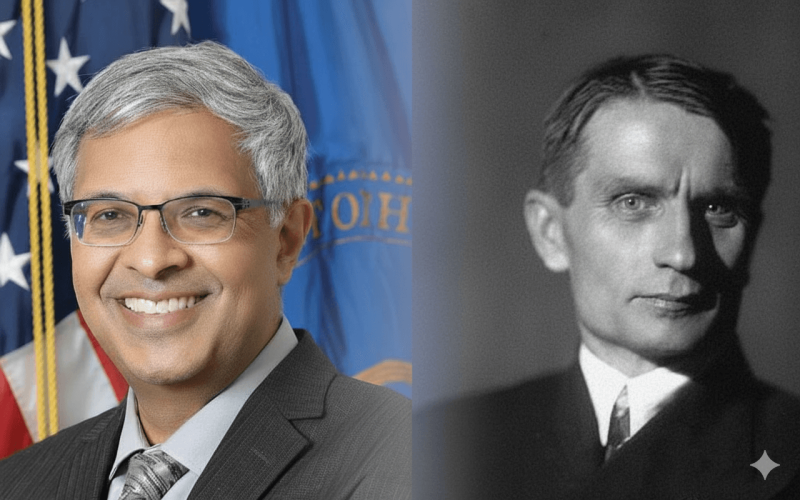
An insecure and inept but ambitious scientist climbs out of obscurity up a ladder of political favor in a burgeoning totalitarian society. What he lacks in professional competence and talent, he makes up for in sycophancy and pseudoscientific imagination. He leverages his connections within the Party to get the ear of the dictator so he can tell him what he wants to hear. The dictator loves his ideas despite their scientific implausibility, because they serve his goals for consolidating power and neutralizing dissent. Other scientists protest and present evidence that the scientist is wrong. The scientist denounces his colleagues as ideological enemies of the state, so the dictator obligingly eliminates them. The scientist’s unsupported but authoritarian-serving policy ideas are implemented, leading to the deaths of millions.
It’s hard to tell whether I’m talking about NIH Director Jay Bhattacharya or the former Soviet Academy of Sciences President Trofim Denisovich Lysenko, until you get to the deaths of millions part of the biography. Lysenko’s pseudoscientific ideas led to policies in the Soviet Union that did kill millions in the past. Bhattacharya tried and failed to do that with the Great Barrington Declaration, but now, as the leader of the largest biomedical research organization in the world, he is on track to succeed.
Sowing the seeds of discontent
Lysenko was a Soviet agronomist who claimed to have developed a novel method of growing cereal grains called vernalization that produced wheat strains with increased crop yields and extended growing seasons. This was especially important, because Joseph “Big Brother” Stalin was enforcing agricultural collectivism across the Soviet Union. Rapidly forcing collective farms to begin crop production at national scale and relocating or purging the kulaks (prosperous, land-owning peasants who resisted collectivization) devastated food production. People were starving and Stalin was desperate for a solution that would not require him to admit that collectivization had failed.
…
The only problem was that vernalization didn’t work. It turns out that heritable traits are genetic after all, as a growing chorus of geneticists including Vavilov pointed out. So Lysenko faked a bunch of data and lied about his findings. Besides vernalization, he claimed that plants select their mates, some plants self-sacrifice for the good of other plants, and fields could self-fertilize.
Bhattacharya first came to prominence with the Santa Clara serology study in April 2020, a widely pilloried preprint that claimed the mortality rate of COVID-19 was much lower than most other estimates. It was later revealed that this study was partly funded by the CEO of JetBlue Airlines, who was looking for data to support lifting pandemic-related restrictions on air travel. A few months later, Bhattacharya dropped the Great Barrington Declaration, a pandemic policy proposal calling for “vulnerable” people to isolate forever, while encouraging a COVID free-for-all everywhere else. That would have resulted in mass infection and another million deaths in the US if it had been implemented.

…
Just as Lysenko described genetic heritability as an instrument of capitalist oppression, Bhattacharya defended his position in socioeconomic terms, deriding an elite “laptop class” for implementing supposedly destructive pandemic response policies like mask and vaccine mandates and school closures. According to Bhattacharya, privileged academic and government scientists and public health officials wielded interventions meant to keep people from dying from COVID like a weapon against the proletariat.
This is an excerpt. Read the original post here