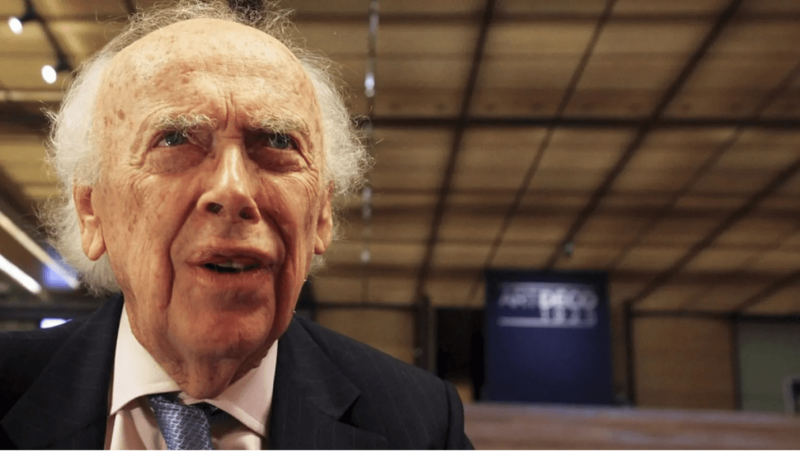
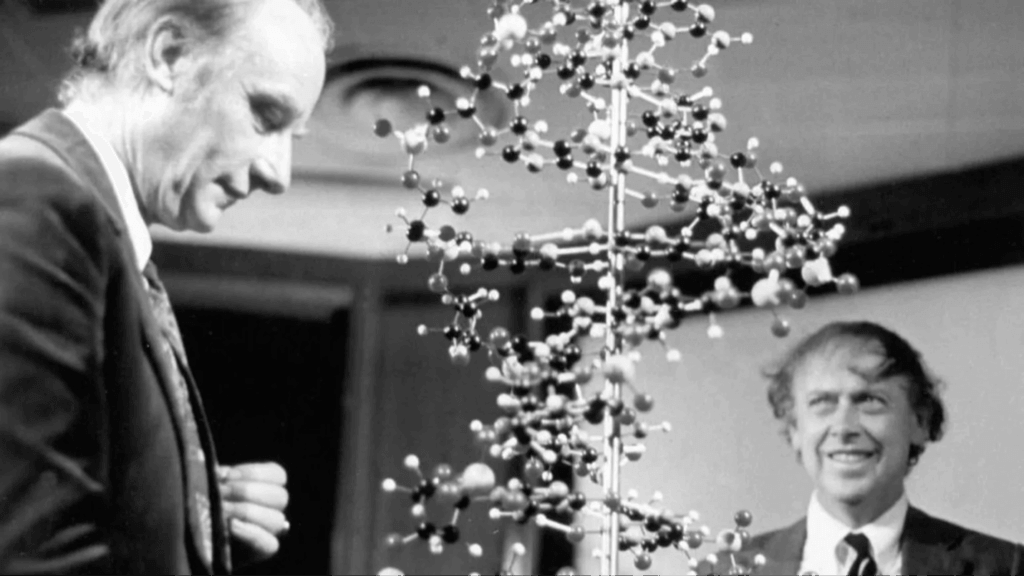
The recent death of James Watson, co-discoverer with Francis Crick of the three-dimensional structure of the genetic material DNA, brought back memories. Although a leader and groundbreaking scientist, he was also known for the occasional insensitive comment and controversial views that reawakened the hushed field of eugenics.
Watson and Crick shared the Nobel Prize in 1962. Watson went on to launch the Human Genome Project at the National Institutes of Health, and then to become Chancellor Emeritus of the Cold Spring Harbor Laboratory on Long Island.
I had two curious encounters with the man.
Futile journey
Watson earned his doctorate at Indiana University in 1950; I did the same 30 years later. I heard him speak when he visited the campus, in Bloomington, when I was a grad student in genetics, but I was too sleep-deprived to remember anything. Shortly after Francis Crick died in 2004, I decided to interview Dr. Watson while he was still around. He’d agreed to sit down for a chat, perhaps because we had some things in common. I was writing for The Scientist at the time, working on a book about gene therapy, and was also the author of several textbooks. Watson wrote genetics textbooks, too, such as The Molecular Biology of the Gene, as well as books on his observations on life, such as Avoid Boring People, and of course, The Double Helix.
So, I journeyed 14 hours on Amtrak during a single day, going from Schenectady, New York to Cold Spring Harbor Laboratory, arriving early afternoon. Watson was prompt, polite, very well dressed, and charming. And then I asked my first question.
“Dr. Watson, which do you think was more significant, deducing the structure of DNA, or sequencing the human genome?”
He sat back, smiled, and stroked his chin, seemingly deep in thought. It wasn’t a bad question to start. A pause, then …
“Ricki, do you consider yourself a girl or a woman?”
I came prepared with a list of questions about science in general and genetics in particular, but never could get him to answer me seriously. I didn’t even get enough material to publish my intended article, nor add anything to my human genetics textbook. At least I was reimbursed for the train fare. Perhaps I’d get another chance, if Dr. Watson spoke at a conference I was attending.
Genome pioneer
Seven years later, Watson was the first speaker at the opening session of the 12th International Congress of Human Genetics in Montreal in October, 2011. He was on a panel of “genome pioneers” who were among the first to have their genomes sequenced — which was then a very big deal. Watson’s sequence was second, following that of Craig Venter, who led the private effort to sequence the first genome.
The session was led by Kevin Davies, who wrote “The $1,000 Genome” (2010), Editing Humanity: The CRISPR Revolution and the New Era of Genome Editing (2021), and is writing a book on sickle cell disease due out next year. Science journalists attend these meetings, and we were told we could freely quote from lectures, so Watson’s comments were widely circulated (mostly minus the more offensive ones).
I quoted from the session in Why I Don’t Want to Know My Genome Sequence, an article published on the USC Annenberg Center for Health Journalism website. A useful roundup of Dr. Watson’s greatest hits can be found at Goodreads. Watson’s quotable quotes ranged from the blunt — “No one may have the guts to say this, but if we could make better human beings by knowing how to add genes, why shouldn’t we?” — and profound — “Our goal should be to understand our differences” — to “There is no firm reason to anticipate that the intellectual capacities of peoples geographically separated in their evolution should prove to have evolved identically. Our wanting to reserve equal powers of reason as some universal heritage of humanity will not be enough to make it so.”
He was sexist and racist and spoke as if he would say anything that popped into his head — something that these days very few people can get away with.
Here is a dialogue from when I heard Watson speak about genome pioneers. Select audience questions are in CAPS, Watson’s responses in italics, and my commentary and explanation follow.
WHY DID YOU HAVE YOUR GENOME SEQUENCED?
I thought, why not? I had no objection, with the exception of not wanting to know ApoE4. My grandmother had Alzheimer’s in her 90s, and the fact that I was in my 70s and didn’t have it didn’t reassure me I wouldn’t in my 90s.
At Watson’s request, the gene ApoE4 and the surrounding DNA were intentionally left out of his published genome sequence because he didn’t want to know. At that time, people with two copies of a variant of this gene were thought to have a 15-fold increased risk of Alzheimer’s, and people with one copy a 3-fold increased risk. However, recent studies have found that women are at higher risk, ApoE4 interacts with other genes in ways that affect risk; and additional ApoE4 variants have been identified. As far as I know, he never publicly reported developing Alzheimer’s and lived to age 97.
WHAT DID YOU LEARN THAT WAS USEFUL?
Finding that I am a slow metabolizer of antipsychotics and beta blockers. I have a slightly irregular heartbeat, and the doctor put me on beta blockers. Two put me to sleep. Now I take them once a week, so knowing I’m a slow metabolizer was a real medical benefit. It also may have explained a mystery concerning my son. He almost died of neuroleptic malignant syndrome from an antipsychotic. I now know that if I go psychotic, I will tell people I can’t take those drugs.
WAS ANY GENOME INFORMATION NOT HELPFUL?
They told me I had something that should have killed me, a mutation in a DNA repair gene. And so, I decided not to think about it. I didn’t go and look it up. Then they told me I was one base pair off the bad one. They also told me I was a carrier for BRCA1, so I thought I would have to phone my nieces because their mother had breast cancer. But before that I asked Mary-Claire King (who identified BRCA1 and BRCA2), and she said no, I had a harmless variant. So, I’m glad I didn’t call my nieces because then they would have paid that disgraceful sum of money to Myriad Genetics.
WHO SHOULD HAVE THEIR GENOMES SEQUENCED?
I’d like to see children who have mental illness sequenced with their parents. My son has schizophrenia. The moment you have a son who is not normal, you wonder if you are the cause, or if you could have done something differently. Finding a mutation would make parents see that it was just genetic injustice, not anything they did. Knowing that won’t make their child healthy, but they won’t have the double whammy of thinking they did something wrong. I think an educated society doesn’t like genetics because it is so deterministic, and they would prefer it if you could have diets so you wouldn’t have a mentally ill child.





It is my belief that about 5% of children are born with rather bleak long-term futures. They really won’t be able to take care of themselves. They might become homeless later in life, and I think making people aware of this goes back to Hermann Müller, who worried about mutational load. We should think this way again.
Evolution means mutations, and there are going to be losers who, 20,000 years ago, would not have lived very long. But now in our so-called compassionate society, we should take care of them, but we do so very badly as they age. There are some born losers. It’s not that their parents were bad. But what’s the ethical responsibility to take care of the genetic losers? Having set up the ELSI research program, I suspect that all the programs put together have yielded nothing of value. They’re talking about minor things. The major issue is, what do we do with people with mad genes? That’s never discussed.
Hermann Muller won the 1946 Nobel Prize in Physiology or Medicine for discovering that X-rays induce mutations, and, relevant to Watson’s comment, writing a seminal book on eugenics, Out of the Night: A Biologist’s View of the Future (New York: Vangard, 1935.)
ELSI stands for The Ethical, Legal and Social Implications part of the Human Genome Project.
“The unraveling of a Nobel Prize: How Hermann Muller was awarded the Nobel Prize: A front for eugenics,” by Edward J. Calabrese from the University of Massachusetts, Amherst, and Dima Yazji Shamoun of the University of Texas, Austin, published in the Journal of Occupational and Environmental Hygiene, asserts that Muller’s research attempted to legitimize eugenics. It’s possible that Muller’s coining of the phrase “genetic load” for dangerous spontaneous mutations inspired Watson’s use of the term “genetic losers (which for him, may have been a neutral statement and not a judgment).
HAS YOUR SON INFLUENCED YOU TO HAVE YOUR GENOME SEQUENCED?
My son would say yes, but he didn’t want to. He doesn’t want to discuss it. I would have a completely different view, that we might be able to help him and he should have no choice, but that is the sort of thing brought up at ELSI meetings. I find them counterproductive to help the people born with genetic disease.
I’m very conscious of genetic losers – other people want to deny their existence. Other people want to cure them.
ARE YOU WORRIED ABOUT THE FLOOD OF DATA FROM SEQUENCING GENOMES?
I’m more worried that we’ll get the flood of information, and we won’t use it because of excessive concern about privacy. Right now, I’d be pragmatic, be as free as possible with sequencing genomes, and then if disaster is the result, we’ll try to correct it. I’d hate for anyone to say ‘you can’t tell your child that he has a DNA change.’ I think parents, within limits, should have control over what their children know, and trying to regulate that would be just awful.
I’m very happy the $1000 genome exists. Genetics will help us to understand why people don’t fit in. Every time someone goes into a children’s hospital with a serious disease, it would be immoral NOT to sequence him.
Closure
At the end of the panel discussion in 2011, I was among the crowd of mostly young people (graduate students and post-docs) with Y chromosomes who approached Dr. Watson — I’d wanted to ask him to review my soon-to-be-published gene therapy book. I was very dressed up (rare for me) and the only XX in the immediate vicinity. Dr. Watson turned on the charm and talked to me for nearly five minutes, ignoring the XY groupies.
I was embarrassed at the attention, and escaped as soon as I could politely do so. Despite his friendliness, he never responded to my follow-up request to review my book, and never acknowledged having received it when I sent him one of my personal copies.
James Watson was certainly unique, and contributed much to science. But in reading over his comments once again, here in 2025, I couldn’t help but be reminded of another older man in a position of great power who regularly blurts out offensive things that others wouldn’t even think, yet dare say out loud.
Perhaps Watson said some of the things that he did because the echo chamber of social media had yet to come along — although I suspect that wouldn’t have stopped him. Among other targets, he lampooned religious people, those with weight problems, and even scientists like himself:
“The biggest advantage to believing in God is you don’t have to understand anything, no physics, no biology. I wanted to understand.” (answer to student, date not known)
“Whenever you interview fat people, you feel bad, because you know you’re not going to hire them.” (2000, public statement on obesity)
“One could not be a successful scientist without realizing that, in contrast to the popular conception supported by newspapers and mothers of scientists, a goodly number of scientists are not only narrow-minded and dull, but also just stupid.” (The Double Helix, 1968)
But my favorite quote evokes the consequences of what he and Francis Crick accomplished:
“I never dreamed that in my lifetime my own genome would be sequenced.”
Ricki Lewis is a science writer with a PhD in genetics. She regularly contributes articles to PLOS Blogs: DNA Science. She is author of the textbook Human Genetics: Concepts and Applications and The Forever Fix: Gene Therapy and the Boy. Follow her on her website