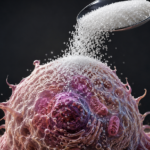
Mutation identified that contributes to Lou Gehrig’s disease and possibly Alzheimer’s

ceprosteve

A team led by scientists at St. Jude Children’s Research Hospital and Mayo Clinic has identified a basic biological mechanism that kills neurons in amyotrophic lateral sclerosis (ALS) and in a related genetic disorder, frontotemporal dementia (FTD), found in some ALS patients. ALS is popularly known as Lou Gehrig’s disease.

Phase separation is a mechanism by which proteins assemble into organized assemblies, called membrane-less organelles, necessary for orderly cell functions. The researchers found that the ALS/FTD mutation produces an abnormal version of a protein called TIA1 that is a building block of such organelles. As a result, in ALS, the proteins within the organelles accumulate and kill neurons that control muscles. In FTD, the accumulation kills neurons in the brain. The researchers noted that abnormal phase separation may also underlie Alzheimer’s disease.

[Researcher J. Paul Taylor, chair of the St. Jude Cell and Molecular Biology Department] said, “These findings are part of an emerging theme that there is a whole spectrum of diseases that includes ALS, and some forms of dementia and myopathy, that are caused by disturbance in the behavior of these structures that perturbs cellular organization.”

The GLP aggregated and excerpted this blog/article to reflect the diversity of news, opinion, and analysis. Read full, original post: Scientists identify basic biological mechanism that kills neurons in ALS

{{ reviewsTotal }}{{ options.labels.singularReviewCountLabel }}
{{ reviewsTotal }}{{ options.labels.pluralReviewCountLabel }}
{{ options.labels.newReviewButton }}
{{ userData.canReview.message }}

Related Articles

Infographic: Global regulatory and health research agencies on whether glyphosate causes cancer

Infographic: Global regulatory and health research agencies on whether glyphosate causes cancer

Does glyphosate—the world's most heavily-used herbicide—pose serious harm to humans? Is it carcinogenic? Those issues are of both legal and ...

Most Popular

Screenshot-2026-04-22-at-12.21.32-PM
Viewpoint: Why the retracted Monsanto glyphosate study doesn’t change the science—the world’s most popular herbicide is safe 
Picture1
The FDA couldn’t find a vaccine safety crisis, so it buried its own research
ChatGPT-Image-May-1-2026-11_42_59-AM-2
Viewpoint: NAD is the wellness grifters latest evidence-lite longevity fad. At least the mice are impressed.
global warming
‘Implausible’: Top climate scientists reject worst-case scenario—soaring temperatures and fast-rising sea levels
Screenshot-2026-05-21-at-12.15.17-PM
UK gene-editing milestone: Livestock barley that increases ruminant value and reduces methane emissions is first-approved CRISPR crop
vax-misinformation-main
Facts & Fallacies Podcast: Limit free speech to blunt social media misinfo?
Screenshot-2026-05-21-at-3.15.53-PM
Chiropractors may no longer be modern-day snake oil salesmen, but the benefits of their therapy are limited–at best
ChatGPT-Image-Apr-16-2026-02_56_53-PM
Financial incentives, over diagnosis, and weak oversight: Autism claims are driving up Medicare costs
ChatGPT-Image-May-12-2026-11_27_01-AM-2
AI likely to improve health care, research shows—but not for blacks and ethnic minorities
Screenshot-2026-05-20-at-5.11.17-PM
Viewpoint: No, sugar doesn’t ‘feed’ cancer — common cancer myths, debunked

Sorry. No data so far.

glp menu logo outlined

Get news on human & agricultural genetics and biotechnology delivered to your inbox.