Twenty-year review: GM crops are safe

gm crops
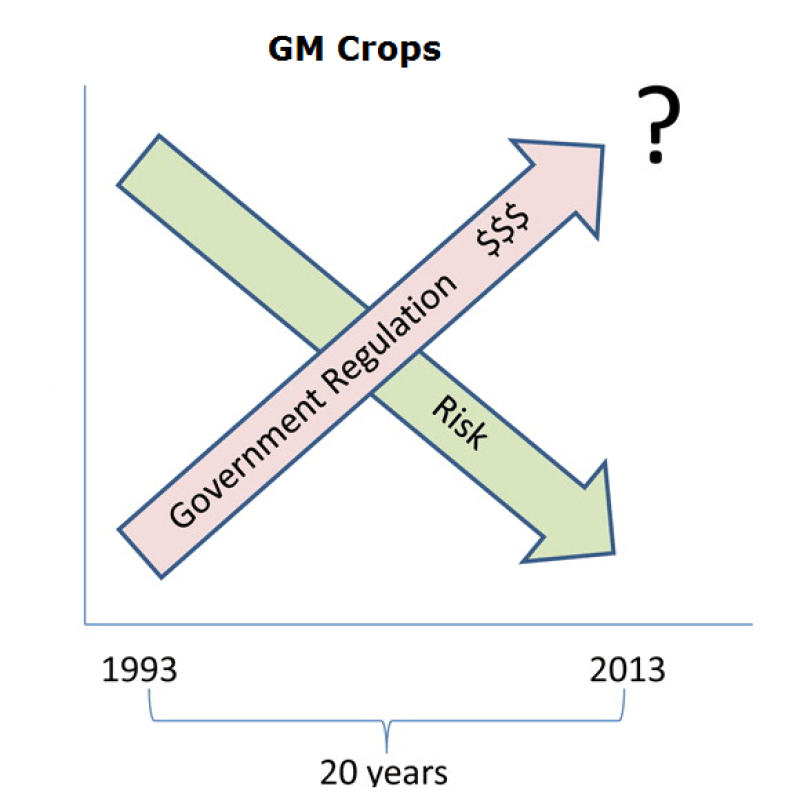
Adapted from Fig 1 in paper. See link below.

A comprehensive review of the last 20 years of peer-reviewed research on the compositional equivalency of transgenic crops — that is, the relative safety of food from genetically modified (GM) crops to their unmodified equivalents — has found that not only are transgenic crops no less safe than their traditional counterparts, but that the creation of transgenic crops is “less disruptive of composition compared with traditional breeding.”

This meta-study was conducted by a former USDA official, William D. Price, and Dow Chemical scientist Rod A. Herman. It was published on February 15, 2013 in The Journal of Agricultural and Food Chemistry.

Over the past 20 years, the U.S. FDA found that every one of the 148 transgenic events that they evaluated to be substantially equivalent to their conventional counterparts, as have the Japanese regulators studying 189 examples, including foods with combined-traits. These studies spanned a broad range of crops, including corn, soybean, cotton, canola, wheat, potato, alfalfa, rice, papaya, tomato, cabbage, pepper, raspberry, and a mushroom, and traits of herbicide tolerance, insect resistance, virus resistance, drought tolerance, cold tolerance, nutrient enhancement, and expression of protease inhibitors. “Hence,” the authors write, “compositional equivalence studies uniquely required for GM crops may no longer be justified on the basis of scientific uncertainty.” In other words: no special studies are required of GM crops on the basis of scientific uncertainty; unintended health consequences have failed to manifest in GM crops.

You can view the original paper here: “Unintended Compositional Changes in Genetically Modified (GM) Crops: 20 Years of Research,” Journal of Agricultural and Food Chemistry


Related Articles

Infographic: Global regulatory and health research agencies on whether glyphosate causes cancer

Infographic: Global regulatory and health research agencies on whether glyphosate causes cancer

Does glyphosate—the world's most heavily-used herbicide—pose serious harm to humans? Is it carcinogenic? Those issues are of both legal and ...

Most Popular

PFAS Molecules and Hazard Icons
Viewpoint: $$$ Billions of reasons why environmental activists are trying to slap a ‘killer PFAS’ label on many safe and essential ‘forever chemicals’
Screenshot 2026-11-23 at 11.51
Calley Means’ demonization of glyphosate is ‘just craziness’. Farmers are responding with science.
ChatGPT-Image-Mar-10-2026-01_39_01-PM
Viewpoint—“Miracle molecule” debunked: Why acemannan supplements don’t work
Facebook Icons with No Syringe and Thumbs-Up
RFK Jr.’s science-twisting anti-vaccine group Children’s Health Defense is back on Facebook and Instagram after Meta inexplicably lifts its ban
Pastel Breakfast Pedestals with Yogurt Bowl
RFK Jr. is about to issue an edict defining ultra-processed foods. What could go wrong?
Screenshot-2026-11-17-at-12.18.09-PM
Challenging glyphosate fear-mongering: Statewide Nebraska study finds no link between weedkiller use and non-Hodgkin lymphoma
Wholewheat Bread and Yogurt Ingredients
Viewpoint: RFK Jr.’s reckless good intentions: Do we really want to ban whole-wheat bread and yogurt?
Screenshot 2026-11-23 at 11.11
Sweat lodges and canoe journeys: Native American healing gains Medicaid coverage as Trump cuts funding and restricts eligibility nationwide
Digital Code Doctor Holding Medicine Bottle
Did you know you’re storing years’ worth of poop in your intestines? Beware: That’s the kind of junk science AI “doctors” are peddling 
Grayscale Collage of Protest and Choice
Viewpoint: Medical Freedom movement? A sobering look at RFK Jr.’s disastrous two years as our health and food czar 
Screenshot-2026-11-18-at-12.42.18-PM
Viewpoint: MAHA/MAGA/RFK Jr. health disinformation crackup is coming. Beware as Bhattacharya, Makary, Prasad, and Oz seek lucrative second acts
Screenshot-2026-11-16-at-2.37.32-PM
30 years of GMO farming: Is the boom in glyphosate and glufosinate use harming the environment? Data show they’re the most sustainable choice
Soybean Harvest in Cupped Hands
30 years of GMO farming: Defying cynics, we’ve had larger harvests, lower costs, and $385 billion in added global farmer income
glp menu logo outlined

Get news on human & agricultural genetics and biotechnology delivered to your inbox.