How GMO crops help farmers, communities and the environment

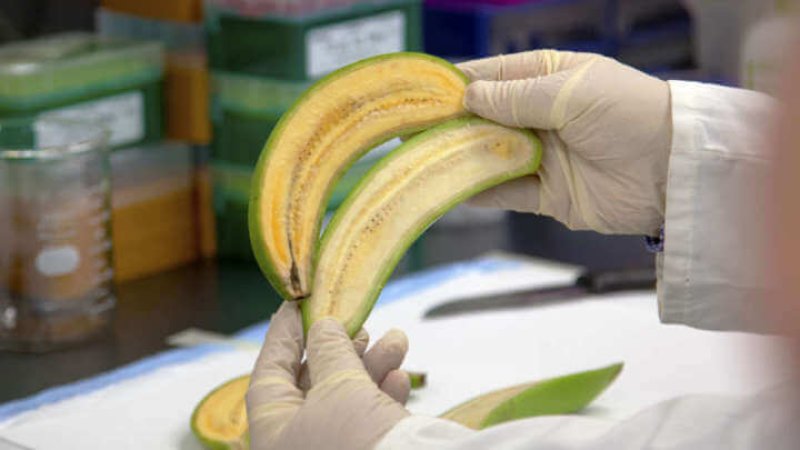
default a golden banana top compared with a non modified cavendish banana qut
Image: IFL Science

1. Genetic engineering can be good for farmers.“GE crops are cultivated to help food grow better,” says [Dr. Tamika Sims, director of food technology communications at the International Food Information Council Foundation]. The benefits vary from crop to crop, but as Dr. Sims explains, these might include protection from pests and disease, the ability to use fewer resources (e.g., saving on water) and enhanced productivity (e.g., growing more food in less space).

…

2. It’s also good for the environment — probably. “GE crops have notably increased crop yields and simultaneously decreased pesticide use,” says Dr. Sims. While different studies make different claims about how much pesticide use has declined — and some claim that it hasn’t — the overall impact on the environment seems positive.
3. It could be *really* good for communities. “GE crops can also be enhanced with nutrients, which can help people with limited access to nutritious foods,” says Dr. Sims. “Inventions such as golden rice, a GMO rice crop (developed to have an enhanced amount pro-vitamin A), and the GMO Cavendish bananas (made to be resistant to Fusarium wilt disease) are helping provide nutritious foods to people who lack access these essential nutrients.” She also points out that increased crop yields support sustained access to fruits and vegetables for more people.

Read full, original post: Here’s Why You Don’t Need to Freak Out About GMOs

Related Articles

Infographic: Global regulatory and health research agencies on whether glyphosate causes cancer

Infographic: Global regulatory and health research agencies on whether glyphosate causes cancer

Does glyphosate—the world's most heavily-used herbicide—pose serious harm to humans? Is it carcinogenic? Those issues are of both legal and ...

Most Popular

Screenshot-2026-11-17-at-12.18.09-PM
Challenging glyphosate fear-mongering: Statewide Nebraska study finds no link between weedkiller use and non-Hodgkin lymphoma
Screenshot-2026-11-16-at-2.37.32-PM
30 years of GMO farming: Is the boom in glyphosate and glufosinate use harming the environment? Data show they’re the most sustainable choice
Soybean Harvest in Cupped Hands
30 years of GMO farming: Defying cynics, we’ve had larger harvests, lower costs, and $385 billion in added global farmer income
ChatGPT-Image-Mar-10-2026-01_39_01-PM
Viewpoint—“Miracle molecule” debunked: Why acemannan supplements don’t work
Stormlit Portrait Over Golden Mountains
Searching for life where no one thought to look: A renowned astrophysicist’s seemingly quixotic quest to explore Venus’s clouds
Screenshot-2026-11-19-at-7.54.57-PM
European General Court sides with scientists, dismisses activist claims that glyphosate is toxically dangerous
Screenshot-2026-11-13-at-10.02.02-AM
Viewpoint: Why it’s such a big deal that under Trump-RFK Jr., the U.S. has lost its ‘measles-free’ status  
BEMT Lotion for Freckled Skin
Burned by FDA bureaucracy: Why Americans waited decades for cancer-preventing sunscreen
Screenshot-2026-11-09-at-3.01.19-PM
Are Texas data centers killing calves? Debunking viral AI claims
glp menu logo outlined

Get news on human & agricultural genetics and biotechnology delivered to your inbox.