How artificial intelligence could transform the ‘art of medicine’

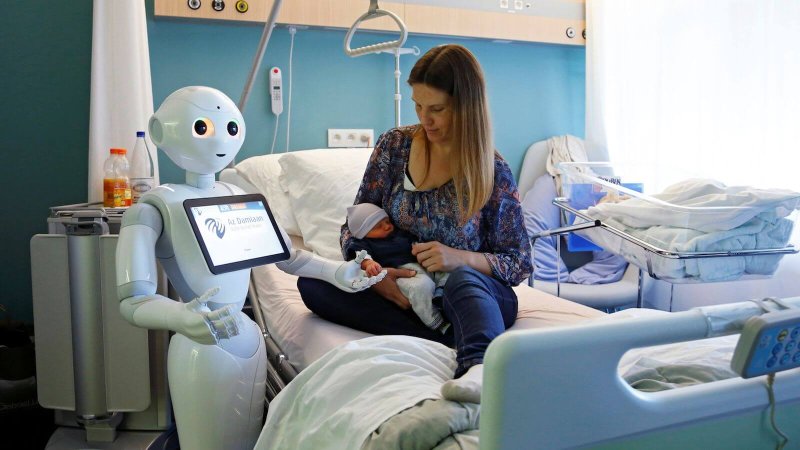
robot helping baby
Image credit: Reuters/Francois Lenoir

Every patient is unique, and the art of medicine is the component of the practice that addresses such uniqueness with compassion and care. Will artificial intelligence (AI) change all of that?

…

Artificial intelligence … involves data analytics coupled with the ability to predict outcomes and decision-making capabilities for the development of treatment plans based on empirical evidence. Such applications are geared toward saving costs as well as improving patient outcomes.

…

Artificial intelligence may also be used in hands-on delivery of care. There are several robotic systems, such as the da Vinci robots that assist—but do not replace—surgeons in operating on prostate cancer patients, enabling them to better reach tissues and resulting in improved outcomes. Certain medical devices operate autonomously—implanted defibrillators, for example, which monitor a patient’s heart rate and may automatically deliver a shock if the patient’s heart rate is too fast or irregular. However, such devices are inserted by, and used under the direction of, physicians. The question remains as to whether we will see robots that not only assist the physician in surgical or other procedures, but which operate solely independent of and without the need for a physician medical judgment.


…

Currently, the art remains in medicine as physicians remain hands-on in the ultimate decision making about patient care. Will medicine go the way of the driverless car, or will it be more like today’s state-of-the art automobile, where a human remains in control but with added safety features in the form of driver assistance technology?

Read full, original post: Could Artificial Intelligence Take the Art out of Medicine?

Related Articles

Infographic: Global regulatory and health research agencies on whether glyphosate causes cancer

Infographic: Global regulatory and health research agencies on whether glyphosate causes cancer

Does glyphosate—the world's most heavily-used herbicide—pose serious harm to humans? Is it carcinogenic? Those issues are of both legal and ...

Most Popular

ChatGPT-Image-Mar-10-2026-01_39_01-PM
Viewpoint—“Miracle molecule” debunked: Why acemannan supplements don’t work
Screenshot-2026-09-24-at-3.25.18-PM
No, organic eggs are not more nutritious or necessarily healthier than regular eggs. They are far more expensive.
Screenshot-2026-09-28-at-2.41.21-PM
Viewpoint: 7-OH controversy: An opioid is available over-the-counter–even at gas stations. Should we be concerned?
Screenshot-2026-09-17-at-1.07.08-PM
'We are dangerously addicted to antidepressants': Should we heed RFK Jr.’s sobering warning?
ChatGPT-Image-Sep-25-2026-10_36_43-AM
New federal autism committee head has financial ties to leucovorin
ChatGPT-Image-Sep-25-2026-11_36_56-AM
Now AI almost started a war with China
ChatGPT-Image-Sep-22-2026-11_17_31-AM
The exploding controversy over AI’s built-in survival drive
ChatGPT-Image-Sep-25-2026-11_57_15-AM
RFK, Jr. likely violated federal ethics guidelines in accepting more than $4,275,000 in gifts and book advances from MAHA allies
ChatGPT-Image-Sep-2-2026-02_03_32-PM
How much of a problem is AI’s water use?
Screenshot-2026-09-16-at-10.27.33-AM
Viewpoint: SCOTUS poised to address First Amendment tension between mandatory vaccines, children’s health and religious freedom 
Woman_Vaping_Electronic_Cigarette_50687233623
Trump administration clears the way for speedy approvals of once-restricted tobacco vapes and pouches
glp menu logo outlined

Get news on human & agricultural genetics and biotechnology delivered to your inbox.