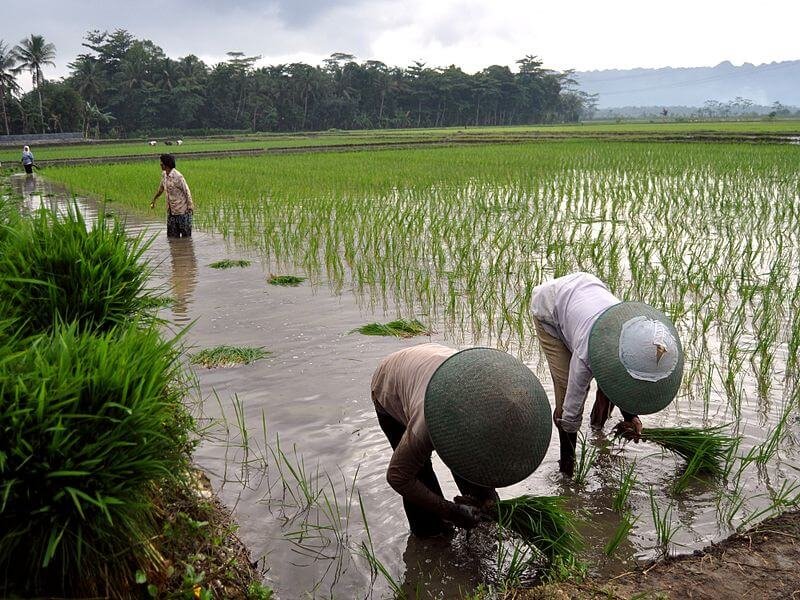
Crops engineered to consume less nitrogen fertilizer could protect vulnerable ecosystems

Bms rice planting rwg

Rice, wheat and other grains that have been bred to produce larger harvests using less land have been critical to feeding Earth’s population in the past 50 years. But these crops come with a significant cost: Their thirst for the chemical nutrients in fertilizer contributes to pollution that threatens air, land and sea. Now a team of scientists has genetically engineered new high-yield grain varieties that require less fertilizer ….

The green revolution of the 1950s and ’60s supercharged agricultural production worldwide, thanks to breeding innovations, added fertilizer and other management technologies. Crop yields boomed, nourishing millions. “In that time people just wanted food security,” says Xiangdong Fu, a plant geneticist at the Chinese Academy of Sciences. But it soon became clear the heavy use of nitrogen fertilizer wreaks havoc on ecosystems.

…

Fu and his team think they’ve found the key in grains’ genes. Their survey of the DNA of 36 rice varieties revealed a gene encoding growth-regulating factor 4 (GRF4), a protein that enhanced both nitrogen uptake and growth. But the nitrogen-hungry crops also owe their efficiency to a family of growth-suppressing proteins called DELLA, which yield more diminutive plants that can better withstand strong weather. Using genetic engineering, the team tipped the GRF4–DELLA balance by increasing expression of the GRF4-producing gene, the authors wrote …. in Nature.

Read full, original article: Rice Genes Could Be Key to Stemming Nitrogen Pollution

Related Articles

Infographic: Global regulatory and health research agencies on whether glyphosate causes cancer

Infographic: Global regulatory and health research agencies on whether glyphosate causes cancer

Does glyphosate—the world's most heavily-used herbicide—pose serious harm to humans? Is it carcinogenic? Those issues are of both legal and ...

Most Popular

Soybean Harvest in Cupped Hands
30 years of GMO farming: Defying cynics, we’ve had larger harvests, lower costs, and $385 billion in added global farmer income
Screenshot-2026-11-17-at-12.18.09-PM
Challenging glyphosate fear-mongering: Statewide Nebraska study finds no link between weedkiller use and non-Hodgkin lymphoma
Nurturing Care Beneath the Crunchy Moms Logo
Crunchy Moms disinformation flood: Zuckerberg's Facebook has opened floodgates on measles and vaccines
Screenshot-2026-11-19-at-7.54.57-PM
European General Court sides with scientists, dismisses activist claims that glyphosate is toxically dangerous
Screenshot-2026-11-16-at-2.37.32-PM
30 years of GMO farming: Is the boom in glyphosate and glufosinate use harming the environment? Data show they’re the most sustainable choice
gut health
Health vs. hype on gut health: We are flooded by misinformation
Screenshot-2026-11-18-at-2.44.24-PM
Why should thousands of Americans die every year waiting for a kidney transplant? There’s an easy fix to this morbid reality
Screenshot-2026-11-19-at-7.23.23-PM
Viewpoint: After a yearlong hiatus, the U.S. Preventive Services Task Force is back in business—gutted by RFK Jr. and promoting junk science
Stormlit Portrait Over Golden Mountains
Searching for life where no one thought to look: A renowned astrophysicist’s seemingly quixotic quest to explore Venus’s clouds
ChatGPT-Image-Mar-10-2026-01_39_01-PM
Viewpoint—“Miracle molecule” debunked: Why acemannan supplements don’t work
measles
The grim human cost of the Trump—RFK Jr. measles-prevention failure: 16 times more cases than in 2024
Gloved Hand Holding M-M-R Vaccine Vial
Viewpoint: The dangerous lie RFK Jr.-founded Children’s Health Defense is circulating to discredit one of medicine’s great breakthroughs: the MMR (measles-mumps-rubella) vaccine
glp menu logo outlined

Get news on human & agricultural genetics and biotechnology delivered to your inbox.