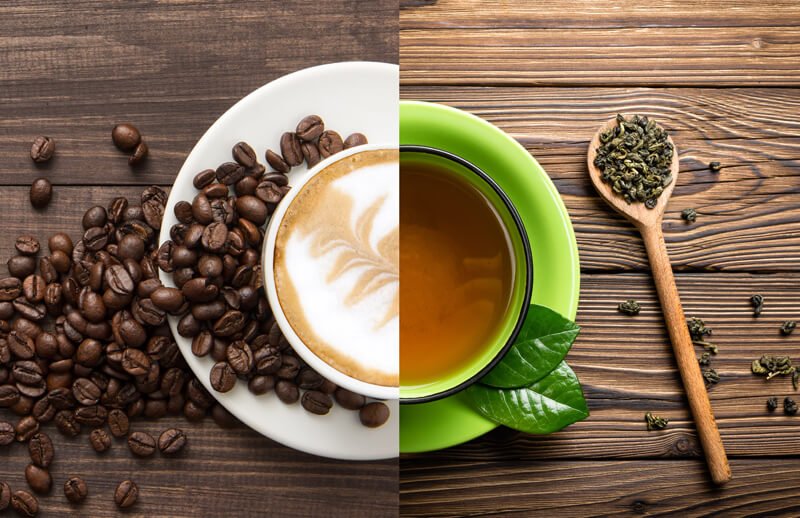
Whether you prefer coffee or tea may depend on your DNA

coffee vs tea health benefits singapore
Image credit: Linette Lai

Whether people prefer coffee or tea may boil down to a matter of taste genetics.

People with a version of a gene that increases sensitivity to the bitter flavor of caffeine tend to be coffee drinkers, researchers report online November 15 in Scientific Reports. Tea drinkers tended to be less sensitive to caffeine’s bitter taste, but have versions of genes that increase sensitivity to the bitterness of other chemicals, the researchers found.

â€Ĥ

Researchers in Australia, the United States and England examined DNA from more than 400,000 participants in the UK Biobank, a repository of genetic data for medical research. Participants also reported other information about their health and lifestyle, including how much tea or coffee they drink each day.

The team added up each person’s variants in the taste genes, creating a genetic score for how intensely the person tastes each of the bitter chemicals. The researchers then compared those scores to the people’s reported beverage choices.

People who had the highest genetic score for detecting caffeine’s bitterness were 20 percent more likely to be heavy coffee drinkers, downing four or more cups a day, than those without the increased sensitivity.

â€Ĥ

Coffee drinkers may have learned to enjoy caffeine’s bitterness because it’s a sign of the buzz the chemical provides. But tea drinkers may not actually like the bitterness of PROP and quinine, says [epidemiologist Marilyn] Cornelis.

Read full, original post: Coffee or tea? Your preference may be written in your DNA

Related Articles

Infographic: Global regulatory and health research agencies on whether glyphosate causes cancer

Infographic: Global regulatory and health research agencies on whether glyphosate causes cancer

Does glyphosate—the world's most heavily-used herbicide—pose serious harm to humans? Is it carcinogenic? Those issues are of both legal and ...

Most Popular

ChatGPT-Image-Aug-4-2026-10_15_14-AM
Viewpoint—A hard look at the Fauci diaries: Do they change what we know about COVID’s origins?
ChatGPT-Image-Mar-10-2026-01_39_01-PM
Viewpoint—“Miracle molecule” debunked: Why acemannan supplements don’t work
png-food-sweetener-nutri
Junk science alert: Does a recent ballyhooed study really prove that artificial sweeteners are worse for your brain than sugar? 
Screenshot-2026-08-05-at-7.37.27-PM-1
Facts & Fallacies podcast: 'Zombie apocalypse'? Cities move toward drug legalization, flirt with disaster
Screenshot-2026-08-05-at-8.51.10-AM
Viewpoint: ‘ICUs were empty in NYC and across the US’: RFK, Jr. accuses pro-vaccine liberals of exaggerating the number of COVID deaths
ChatGPT-Image-Aug-4-2026-11_19_30-AM
41-state Cyclospora outbreak exposes widespread state-to-state communication failures
ChatGPT-Image-Aug-4-2026-12_42_58-PM
Viewpoint: Fact-checking CNN interview with RFK, Jr. underscores the depth of his disinformation delusions
ChatGPT-Image-Aug-4-2026-07_52_00-PM
No liability for scientific due diligence: California Supreme Court rejects bizarre lawsuit faulting Gilead for fully evaluating HIV drug before release
ChatGPT-Image-Aug-5-2026-09_54_10-AM
Viewpoint: Data center rejections hit 275 in 2026. Opponents are not the Luddites portrayed by the media
ChatGPT-Image-Aug-4-2026-10_56_29-AM
Viewpoint: Viral social media misinformation drives cancer patients toward ‘wellness grifters’ and dangerous, unregulated supplements
Picture1
Hiroshima at 81: America’s new nuclear bomb, a buried Iranian target, and a question no one wants to ask
ChatGPT-Image-Jul-17-2026-09_50_27-AM
Viewpoint: How disease tracking and prevention has cratered under the Kennedy-Trump administration
ChatGPT Image Jul 29, 2026, 06_26_01 PM 2
Facts & Fallacies podcast: Organic food myths make a comeback on Instagram, with Dr. Kevin Folta
glp menu logo outlined

Get news on human & agricultural genetics and biotechnology delivered to your inbox.