
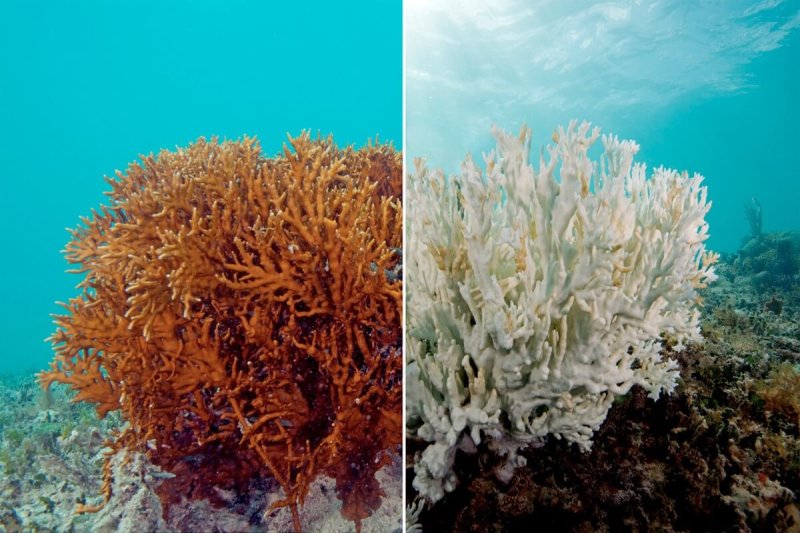
CRISPR-edited coral: Gene editing could help Great Barrier Reef survive climate change

Staghorn coral. Credit: Rosa Li

An international team of experts used CRISPR-Cas9 to elucidate the heat tolerance of a coral in the Great Barrier Reef. Their findings provide insights into the management and conservation of corals in the face of climate change. Their study is published in the Proceedings of the National Academy of Sciences (PNAS).

The team developed an enhanced CRISPR-Cas9 system to turn off the Heat Shock Transcription Factor 1 gene (HSF1) in coral Acropora millepora. HSF1 has been observed to be involved in heat response in many other organisms. Results showed that the modified larvae did not survive in the water when the temperature was raised to 34 degrees while the unmodified larvae survived in the water with such temperature.

Read the original post

Related Articles

Infographic: Global regulatory and health research agencies on whether glyphosate causes cancer

Infographic: Global regulatory and health research agencies on whether glyphosate causes cancer

Does glyphosate—the world's most heavily-used herbicide—pose serious harm to humans? Is it carcinogenic? Those issues are of both legal and ...

Most Popular

ChatGPT-Image-Mar-10-2026-01_39_01-PM
Viewpoint—“Miracle molecule” debunked: Why acemannan supplements don’t work
Screenshot 2026-11-23 at 11.51
Calley Means’ demonization of glyphosate is ‘just craziness’. Farmers are responding with science.
Screenshot-2026-11-16-at-2.37.32-PM
30 years of GMO farming: Is the boom in glyphosate and glufosinate use harming the environment? Data show they’re the most sustainable choice
Neon-AI-Globe-Network
Viewpoint: The three biggest threats posed by AI hyper-intelligence
Pastel Breakfast Pedestals with Yogurt Bowl
RFK Jr. is about to issue an edict defining ultra-processed foods. What could go wrong?
glp menu logo outlined

Get news on human & agricultural genetics and biotechnology delivered to your inbox.
















