Viewpoint: Why ‘better safe than sorry’ is a bad approach when vaccine side effects present limited risks

Credit: Reuters
Credit: Reuters

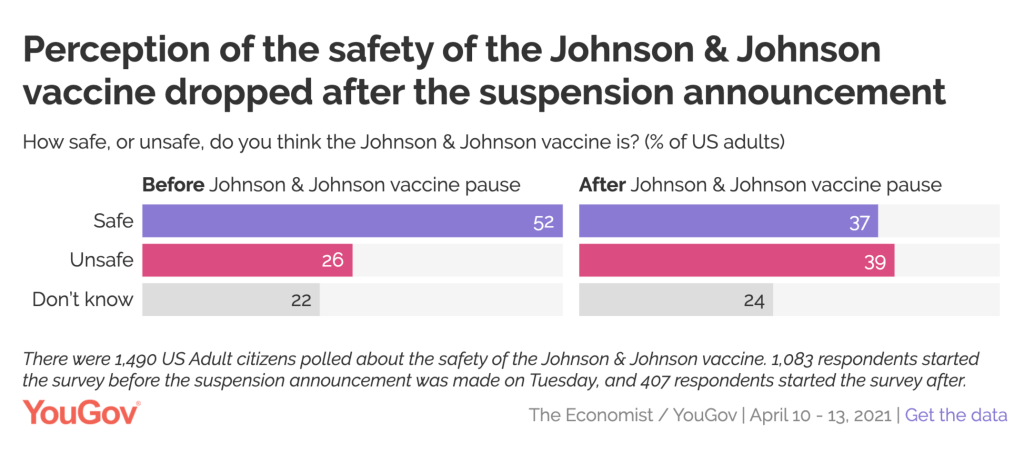
[Adenovirus-based COVID vaccines like the AstraZeneca and Johnson & Johnson shots] have been temporarily suspended in 18 countries in Europe, South Africa, and the US pending a review on very rare incidence of specific type of blood clots. Most countries restarted them again soon after. I fear there is a potential for these hasty vaccine suspensions having led to more harm than good.

…

It feels more reassuring to actively take a step to avoid a risk (vaccination side-effect), while passively allowing the risk of disease to continue.

Recent opinion piece in the BMJ (British Medical Journal) also warns of this effect, called omission bias – it’s easier to remove an action we fear may cause harm, even when harm from inaction is greater.

Mis- and disinformation are distorting science and public policy. Subscribe to our Daily and Weekly Digests for incisive coverage of ‘disruptive’ innovations in AI, agricultural biotechnology, food, chemicals, nuclear energy, vaccines, and other disruptive innovations.

Defaulting to a “better safe than sorry” approach, at least temporarily, is a reaction with a large emotional component – and I don’t call it emotional to belittle or ridicule, on the contrary. These feelings affect all of us and can be very hard to ignore. Public health professionals are not immune to such impulses and their responsibilities are likely to increase the pressure they feel. But health authorities should take particular care not to let natural biases in risk perception interfere with more objective guiding principles.

Read the original post

Related Articles

Infographic: Global regulatory and health research agencies on whether glyphosate causes cancer

Infographic: Global regulatory and health research agencies on whether glyphosate causes cancer

Does glyphosate—the world's most heavily-used herbicide—pose serious harm to humans? Is it carcinogenic? Those issues are of both legal and ...

Most Popular

Screenshot-2026-11-17-at-12.18.09-PM
Challenging glyphosate fear-mongering: Statewide Nebraska study finds no link between weedkiller use and non-Hodgkin lymphoma
Screenshot-2026-11-16-at-2.37.32-PM
30 years of GMO farming: Is the boom in glyphosate and glufosinate use harming the environment? Data show they’re the most sustainable choice
Soybean Harvest in Cupped Hands
30 years of GMO farming: Defying cynics, we’ve had larger harvests, lower costs, and $385 billion in added global farmer income
ChatGPT-Image-Mar-10-2026-01_39_01-PM
Viewpoint—“Miracle molecule” debunked: Why acemannan supplements don’t work
Stormlit Portrait Over Golden Mountains
Searching for life where no one thought to look: A renowned astrophysicist’s seemingly quixotic quest to explore Venus’s clouds
Screenshot-2026-11-19-at-7.54.57-PM
European General Court sides with scientists, dismisses activist claims that glyphosate is toxically dangerous
Screenshot-2026-11-13-at-10.02.02-AM
Viewpoint: Why it’s such a big deal that under Trump-RFK Jr., the U.S. has lost its ‘measles-free’ status  
BEMT Lotion for Freckled Skin
Burned by FDA bureaucracy: Why Americans waited decades for cancer-preventing sunscreen
Screenshot-2026-11-09-at-3.01.19-PM
Are Texas data centers killing calves? Debunking viral AI claims
Prescription Capsules Scattered on Twenty-Dollar Bills
Facts & Fallacies podcast: America's health care system is broken. A doctor explains how to fix it, Part 2
glp menu logo outlined

Get news on human & agricultural genetics and biotechnology delivered to your inbox.