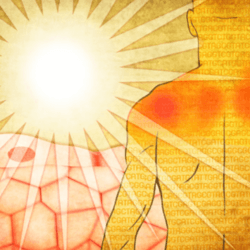
Genetics might explain preferences of heat or cold

preferdryhea
Image via Medical Xpress.

While people in the East and Midwest have been suffering through an intense cold system drifting in from the Arctic, those in the Southwest have been enjoying beautiful, warm weather – and rubbing it in to family and friends in cooler climates by boasting about it on social media.

But much like living in sub-zero temperatures, living in extreme heat presents some of its own challenges. And your ability to cope has much more to do with just an emotional response to temperatures.

University of Arizona experts involved in weather-related research say other factors, such as genetics, play an important role in human climate adaptability. For example, a person’s ability to sweat, one’s skin pigmentation, the strength of one’s heart and even how close one’s blood vessels are to the surface of his or her skin are among the factors that determine a person’s adaptability.

“If you put two people in an environment with the same stimulus, over time, they will still carry a genetic predisposition. One person’s body may change to adapt, but it won’t change as much as someone of a different predisposition who does better in that climate,” said Dr. Brian S. Drummond, a clinical assistant professor and medical director for the University of Arizona Medical Center-South Campus.

So, in the midst of variable weather conditions across the nation, a question comes to mind: Can humans actively and naturally become more adaptable to extreme temperatures?

The answer: yes and no. Indeed, it’s complicated.

Read the full, original article: Prefer dry heat to arctic chill? Genetics might be the reason

Additional Resources:

{{ reviewsTotal }}{{ options.labels.singularReviewCountLabel }}
{{ reviewsTotal }}{{ options.labels.pluralReviewCountLabel }}
{{ options.labels.newReviewButton }}
{{ userData.canReview.message }}

Related Articles

Infographic: Global regulatory and health research agencies on whether glyphosate causes cancer

Infographic: Global regulatory and health research agencies on whether glyphosate causes cancer

Does glyphosate—the world's most heavily-used herbicide—pose serious harm to humans? Is it carcinogenic? Those issues are of both legal and ...

Most Popular

Screenshot 2025-08-25 203032
Mazzenga’s 20-year old muscles: How a still-going-strong 92-year old sprinter wins every race she enters
Screenshot-2026-06-08-at-10.19.30-AM
‘Natural’ wellness supplements linked to liver injury
global warming
‘Implausible’: Top climate scientists reject worst-case scenario—soaring temperatures and fast-rising sea levels
Screen Shot at AM
Facts & Fallacies Podcast: Right-wing politics bad for your health? Separating speculation from science
Screenshot-2026-06-05-at-2.12.30-PM
Some plants can poison you. So how did humans figure out what is safe to eat?
Screenshot-2026-06-05-at-1.44.09-PM
Viewpoint: Scientists have scrapped the worst-case climate scenario. Is that proof that climate change is a hoax, as Trump claims?
Credit: ACSH
Viewpoint: Who and what’s to blame for the surge in vaccine-preventable diseases?
ChatGPT-Image-May-28-2026-12_56_54-PM
Viewpoint: Vaccines' non-specific effects? The ‘shoddy’ Danish couple whose 'research’ inspires RFK, Jr.’s health delusion
ChatGPT-Image-Jun-9-2026-03_24_05-PM
Misinformed parents overdosing children with Vitamin A to fight measles
Screenshot-2026-06-08-at-1.35.30-PM
Viewpoint: Social media and fake natural health propaganda fuel surge in use of mostly useless supplements
ChatGPT-Image-Mar-10-2026-01_39_01-PM
Viewpoint—“Miracle molecule” debunked: Why acemannan supplements don’t work
Screenshot 2025-07-30 at 10.48
Can gene editing eliminate Down syndrome? Scientists have done it in lab-grown cells
ChatGPT-Image-Jun-9-2026-11_54_59-AM
Why weight-loss drugs might be reducing cancer rates and making treatment more effective
glp menu logo outlined

Get news on human & agricultural genetics and biotechnology delivered to your inbox.