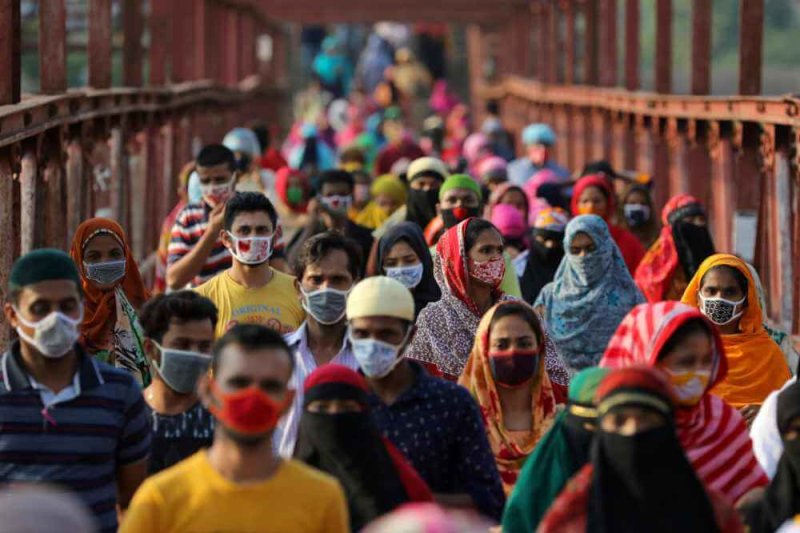
How can we encourage people to wear masks?

Credit: Dhaka Tribune

Researchers from Stanford, Yale, the Bangladeshi nonprofit GreenVoice and the research group Innovations for Poverty Action, among others, are conducting an ongoing study in 600 villages in Bangladesh to figure out the most effective [techniques to encourage mask-wearing], with the goal of sharing them across the globe.

The researchers randomly chose 300 villages to receive mask interventions for eight weeks. Another 300 villages received no intervention at all — they’d be the comparison group.

Follow the latest news and policy debates on sustainable agriculture, biomedicine, and other ‘disruptive’ innovations. Subscribe to our newsletter.

The strategies essentially centered on free face coverings and reminders. Each household got three free masks, but people could also get free masks at mosques or markets. People were shown videos of notable Bangladeshis, such as national cricket star Shakib Al Hasan or Prime Minister Sheikh Hasina, discussing how and when to wear the face coverings. 

[Yale professor Mushfiq] Mobarak and his team were surprised by what they found. The core interventions — which included the free masks and frequent reminders — more than tripled mask use, from 13% in the comparison villages to 42% in the treatment villages.

Furthermore, people kept wearing masks after the volunteer promoters of masks left the villages. “Even after 10 weeks, after we finished everything, the mask-wearing persisted. That’s what got us excited,” Mobarak says.


This is an excerpt. Read the original post here.

{{ reviewsTotal }}{{ options.labels.singularReviewCountLabel }}
{{ reviewsTotal }}{{ options.labels.pluralReviewCountLabel }}
{{ options.labels.newReviewButton }}
{{ userData.canReview.message }}

Related Articles

Infographic: Global regulatory and health research agencies on whether glyphosate causes cancer

Infographic: Global regulatory and health research agencies on whether glyphosate causes cancer

Does glyphosate—the world's most heavily-used herbicide—pose serious harm to humans? Is it carcinogenic? Those issues are of both legal and ...

Most Popular

Picture1
The FDA couldn’t find a vaccine safety crisis, so it buried its own research
Screenshot-2026-04-22-at-12.21.32-PM
Viewpoint: Why the retracted Monsanto glyphosate study doesn’t change the science—the world’s most popular herbicide is safe 
ChatGPT-Image-May-7-2026-12_32_36-PM
Viewpoint: The state of U.S. vaccine policy? Dismal nationally, but some states are stepping up.
placebo
Viewpoint — Alternative medicine and the placebo effect: Selling a reassuring illusion of health
_20250221_nib_rfk_trump
Viewpoint: 'Crisis of public trust': Autism support community shocked RFK continues to peddle false claims about the danger of vaccines
ChatGPT-Image-May-18-2026-01_45_05-PM-2
Newest hantavirus conspiracy: Online disinformation turns outbreak into latest ivermectin grift
ChatGPT-Image-May-18-2026-12_06_18-PM-2
Defying death: The immortality movement goes mainstream
Screenshot-2026-04-13-at-1.39.26-PM
Viewpoint: ‘Safer for children?’ Stonyfield yogurt under fire for deceptive organic marketing
Screenshot-2026-04-22-at-10.46.29-AM
Viewpoint: How to counter science disinformation? Science journalist offers 12 practical tips
Defense_Secretary_Ash_Carter_tours_the_Microsoft_Cybercrime_Center_in_Seattle_March_3_2016
How criminals are using AI to target social media users and steal their money and confidential data
glp menu logo outlined

Get news on human & agricultural genetics and biotechnology delivered to your inbox.