Agrivoltaics: With farm land scarce, solar panels can work in tandem with agriculture

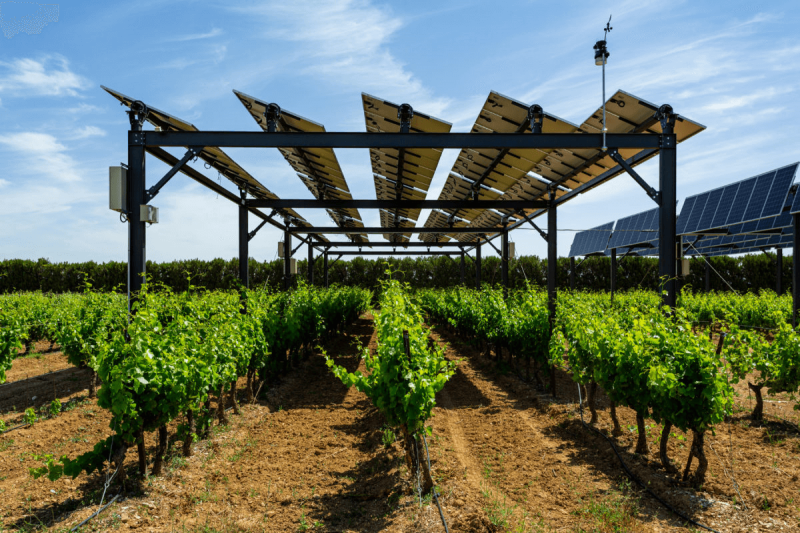
Credit: Antoine Bolcato via RPC

Farmers installing solar panels on their land traditionally have kept their paneled acres separate from those containing their crops. But this is becoming less appealing as land for farming becomes scarcer and its value soarsFarmland in the U.S. has contracted nearly 25% since the 1950s, according to data from the U.S. Department of Agriculture, and it is selling for record prices.

The concept of agrivoltaics is simple: Solar panels elevated anywhere from 6 to 18 feet off the ground create a microclimate for the crops grown below them. The shade helps the land retain more moisture than a traditional field and protects crops from the worst of the summer sun. It isn’t an ideal setup for every crop, but some thrive in it.

Follow the latest news and policy debates on sustainable agriculture, biomedicine, and other ‘disruptive’ innovations. Subscribe to our newsletter.

Producing significant revenue streams from crops is the next challenge for the technology. Researchers are now studying whether agrivoltaics can be scaled up to support commercial production of row crops, primarily corn and soybeans. Purdue University researchers, for example, are testing various agrivoltaic configurations in hopes of coming up with the optimal setup for each row crop. The university has tested agrivoltaic models on four growing seasons of corn so far, and two growing seasons of soybeans.


This is an excerpt. Read the original post here

{{ reviewsTotal }}{{ options.labels.singularReviewCountLabel }}
{{ reviewsTotal }}{{ options.labels.pluralReviewCountLabel }}
{{ options.labels.newReviewButton }}
{{ userData.canReview.message }}

Related Articles

Infographic: Global regulatory and health research agencies on whether glyphosate causes cancer

Infographic: Global regulatory and health research agencies on whether glyphosate causes cancer

Does glyphosate—the world's most heavily-used herbicide—pose serious harm to humans? Is it carcinogenic? Those issues are of both legal and ...

Most Popular

ChatGPT-Image-May-7-2026-12_32_36-PM
Viewpoint: The state of U.S. vaccine policy? Dismal nationally, but some states are stepping up.
Screenshot-2026-04-13-at-1.39.26-PM
Viewpoint: ‘Safer for children?’ Stonyfield yogurt under fire for deceptive organic marketing
Screenshot-2026-04-22-at-10.46.29-AM
Viewpoint: How to counter science disinformation? Science journalist offers 12 practical tips
ChatGPT-Image-May-7-2026-12_16_37-PM-2
Viewpoint: Are cancer rates ‘skyrocketing’ as RFK, Jr. and MAHA claim? The evidence says mostly the opposite
the magic of mRNA
Viewpoint: Anti-vax fake ‘turbo cancer’ claims threaten cancer treatment breakthroughs
ChatGPT-Image-May-7-2026-01_23_27-PM-2
Viewpoint: Will AI democratize personalized cancer treatment or fuel medical misinformation?
Defense_Secretary_Ash_Carter_tours_the_Microsoft_Cybercrime_Center_in_Seattle_March_3_2016
How criminals are using AI to target social media users and steal their money and confidential data
artificial intelligence brain think illustration md
Viewpoint — Digital gods and human extinction: Will we be the first species ever to design our own descendants?
ChatGPT-Image-May-12-2026-08_39_41-PM
GLP podcast: Big Pharma, Big Ag, Big Food—health harming industries or life-saving innovators?
Screenshot-2026-04-23-at-11.00.36-AM
Regulators' dilemma: Thalidomide, Metformin, and the cost of getting drug approvals wrong
RFKjr-Tech-Vax-Misinfo
As U.S. officials spread medical misinformation, scientists fact check online
Picture1-1
Cooling the planet with balloons: Could a geoengineering gamble slow global warming?
glp menu logo outlined

Get news on human & agricultural genetics and biotechnology delivered to your inbox.