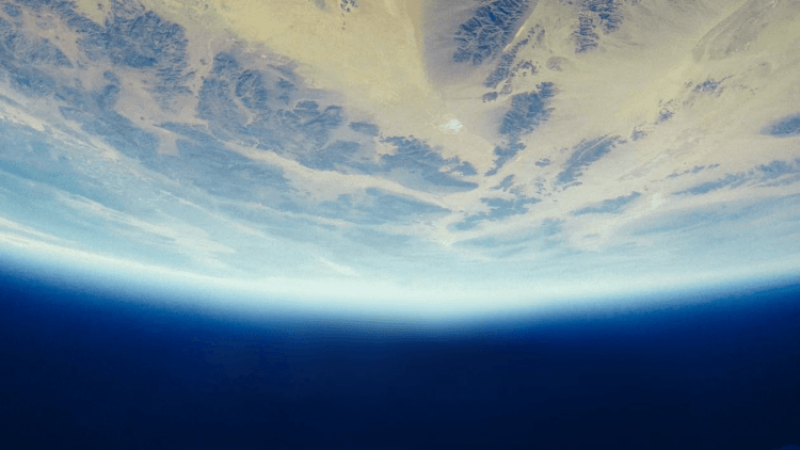
When does our atmosphere end and space begin? The answer is — up in the air

When does our atmosphere end and space begin? The answer is — up in the air
Credit: Pexels/ Jaymantri

Outer space is fundamentally different from what we experience down here, isn’t it?

But is there a boundary? Is there a place above our heads where you clearly transition to being in outer space?

This is a question that has been debated for decades and to which there is still no good answer, according to the United Nations Office for Outer Space Affairs.

Follow the latest news and policy debates on sustainable agriculture, biomedicine, and other ‘disruptive’ innovations. Subscribe to our newsletter.

Our atmosphere is made up of different layers, but these layers show no clear transition point to outer space, either. The second highest layer is called the thermosphere, which extends from about 70 to 700 kilometres, according to NASA.

The International Space Station, which orbits about 400 kilometres above our heads, is located in the thermosphere.

Intuitively, this seems like outer space, but there is still some air here. The distance between the air molecules is much, much farther apart than in the atmosphere lower down, but it is enough for the space station to be slowed down a little by the air.

The atmosphere continues far above the space station. The outermost part of the atmosphere is called the exosphere, and it continues all the way up to about 10 000 kilometres above the Earth’s surface. The atmosphere becomes less and less dense until it becomes almost impossible to distinguish it from what is called outer space.


This is an excerpt. Read the full article here

{{ reviewsTotal }}{{ options.labels.singularReviewCountLabel }}
{{ reviewsTotal }}{{ options.labels.pluralReviewCountLabel }}
{{ options.labels.newReviewButton }}
{{ userData.canReview.message }}

Related Articles

Infographic: Global regulatory and health research agencies on whether glyphosate causes cancer

Infographic: Global regulatory and health research agencies on whether glyphosate causes cancer

Does glyphosate—the world's most heavily-used herbicide—pose serious harm to humans? Is it carcinogenic? Those issues are of both legal and ...

Most Popular

ChatGPT-Image-May-7-2026-12_16_37-PM-2
Viewpoint: Are cancer rates ‘skyrocketing’ as RFK, Jr. and MAHA claims? The evidence says mostly the opposite
Screenshot-2026-04-13-at-1.39.26-PM
Viewpoint: ‘Safer for children?’ Stonyfield yogurt under fire for deceptive organic marketing
Screenshot-2026-04-22-at-10.46.29-AM
Viewpoint: How to counter science disinformation? Science journalist offers 12 practical tips
png-pill-omega-Supp-fish-oil
Millions take omega-3 fish oil for brain health. New research suggests it may do the opposite.
Screenshot-2026-04-23-at-11.00.36-AM
Regulators' dilemma: Thalidomide, Metformin, and the cost of getting drug approvals wrong
ChatGPT Image May 14, 2026, 09_51_35 PM
Facebook swamped by hundreds of thousands of scam ads for illegal or dangerous medical products
ChatGPT Image May 12, 2026, 01_21_30 PM
How big health brands are funding online medical misinformation 
ChatGPT-Image-May-13-2026-12_43_37-PM-2
Longevity: Is cellular rejuvenation even possible?
Picture1-1
Cooling the planet with balloons: Could a geoengineering gamble slow global warming?
ChatGPT-Image-May-12-2026-08_39_41-PM
GLP podcast: Big Pharma, Big Ag, Big Food—health harming industries or life-saving innovators?
Screenshot 2026-05-12 at 11.01
Viewpoint: Can this California pediatrician and Congressional hopeful quell anti-vaccine extremists?

Sorry. No data so far.

glp menu logo outlined

Get news on human & agricultural genetics and biotechnology delivered to your inbox.