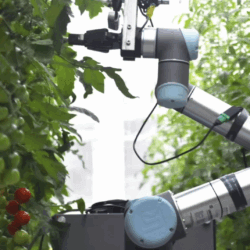
Tiny pollinating drones come to rescue of overworked bees

Credit: Nitin J Sanket and University of Maryland DRUM

About two-thirds of the crops that feed the world rely on pollination by bees and other insects. Without them, we’d be looking at an agricultural doomsday scenario. And this is exactly what a University of Maryland professor wants to avoid – with the help of an army of tiny drones.

Yiannis Aloimonos is developing RoboBeeHive, an artificial beehive that would house a bunch of small drones within a bigger, arm-length drone. This beehive will be able to attach itself to a tree, opening up to unleash a swarm of tiny drones.

According to a statement by the University of Maryland Institute for Advanced Computer Studies:
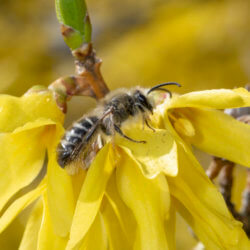
The drones use artificial intelligence to autonomously navigate and avoid obstructions — animals, trees, or other drones busy spreading pollen — as they carry pollen between plants that stick to simulated bee fur. And if the weather takes a turn for the worse, a message from the “hive” calls them back.

Mis- and disinformation are distorting science and public policy. Subscribe to our Daily and Weekly Digests for incisive coverage of ‘disruptive’ innovations in AI, agricultural biotechnology, food, chemicals, nuclear energy, vaccines, and other disruptive innovations.

With two onboard cameras providing 360-degree vision, these pollination drones can also be used for tasks other than pollinating crops. For example, inspecting bridges to spot cracks and other problems, or assisting in search-and-rescue operations by self-navigating through rubble and broken windows to find trapped people.


This is an excerpt. Read the original post here

Related Articles

Infographic: Global regulatory and health research agencies on whether glyphosate causes cancer

Infographic: Global regulatory and health research agencies on whether glyphosate causes cancer

Does glyphosate—the world's most heavily-used herbicide—pose serious harm to humans? Is it carcinogenic? Those issues are of both legal and ...

Most Popular

Screenshot-2026-11-16-at-2.37.32-PM
30 years of GMO farming: Is the boom in glyphosate and glufosinate use harming the environment? Data show they’re the most sustainable choice
ChatGPT-Image-Mar-10-2026-01_39_01-PM
Viewpoint—“Miracle molecule” debunked: Why acemannan supplements don’t work
Soybean Harvest in Cupped Hands
30 years of GMO farming: Defying cynics, we’ve had larger harvests, lower costs, and $385 billion in added global farmer income
Stormlit Portrait Over Golden Mountains
Searching for life where no one thought to look: A renowned astrophysicist’s seemingly quixotic quest to explore Venus’s clouds
Screenshot-2026-11-19-at-7.23.23-PM
Viewpoint: After a yearlong hiatus, the U.S. Preventive Services Task Force is back in business—gutted by RFK Jr. and promoting junk science
Screenshot-2026-11-19-at-7.54.57-PM
European General Court sides with scientists, dismisses activist claims that glyphosate is toxically dangerous
Screenshot-2026-11-17-at-12.18.09-PM
Challenging glyphosate fear-mongering: Statewide Nebraska study finds no link between weedkiller use and non-Hodgkin lymphoma
Nurturing Care Beneath the Crunchy Moms Logo
Crunchy Moms disinformation flood: Zuckerberg's Facebook has opened floodgates on measles and vaccines
glp menu logo outlined

Get news on human & agricultural genetics and biotechnology delivered to your inbox.