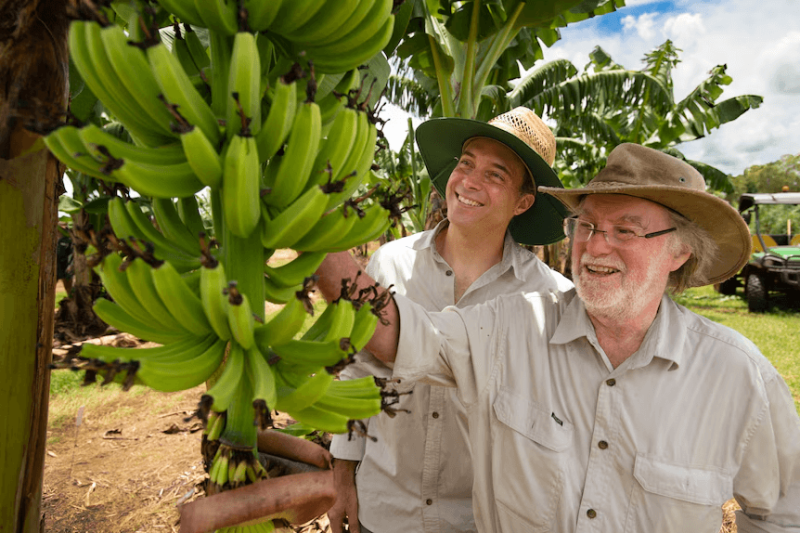

“[QCAV-4] is a Cavendish,” [Prof James Dale] says. “The bananas look the same, they feel the same, they peel the same, they smell the same and, we’re 99.99% sure, they are going to taste exactly the same.
…
The reason Dale can be supremely confident that the QCAV-4’s flavour is identical to the Cavendish banana – which accounts for 97% of bananas grown in Australia and 99% of those exported in the world – is because his team has only removed a single gene from the 25,000 genes in a wild species of banana and inserted it into the chromosome of the Cavendish.
[T]he gene in question’s qualities relate to disease resistance.
Because commercial bananas are sterile, rather than sexually reproducing, they are propagated by cutting stems from a parent plant. This means that every single Cavendish banana ever grown is a clone of a single seed produced as a naturally occurring hybrid, probably more than 1,000 years ago.


…
This lack of genetic diversity makes the commercial bananas extremely vulnerable to an outbreak of bacterial disease and fungus that could unleash a “banana apocalypse”. The kind of apocalypse that wiped out the Western world’s first commodity banana, the Gros Michel – known as “Big Mike” – by the 1960s. Or the kind of outbreak that is, even now, marching around the world’s Cavendish plantations.