
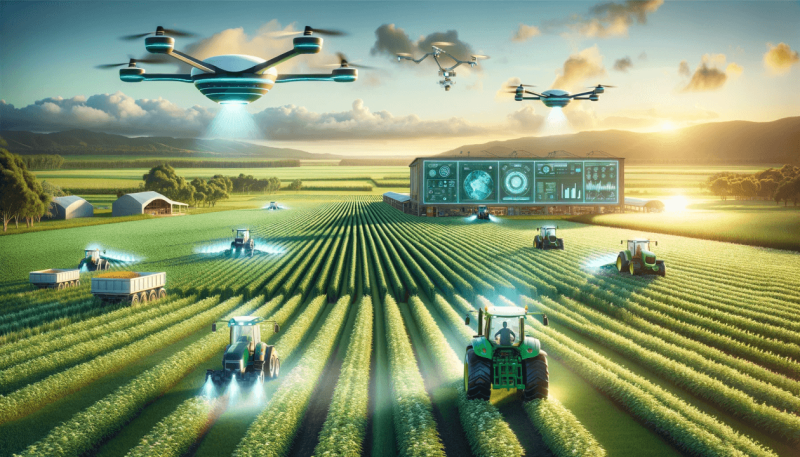
How AI is already optimizing food production

Credit: Cristi Movilă/LinkedIn

[A]rtificial intelligence, or AI, is already being harnessed to optimize food production. Technology products that are currently on the market include apps that can monitor the health of crops and make changes to their surroundings accordingly. The startup Carbon Robotics uses deep learning algorithms to identify weeds in fields from live camera feed. If unwanted plants are detected, its LaserWeeder machine then uses robotics and lasers to cut them precisely out. Weeds cause $32 billion losses in plant production every year, and traditional herbicides can pose major environmental and health hazards, so alternative innovations are urgently needed for farming.

…

As climate change becomes increasingly prevalent, the intersection between technology and agriculture may be a promising place to find solutions. In fact, artificial intelligence, or AI, is already being harnessed to optimize food production.

Mis- and disinformation are distorting science and public policy. Subscribe to our Daily and Weekly Digests for incisive coverage of ‘disruptive’ innovations in AI, agricultural biotechnology, food, chemicals, nuclear energy, vaccines, and other disruptive innovations.

AI has immense potential to make changes [to] food resources and the environment. Although it’s still developing, this option is an essential part of the conversation surrounding sustainable agriculture.

This is an excerpt. Read the original post here

Related Articles

Infographic: Global regulatory and health research agencies on whether glyphosate causes cancer

Infographic: Global regulatory and health research agencies on whether glyphosate causes cancer

Does glyphosate—the world's most heavily-used herbicide—pose serious harm to humans? Is it carcinogenic? Those issues are of both legal and ...

Most Popular

Screenshot-2026-11-16-at-2.37.32-PM
30 years of GMO farming: Is the boom in glyphosate and glufosinate use harming the environment? Data show they’re the most sustainable choice
Nurturing Care Beneath the Crunchy Moms Logo
Crunchy Moms disinformation flood: Zuckerberg's Facebook has opened floodgates on measles and vaccines
Stormlit Portrait Over Golden Mountains
Searching for life where no one thought to look: A renowned astrophysicist’s seemingly quixotic quest to explore Venus’s clouds
ChatGPT-Image-Mar-10-2026-01_39_01-PM
Viewpoint—“Miracle molecule” debunked: Why acemannan supplements don’t work
Soybean Harvest in Cupped Hands
30 years of GMO farming: Defying cynics, we’ve had larger harvests, lower costs, and $385 billion in added global farmer income
Screenshot-2026-11-19-at-7.23.23-PM
Viewpoint: After a yearlong hiatus, the U.S. Preventive Services Task Force is back in business—gutted by RFK Jr. and promoting junk science
Screenshot-2026-11-19-at-7.54.57-PM
European General Court sides with scientists, dismisses activist claims that glyphosate is toxically dangerous
Screenshot-2026-11-17-at-12.18.09-PM
Challenging glyphosate fear-mongering: Statewide Nebraska study finds no link between weedkiller use and non-Hodgkin lymphoma
Screenshot-2026-11-18-at-2.44.24-PM
Why should thousands of Americans die every year waiting for a kidney transplant? There’s an easy fix to this morbid reality
glp menu logo outlined

Get news on human & agricultural genetics and biotechnology delivered to your inbox.












