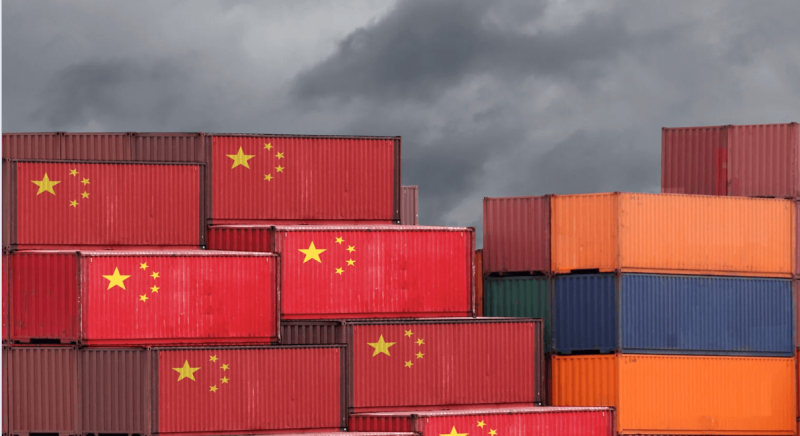
U.S.-China trade war is turning the country into a net importer of food

Screenshot 2025-10-14 at 12.08.31 PM

The United States, long regarded as a global agricultural leader, is facing a major shift as its farm trade balance moves deeper into deficit. According to a recent study by the University of Illinois Urbana-Champaign and Texas Tech University, US agricultural imports now surpass exports—a trend expected to worsen. 

“For most of recent history, the U.S. was a net agricultural exporter. But in the last couple of years, that has reversed, and what used to be a persistent surplus has turned into a persistent and growing deficit, where we’re importing much more than we export. Current projections estimate that the agricultural trade deficit will reach $49 billion by the end of 2025,” said lead author William Ridley, associate professor in the Department of Agricultural and Consumer Economics, part of the College of Agricultural, Consumer and Environmental Sciences at U. of I. 

While the US continues to be a top producer of crops like corn, soybeans, wheat, and cotton, exports are stagnating while imports—especially fruits, vegetables, and canola oil—continue to climb. The ongoing trade dispute with China remains a major factor behind this shift. 

Follow the latest news and policy debates on sustainable agriculture, biomedicine, and other ‘disruptive’ innovations. Subscribe to our newsletter.

China’s retaliatory tariffs on key US exports such as soybeans, wheat, corn, and cotton have sharply reduced trade flows. Between 2017 and 2018 alone, soybean exports fell by 73%, wheat by 67%, and corn by 61%, amounting to a $14 billion overall loss. 

Although the 2020 Phase One agreement briefly improved exports, trade quickly declined again. China has since turned to Brazil, Canada, and Argentina for supply, while investing heavily in its own crop production and biotechnology. 

Meanwhile, competitors like Brazil are strengthening their market position through higher productivity and better export infrastructure. Analysts warn that without renewed market access or strategic investments, the US may continue to lose its edge in global agriculture. 

This is an excerpt. Read the original post here

{{ reviewsTotal }}{{ options.labels.singularReviewCountLabel }}
{{ reviewsTotal }}{{ options.labels.pluralReviewCountLabel }}
{{ options.labels.newReviewButton }}
{{ userData.canReview.message }}

Related Articles

Infographic: Global regulatory and health research agencies on whether glyphosate causes cancer

Infographic: Global regulatory and health research agencies on whether glyphosate causes cancer

Does glyphosate—the world's most heavily-used herbicide—pose serious harm to humans? Is it carcinogenic? Those issues are of both legal and ...

Most Popular

circular-bioeconomy-should-focus-on-sustainable-wellbeing
GLP podcast: What's wrong with 'doomsday' environmentalism? It's false.
Screenshot-PM-24
Viewpoint: The herbicide glyphosate isn’t perfect. Banning it would be far worse.
d-b
Blocked arteries, kidney stones, nausea, constipation, fatigue: Long list of health problems caused by too much vitamin D 
Screenshot 2026-02-25 at 11.20
Why the herbicide glyphosate is key to sustainable agriculture
ChatGPT-Image-Apr-28-2026-12_46_14-PM-2
Kennedy has quietly stopped touting problematic raw milk. Health concerns aren’t why
ChatGPT-Image-Apr-22-2026-11_06_18-AM
Wellness influencer nonsense: No, nicotine does not boost cognition and productivity, but it can damage your health 
screen shot at pm
Word games: How Moderna is selling its newest vaccine without using the “v” word
ChatGPT-Image-Feb-16-2026-01_57_31-PM
Viewpoint: ‘Science-as-Satan’ unites the MAHA—MAGA movements. Is a breakup in the works?
bayer-supremecourt-lt
EPA concludes glyphosate is not carcinogenic. Missouri courts say Monsanto failed to warn it might be. SCOTUS weighs in.
glp menu logo outlined

Get news on human & agricultural genetics and biotechnology delivered to your inbox.