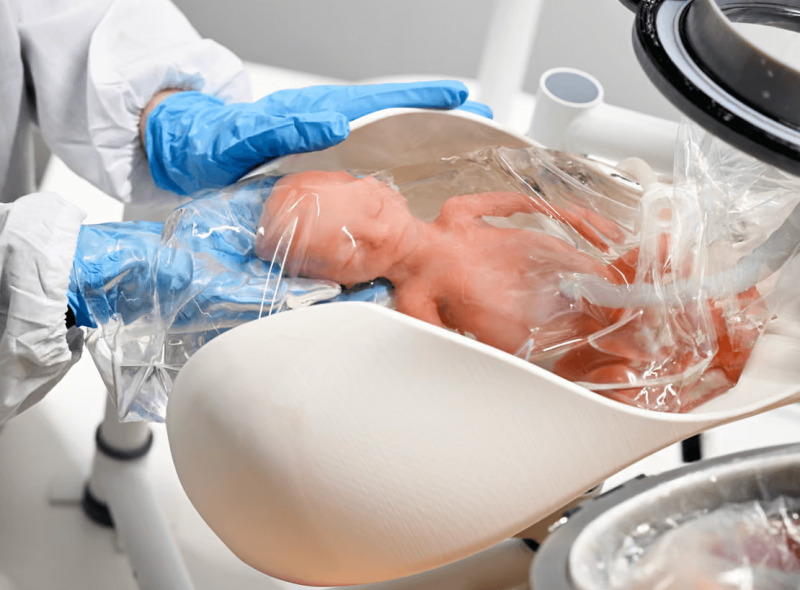
AquaWomb offers a life support system for precarious, premature babies. Not everyone thinks that’s a great idea

Credit: Eindhoven University of Technology/Bart van Overbeeke

In the US, more than 10,000 infants are born each year within … precarious boundaries. Premature birth remains the nation’s second-leading cause of infant death, and even those who survive may face crippling complications, from chronic lung disease to lifelong neurological damage.

Artificial wombs promise to change that trajectory, saving more babies and sparing more parents from grief. But growing a child outside the body also cuts to the core of how people imagine pregnancy and parenthood.

In this way, artificial wombs tug at a taut tightrope of questions that scientists, bioethicists and legal experts are scrambling to cross before human trials begin: how will this technology affect the ways we intervene in preserving life, or how we define life itself?

Follow the latest news and policy debates on sustainable agriculture, biomedicine, and other ‘disruptive’ innovations. Subscribe to our newsletter.

If perfected, an artificial womb could rewrite the limits of viability. Perhaps this is why the handful of labs working on these machines hesitate even to name them.

AquaWomb describes its prototype as a “womb-like life support system”. (They are wary of the political and science-fiction associations attached to the term “artificial womb”.)


This is an excerpt. Read the original post here

{{ reviewsTotal }}{{ options.labels.singularReviewCountLabel }}
{{ reviewsTotal }}{{ options.labels.pluralReviewCountLabel }}
{{ options.labels.newReviewButton }}
{{ userData.canReview.message }}

Related Articles

Infographic: Global regulatory and health research agencies on whether glyphosate causes cancer

Infographic: Global regulatory and health research agencies on whether glyphosate causes cancer

Does glyphosate—the world's most heavily-used herbicide—pose serious harm to humans? Is it carcinogenic? Those issues are of both legal and ...

Most Popular

Screenshot-2026-04-22-at-12.21.32-PM
Viewpoint: Why the retracted Monsanto glyphosate study doesn’t change the science—the world’s most popular herbicide is safe 
Picture1
The FDA couldn’t find a vaccine safety crisis, so it buried its own research
ChatGPT-Image-May-1-2026-11_42_59-AM-2
Viewpoint: NAD is the wellness grifters latest evidence-lite longevity fad. At least the mice are impressed.
ChatGPT-Image-Apr-16-2026-02_56_53-PM
Financial incentives, over diagnosis, and weak oversight: Autism claims are driving up Medicare costs
global warming
‘Implausible’: Top climate scientists reject worst-case scenario—soaring temperatures and fast-rising sea levels
ChatGPT-Image-May-12-2026-11_27_01-AM-2
AI likely to improve health care, research shows—but not for blacks and ethnic minorities
ChatGPT-Image-May-7-2026-01_23_27-PM-2
Viewpoint: Will AI democratize personalized cancer treatment or fuel medical misinformation?

Sorry. No data so far.

glp menu logo outlined

Get news on human & agricultural genetics and biotechnology delivered to your inbox.