Synthetic blood is coming, to be sure, but its arrival at anything more than a small scale may be some years off.
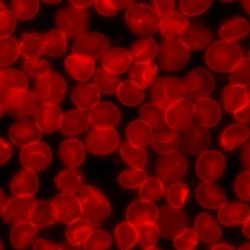
Earlier this year, I picked up reports that the Scottish National Blood Transfusion Service (SNBTS) had announced that its lab-grown red blood cells were ready for human trials — a regenerative medicine first.
SNBTS medical director Mark Turner, speaking with Liam Starkey of Deutsche Welle, reaffirms the promise of synthetic blood to counterbalance the vagaries in the current, donor-based blood supply by providing clean, ready-to-use blood virtually on demand.
However, Turner goes into greater detail now about the time and effort it will take to get lab-grown blood out of the lab and into the bodies of those in need. Turner tells Starkey:
We’ve known for some time that it’s possible to produce red blood cells from so called adult stem cells, but you can’t produce large amounts of blood in that way because of the restrictive capacity of those cells to proliferate.
[…]
It may be possible in due course to manufacture blood on a very large scale, but we’re a very long way from that at the present time. At the moment, our focus is on trying to achieve production of red blood cells which are of the right kind of quality and safety, that they would be fit for human trials.
Turner and the SNBTS have the advantage that their method of generating blood cells using adult stem cells, dodging the ethical bullet of dealing with embryonic stem cells. However, it’s still an involved process that can take a month or more:
“The differentiation process is very complex, you have to recapitulate to a certain extent the entire development that those cells go through from the very early embryo down to you or I,” Turner points out. Five or six different culture environments have to be applied sequentially, and then it takes about 30 days to produce red blood cells, he says.
If their blood passes human trials and moves toward industrial development, they will be faced with even more stringent controls and regulations will be put in place and the cost of production will be of paramount importance. To quote Turner: “”There’s no point in producing a million blood cells for a million pounds – nobody is going to use it!”



Even if a widespread deployment of synthetic blood is a decade or more off, it’s hard to argue against its pursuit:
Most developed economies have sufficient blood supplies for the population’s needs, but very many people around the world do not have access to sufficient, safe blood supplies.
About 50 percent of the blood available worldwide is used by the 15 percent of the population privileged enough to live in very advanced economies, Turner says.
“An estimated 150,000 women each year still die of postpartum hemorrhage – that is hemorrhage after birth – and many could be saved in those countries if there were adequate blood supplies.”
While at first blush lab-grown blood may not seem so dramatic a regenerative breakthrough as, say, stem cell treatments that may help repair damaged spines, the potential impact of a stable, clean, on-demand supply of blood may well make the bigger difference in saving lives.
Read the original article by Liam Starkey at Deutsche Welle: “Artificial blood made from human stem cells could plug the donations hole“
Kenrick Vezina is Gene-ius Editor for the Genetic Literacy Project and a freelance science writer, educator, and naturalist based in the Greater Boston area.
Additional Resources:
- “Artificial Blood Is Patient-Ready,” | The Scientist
- “‘Human-ready’ artificial blood gets closer to becoming a reality,” Tuan C. Nguyen | Washington Post
- “You Won’t Believe It’s Not Blood: 5 Synthetic Substitutes for the Real Thing,” Popular Mechanics