



Ancestry & Evolution
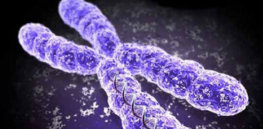
Podcast: That weird time in history when humans had 24 pairs of chromosomes
Everyone knows that humans have 23 pairs of chromosomes. But if you'd looked at a textbook in the 1940s, the ...
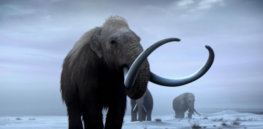
Is resurrecting the woolly mammoth an ‘unnecessary show of scientific hubris’?
Bringing an extinct species back to life was once firmly in the realm of science fiction, but as genetic engineering ...

When culture clashes with science: Teaching evolution to Tibetan monks
“We believe that we came into existence when an ogress mated with a monkey. Is that possible?” The question comes ...

People may have lived in Australia for 120,000 years—twice as long as we thought
Extensive archaeological research in southern Victoria has again raised the prospect that people have lived in Australia for 120,000 years ...
Human brains have been shrinking since the Stone Age. We don’t know why
It’s something of a well-known secret among anthropologists: Based on measurements of skulls, the average brain volume of Homo sapiens ...
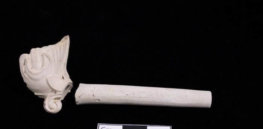
Glimpse into enslaved woman’s life offered by DNA found in clay pipe at Maryland plantation
Clay pipes used for smoking were so common in the 1700s and 1800s that it’s not very remarkable to find ...

Is the spirit of adventure encoded in our genes?
There’s one particular behavioral question that unites many animal species: “Should I explore the wider environment or exploit my current environment?” … ...
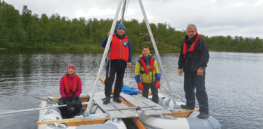
Monitoring biodiversity: Project seeks to catalog arctic life through ‘DNA Barcoding’
[Molecular biologist Inger Greye] Alsos is currently taking part in the formidable task of genetically identifying not just all the ...

‘Only child’ no more: DNA test reveals woman has at least 29 brothers and sisters
For Shauna Harrison, her journey from only child to a sister with 29 siblings started with a revisit to her 23andme ...

How the evolution of our ability to run marathons ‘made us human’
Let’s call it the “running made us human” hypothesis: According to some scientists, distance running was key to our ancestors’ ...

Is one genetic mutation responsible for human endurance?
Studies suggest that a mutation caused humans to lose function of the CMAH gene two to three million years ago—around ...

Philippines cave yields mysterious new human ancestor: Homo luzonensis
Ancient bones and teeth found in Callao Cave in the Philippines have led to the discovery of a previously unknown ...
North Dakota fossil site may be ‘most sensational’ glimpse of final minutes of dinosaur reign
Sixty-six million years ago, an immense asteroid smacked into what is now the Yucatán Peninsula of Mexico, triggering global devastation ...
Podcast: What would have happened if Darwin and Mendel had been on Twitter?
Where would we be now if Darwin and Mendel had been on Twitter? ...
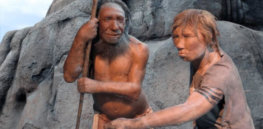
Neanderthals may have been driven to cannibalism by rapid climate change
New research published [April 2019] in the Journal of Archaeological Science suggests the crushing impact of the Last Interglacial Period, also ...

Tracing the birth of new languages—as older tongues fade away
Anthropologists and linguists are working to understand how complex systems of communication emerge—and what they reveal about how to keep ...

66 million years ago a deadly asteroid struck Earth. Scientists just found a fish killed by the impact
At one of the most important ancient graveyards on Earth in North Dakota, paleontologists unearthed the fossilized remains of fish ...

How ‘genetic libraries’ of animal DNA can help us better understand ourselves
Of more than 500 species of sharks in the world’s oceans, scientists have only sequenced a handful of genomes – ...
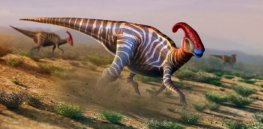
Hues of the past: How we determine the colors of prehistoric animals
[Paleontologist Maria McNamara] studies tissues from insects and vertebrates in order to envision what these critters looked like and how ...
How modern farming may be distorting our analysis of ancient human migration
One of the most widely used tools archaeologists have at their disposal to decipher where prehistoric humans lived and traveled ...

Do humans have a ‘ghost’ ancestor? Artificial intelligence thinks so.
A third archaic human species may have been identified, this time with deep learning methods ...

‘Dramatic’ skull chunk discovery could tell us more about the mysterious Denisovans
Fragments of a hominin skull add to the sparse collection from our obscure cousins ...
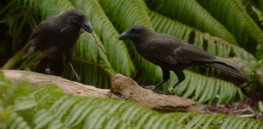
Conservation genomics: Better understanding of DNA could save some species from extinction
Disease, predators and shrinking habitats led to a complete loss of Hawaii’s only remaining lineage of the crow family, the ...

Making the case for early human migration into rain forests
In the past, researchers believed humans were almost exclusively adapted to savanna environments. Previous hypotheses suggested Homo sapiens ... spread ...

Vulnerability to mental illness may have given humans an evolutionary advantage
Nearly one in five Americans currently suffers from a mental illness, and roughly half of us will be diagnosed with ...
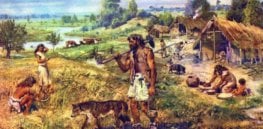
New study claims first farmers in Europe were direct descendants of region’s hunter-gatherers, challenging belief migrants introduced agriculture
For several years it has been broadly acknowledged that agriculture in Europe was first established in the Anatolian peninsula in modern day ...
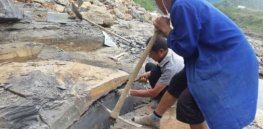
Dozens of new species found in Chinese fossil site provide window into ancient life
Fossil-packed sites like the Burgess Shale in Canada have revealed the unique nature of early animals around 508 million years ...
