One of the most popular arguments of critics of crop biotechnology is the claim that conventional breeding is more “natural” than genetic engineering. Does that claim hold up under the microscope of science?
Kevin Folta, department chair in horticultural sciences at the University of Florida, makes a strong case that such distinctions are an artifact of argument, reflecting an ignorance of how our fruits, vegetables and grains have evolved over the centuries.
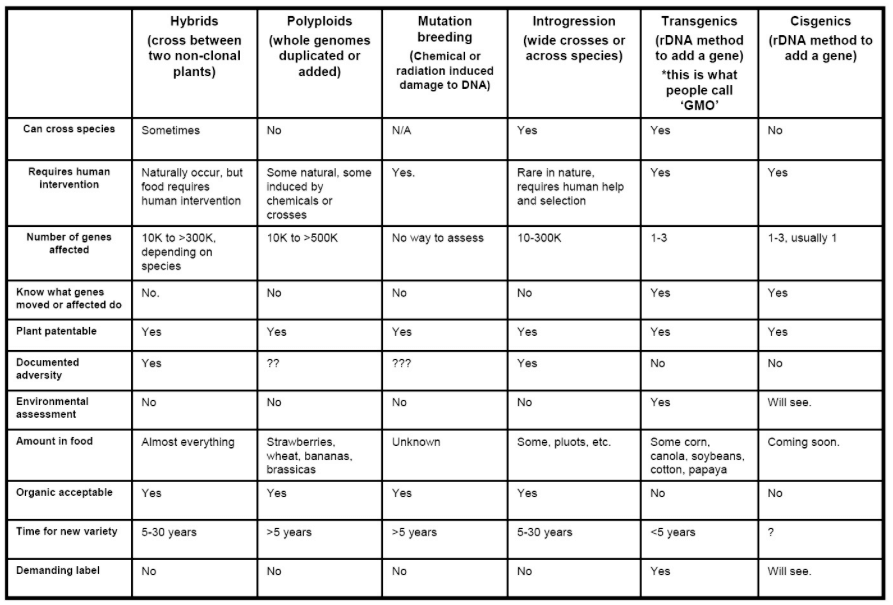
“No plants commonly used for food are “natural,” whether they were bred using transgenics or not,” he says. “The process of crop domestication was a human-mediated process. Only through agriculture, and breeding and selection, selecting elite plants from those that weren’t as good, were humans able to improve crops. This underlines everything we eat. Nothing is in its original form.”
We have two charts to illustrate Folta’s point. The first compares the amount of genetic “scrambling” using various breeding techniques: traditional breeding, mutagenesis, RNA Inteference and Trasgencis–genetic engineering.
(Click to view high resolution image)
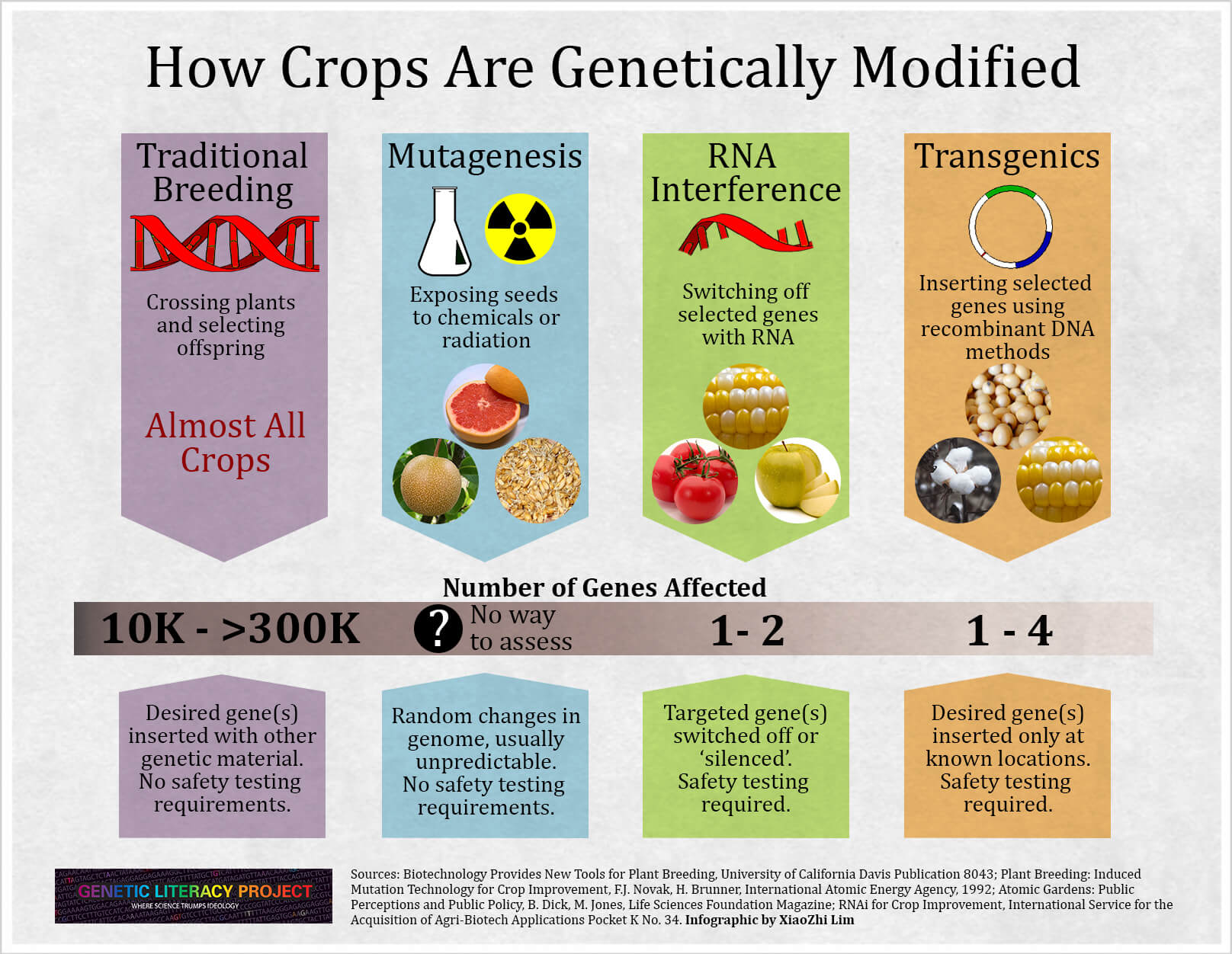
Traditional breeding of crops existed since the beginning of human civilization. Today, it encompasses a whole range of techniques, including high-tech ones like marker-assisted breeding. In traditional breeding, lots of genes are swapped at once, a process that can be “messy,” as described by Cornell plant breeder Margaret Smith. While breeders have been able to cross plants with their wild relatives (called a wide cross) to produce hybrids, the possibilities of using genes from distantly-related or other species are limited.
In the 1920s and 1930s, scientists explored the effect of radiation on a wide variety of plants. They found that applications of radiation produced mutations in plant genomes, creating plants that were different from the original. The Rio Star grapefruit was developed when Texas scientist Richard Hensz irradiated Ruby Red grapefruit seeds with X-rays. The new grapefruit had darker flesh and greater resistance to cold, which helped it survive a severe freeze in 1983 that killed other grapefruit trees. Since the 1940s, thousands of other crops have been produced with mutagenesis.
As molecular techniques in biology became available around the 1970s, scientists began to look more precisely at ways to alter genes in plants. RNA interference techniques allow scientists to switch off genes coding for undesired traits precisely, while recombinant DNA techniques allow them to insert genes coding for desired traits precisely. Other than allowing more precision in genetic modification, these molecular techniques also open up the possibilities of using genes from other species.

When compared to older breeding techniques, the transgenic method is much more precise and controlled; “Breeding has always been more of an art than a science,”
When compared to older breeding techniques, the transgenic method is much more precise and controlled, notes Folta (see chart at right.)
“Breeding has always been more of an art than a science,” Folta says.
Any plant breeder will tell you that. It has been based on very careful observations, good statistics, and large populations, but it still has a certain degree of randomness and weirdness to it. GM technology is quite different in that we know precisely which gene is being used, what that gene does and where it lands in the genome. It’s a precise extension of regular plant breeding.
Any plant breeder will tell you that. It has been based on very careful observations, good statistics, and large populations, but it still has a certain degree of randomness and weirdness to it.”
“GM technology is quite different in that we know precisely which gene is being used, what that gene does and where it lands in the genome. It’s a precise extension of regular plant breeding.”
Folta prepared this chart to prepare various forms of breeding: