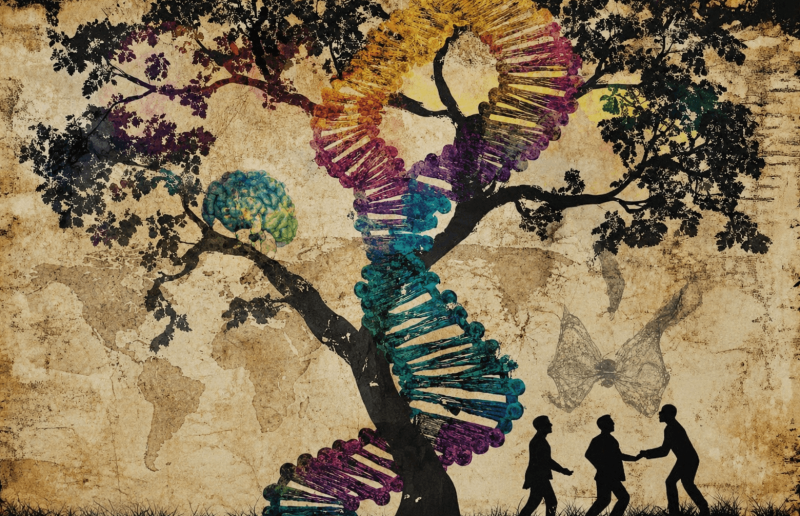

Human evolution, particularly of the brain, ended a long time ago—at least that is what many educated people, wary of claims about biological differences between human groups, prefer to believe. For much of the postwar era, it was widely assumed that natural selection had largely ceased to shape human populations and that any evolution during the past ten millennia was too slow or too slight to detect. …
A landmark study published in Nature last April has complicated that narrative. Drawing on ancient DNA from nearly 16,000 West Eurasians spanning 10,000 years, Harvard geneticist David Reich and colleagues found evidence that directional genetic selection is not only widespread but accelerating. Rather than stasis, evolution has continued to act on hundreds of genetic variants associated with traits ranging from disease risk and body composition to complex behavioural measures, including intelligence.
While the paper itself is technical and cautious, its implications are explosive. Importantly, the selection identified in the study occurred within populations inhabiting distinct ecological and cultural environments, suggesting that recent human evolution has been shaped by local selective pressures rather than a uniform global process. That, in turn, raises the possibility of ongoing regional divergence between different human groups. This has already dragged an older, more troubling word back into the discussion—“race”. This is not the sloppy popular notion based on skin colour or a rigid biological essence. Human genetics substantially overlaps among groups, rendering classical racial categories obsolete. But this provocative research does underscore that many human differences may not be simply skin deep.
For decades, the prevailing view held that while societies have transformed, the evolved architecture of our species has remained fixed since long before the first cities were built. The late palaeontologist Stephen Jay Gould put it like this in 2000: “There’s been no biological change in humans in 40,000 or 50,000 years. Everything we call culture and civilisation we’ve built with the same body and brain.” …
However, the Reich study suggests that the Holocene—our current geological epoch, which began approximately 11,700 years ago at the end of the last Ice Age—has not been a period of stasis at all. It has been a furnace of differentiation. Natural selection has been more pervasive, and more recent, than the Gouldian consensus allows.
…
Much of academia—anthropology and the social sciences in particular—has embraced and fiercely defended the view that race is a “social construct” with little biological significance beyond superficial physical variation. By the 1990s, this position had hardened into something close to institutional orthodoxy—a reflection of the spread of postmodernism and critical race theory.
…




The controversy surrounding the work of David Reich perfectly illustrates the friction between the genomic data and entrenched social orthodoxy.
…
This debate is already coalescing around two distinct factions. “Gouldians”—social scientists and their allies in academia and the media—will continue to insist that any evolutionary changes since the emergence of modern humans are socially inconsequential. What might now be called “Reichians” will point to accumulating data showing that humans have continued to evolve, reshaping morphology, disease susceptibility, and cognition. Where the former treats recent evolution as a footnote, the latter recognises it as a central fact of human history.
Jon Entine is the executive director of the Science Literacy Project/Genetic Literacy Project.
Patrick Whittle has a PhD in philosophy and is a freelance writer with a particular interest in the social and political implications of modern biological science.
This is an excerpt of an article originally posted at Quillette. Any reposting should credit the original article. Find Quillette on X @Quillette