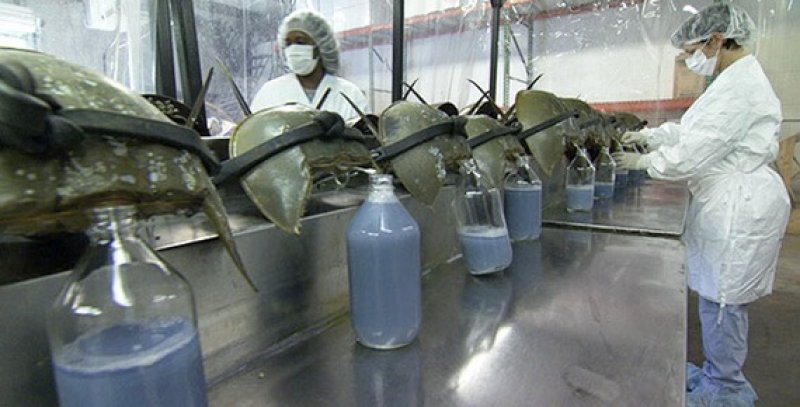
Horshoe crabs are spectacularly odd creatures. They are ‘living fossils’ with evolutionary origins before the fall of the dinosaurs; they’re more closely related to arachnids (e.g. spiders and scorpions) than crustaceans (i.e. crabs); and their bright blue blood is a biomedical treasure.
As Alexis Madrigal notes in his recent piece for The Atlantic, it’s a unique chemical found in their blood that can detect and trap even astonishingly small traces of bacteria. The chemical, coagulogen, is the basis for an extremely powerful and nearly instantaneous test for bacterial contamination, named LAL. The FDA requires every drug certified be tested with LAL. Madrigal writes:
I don’t know about you, but the idea that every single person in America who has ever had an injection has been protected because we harvest the blood of a forgettable sea creature with a hidden chemical superpower makes me feel a little bit crazy. This scenario is not even sci-fi, it’s postmodern technology.
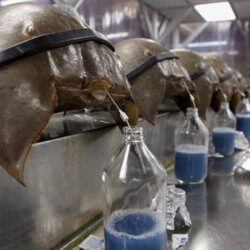
How do we get enough blood to fuel the business? Horshoe crabs conveniently come into shallow shoreline waters en masse when it is time to breed. They’re collected, bled but not killed, and released. Unfortunately, there seem to be unintended damage to the horeshoe crab population, even without mass deaths.
This is where synthetic biology steps in. Madrigal reports:



In particular, biologist Ding Jeak Ling from the National University of Singapore succeeded in producing the key bacterial detection enzyme, known as Factor C, in yeast. She licensed the process to Lonza, which has brought it to market as a product called PyroGene. A German company named Hyglos has been working on another synthetic endotoxin detector, too. Other, even more advanced technologies are on the way, too.
With luck, we’ll soon be able to spare the horeshoe crab the indignity (and ecological damage) of the blood harvest.
Read the full, original story: The Blood Harvest