Powerful new DNA-editing method

In the late 1980s, scientists at Osaka University in Japan noticed unusual repeated DNA sequences next to a gene they were studying in a common bacterium. They mentioned them in the final paragraph of a paper: “The biological significance of these sequences is not known.”

Now their significance is known, and it has set off a scientific frenzy.

The sequences, it turns out, are part of a sophisticated immune system that bacteria use to fight viruses. And that system, whose very existence was unknown until about seven years ago, may provide scientists with unprecedented power to rewrite the code of life.

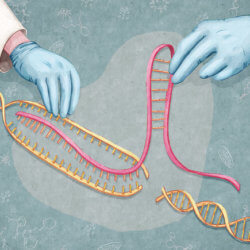
Read the full, original story: A Powerful New Way to Edit DNA

Related Articles

Infographic: Global regulatory and health research agencies on whether glyphosate causes cancer

Infographic: Global regulatory and health research agencies on whether glyphosate causes cancer

Does glyphosate—the world's most heavily-used herbicide—pose serious harm to humans? Is it carcinogenic? Those issues are of both legal and ...

Most Popular

ChatGPT-Image-Sep-23-2026-02_36_39-PM
Viewpoint: After firing the entire National Science Board, Trump reshapes funding initiatives. Here’s the good and the bad.
ChatGPT-Image-Mar-10-2026-01_39_01-PM
Viewpoint—“Miracle molecule” debunked: Why acemannan supplements don’t work
ChatGPT-Image-Sep-10-2026-10_36_07-AM
Viewpoint: Even lousy scientific articles can shield authors when they hype dubious health claims and products
ChatGPT-Image-Sep-30-2026-01_38_36-PM
Viewpoint: Died “with measles” vs. died “from measles”: RFK, Jr.’s dangerously subversive word games
sorghum farmers in kenya FARMERS TREND
Here are all the ways CRISPR gene editing is transforming Africa’s staple crops—and there’s a lot more innovation to come
ChatGPT-Image-Sep-2-2026-02_03_32-PM
How much of a problem is AI’s water use?
glp menu logo outlined

Get news on human & agricultural genetics and biotechnology delivered to your inbox.