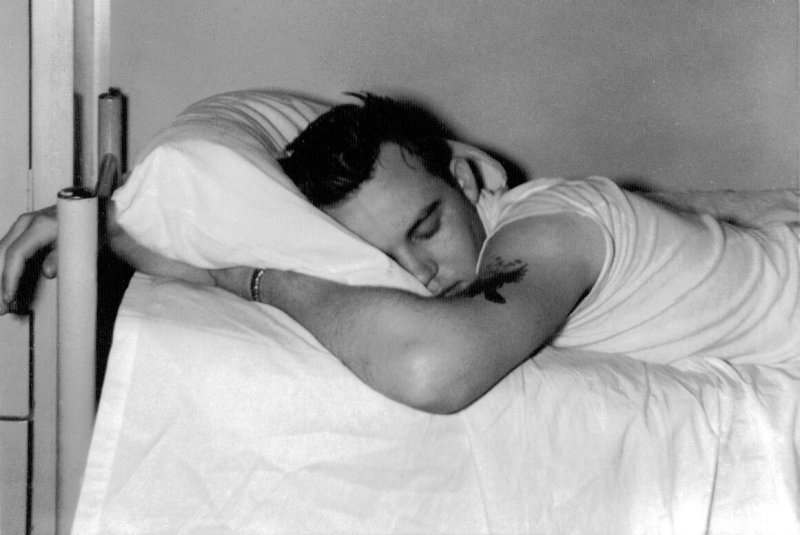
We’ve all met someone who seems to have a preternatural ability to function on what most of us would consider a serious lack of sleep. For me, anything less than seven hours is a no-no, yet I had a friend in college who got by consistently on a scant four or five hours. As Genetic Engineering & Biotechnology News’s Kevin Mayer puts it:
Most adults need seven to nine hours of sleep each night, but nearly 28% of U.S. adults report that they get six hours or less. Surprisingly, some of the sleep-deprived report no ill effects—no daytime sleepiness, no difficulties concentrating, no listlessness. What do these “short sleepers” have that the rest of us lack?
The answer? A single mutation to a gene that seems to not only allow some individuals to get by on six or less hours of sleep per night, but bolsters their resistance to the usual effects of sleep deprivation. (The insidious consequences of sleep deprivation made headlines recently when a study revealed that lack of sleep can distort our ability to tell reality from fiction.) Agata Blaszczak-Boxe summarizes the experimental study for CBS News:
In a study on 100 pairs of twins, researchers found that a twin who had a variant of the BHLHE41 gene called p.Tyr362His slept for only about five hours per night, more than an hour shorter than his twin brother who did not carry the gene. Moreover, the twin who carried the gene mutation had 40 percent fewer average lapses of performance during 38 hours without sleep, and required less recovery sleep after the period of sleep deprivation. The twin with the gene mutation only slept eight hours after being sleep-deprived for an extended period of time, compared with his brother, who slept for 9.5 hours.
The mutated gene has been colloquially dubbed the ‘Thatcher’ gene in honor of Prime Minister Margaret Thatcher’s famed ability to run her nation on as little as four hours of sleep per night.
While it’s tempting to use these findings to justify our own generally sleep-deprived lifestyle here in America (“Oh, I must be one of the lucky mutants!), American Academy of Sleep Medicine President Timothy Morgenthaler said in a statement: “This study emphasizes that our need for sleep is a biological requirement, not a personal preference.”
In a broader context, the study is just the latest of many efforts to probe the great variability of the human species at the genetic level. There are the seemingly obvious traits like height or hair color that are highly heritable and well understood (though not necessarily simple), but there’s a conucopia of more subtle traits — traits closely linked to behavior, in particular — that are only now being explored in depth. Earlier this week I blogged about the genetics of musical mastery, and earlier this week about athletic talent and sexuality.




There’s a definite risk to lending our genes too much deterministic power, but as studies of our more subtle differences as individuals continue to point back to our genetic material it’s hard not to wonder what other bits of individuality might come down to the fundamentals of our biology.
Kenrick Vezina is Gene-ius editor for the Genetic Literacy Project and a freelance science writer, educator, and naturalist based in the Greater Boston area.
Additional Resources:
- The Margaret Thatcher gene: Why some people need less sleep, Tech Times
- The disturbing link between sleep deprivation and false memories, Huffington Post
- There’s a gene for that, Jacobin