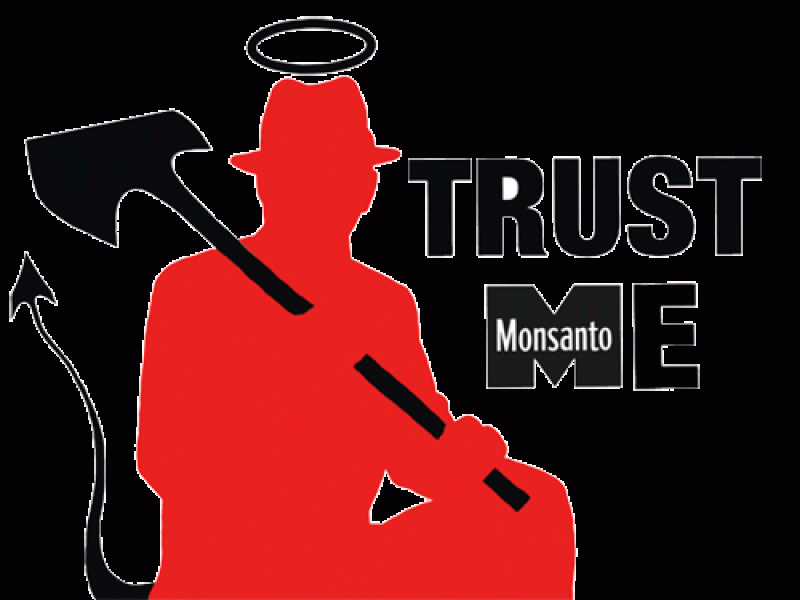
According to standard issue anti-GMO ideology, Monsanto is emblematic of and at the root of all that is wrong with food and agriculture.
“Of all the mega-corps running amok, Monsanto has consistently outperformed its rivals, earning the crown as “most evil corporation on Earth!” opines a familiar rant by the Centre for Research on Globalization, a far left Canadian NGO. “Not content to simply rest upon its throne of destruction, it remains focused on newer, more scientifically innovative ways to harm the planet and its people.”
The pressure on many leftists who do support crop biotechnology is so strong that they often couple their endorsement of GMOs with a pro forma gratuitous swipe at Monsanto, treating it like a crazy uncle or worse, so as not to lose credibility with fellow liberals that they align with on other issues.
Let’s examine four of the major claims targeting Monsanto and match them up against the empirical facts:
(1) Monsanto controls the world seed supply and food industry by abusing the patent system
“It’s not science fiction anymore,” screams CounterPunch.org, a far left website that purports to report on the media. “Monsanto Seeks to Control World’s Food.”
Monsanto is just one seed company in a robust and growing global industry. There are literally thousands of seed companies, selling everything from heirloom seeds to hybrid organics to GMOs. Farmers in industrial countries, including organic farmers, usually opt for patented proprietary seeds as they are more productive. Patents on hybrid seeds have been common in agriculture since the 1930s. GM seeds are also proprietary with normal patent protections—again, as are many hybrid organic seeds.
Major seed companies—not just Monsanto—had faced criticism in the 2000s for not sharing some of its technological research with independent universities. In 2009, they met with corn entomologists and representatives from the US government and public universities in Ames, Iowa to address how to strike a balance between the seed companies’ desire for well-designed scientific studies and the public scientists’ desire to conduct hassle-free research on transgenic seed. The ensuing discussion led to the development of a set of principles, embodied in the Academic Research License (ARL), that has led to the wide availability of GM seeds for independent research by universities and other public institutions. Monsanto alone has ARLs in place with all major agriculturally-focused US universities—about 100 in total.
The criticism that Monsanto controls the seed market, the food supply or the GM business is just not supported by the facts. Despite attacks on the global patent system by fringe organizations like the ETC Group, the US Supreme Court has consistently and overwhelmingly supported the critical role of patents to incentivize research in agriculture and elsewhere. It’s the bedrock of liberal capitalism, which many anti-GMO groups fundamentally oppose.
(2) Monsanto sues organic and other conventional farmers when GM plants show up accidentally on their farms
There is not one legal case—not one—that supports this widely circulated lie. Monsanto has a long-standing public commitment that “it has never been, nor will it be, Monsanto’s policy to exercise its patent rights where trace amounts of our patented seeds or traits are present in a farmer’s fields as a result of inadvertent means.” However, much like Apple in computers or Nike in the shoe and apparel industry or Starbucks in the coffee business, it aggressively protects its patent rights from those who try to steal its intellectual property. Monsanto has sued more than 140 farmers who have used its seeds without licensing agreements and has settled over 700 additional cases of patent rights infringement outside of court.
The myth has been kept on life support by misrepresenting the controversial case of Canadian farmer Percy Schmeiser, who Monsanto sued for illegally saving Roundup Ready canola seeds in the 1990s. Schmeiser, who is now on the anti-GMO paid lecture tour circuit, claims to this day the presence of Monsanto’s patented seeds found in his fields was accidental, due to drift. Three separate court decisions—in 2001, 2002 and 2004—determined he was lying—that he attempted to illegally steal the seeds.
The most important court case in the United States between a grower and agricultural biotech company over alleged “accidental” use of Monsanto seeds was Bowman vs Monsanto, in which SCOTUS unanimously determined that Indiana farmer Vernon Bowman was a ‘seed thief.’ The justices unanimously rejected the Indiana soybean farmer’s argument that the company’s patent “exhausted” when he purchased seeds from a grain elevator to plant on his farm. The Court affirmed a decision rendered by the Court of Appeals for the Federal Circuit, observing that, if purchasers were allowed to replicate an invention, there would be a mismatch between invention and reward and the patent would afford little protection to the inventor. The ruling affirmed that the act of growing a crop of seeds is “making” those seeds, and is covered under patent law.
The unanimous ruling written by Justice Elena Kagan hinted at the deception at the center of Bowman’s actions and argument:
The exhaustion doctrine does not enable Bowman to make additional patented soybeans without Monsanto’s permission (either express or implied). And that is precisely what Bowman did. He took the soybeans he purchased home; planted them in his fields at the time he thought best; applied glyphosate to kill weeds (as well as any soy plants lacking the Roundup Ready trait); and finally harvested more (many more) beans than he started with. That is how “to ‘make’ a new product,” to use Bowman’s words, when the original product is a seed.
As Layla Katiraee writing for the Genetic Literacy Project has reported, the debate over whether Monsanto has ever sued a farmer who unknowingly used Monsanto’s seeds or whose fields were contaminated with Monsanto’s products was laid to rest in 2013 in the court case known as OSGATA vs Monsanto.




The Organic Seed Growers and Trade Association (OSGATA) and others had filed a lawsuit against Monsanto in an effort to invalidate the company’s patents because of alleged fears of Monsanto suing farmers if crops were inadvertently cross-pollinated. The U.S. District Court for the Southern District of New York dismissed the case, noting there was no case or controversy because Monsanto had not taken any action or even suggested taking any action against any of the plaintiffs. OSGATA conceded that Monsanto had never threatened to sue them.
According to the court, plaintiffs had “overstate[d] the magnitude of [Monsanto’s] patent enforcement,” noting that Monsanto’s average of roughly 13 lawsuits per year “is hardly significant when compared to the number of farms in the United States, approximately two million.” The court ruling ended with this statement: “the appellants have alleged no concrete plans or activities to use or sell greater than trace amounts of modified seed, and accordingly fail to show any risk of suit on that basis. The appellants therefore lack an essential element of standing.”
(3) Monsanto sells “Terminator” seeds
Monsanto has never commercialized a biotech trait that resulted in sterile – or “Terminator” – seeds. Through modern biotechnology, it may be possible to develop crops that will not produce viable offspring seeds. Sterile seed technology, dubbed “terminator technology” in the popular press, is one type of gene-use restriction technology in which seed produced by a crop will not grow. Monsanto made a public commitment in 1999 not to commercialize sterile seed technology in food crops.
This pernicious myth has been kept alive almost single-handedly by anti-GMO philosopher and activist Vandana Shiva and others, who have been repeating this lie for years. Here she promotes her recent campaign Occupy the Seed
[T]he minute seeds stop being the seeds of renewal and starts being the seeds of death- like the terminator technology, creating sterile seeds, patented technology that makes it illegal for farmers to save and exchange seed, we get scarcity, that is why a quarter million Indian farmers have committed suicide. We’ve got to save the seeds of life…the seeds of freedom.
This Terminator seed myth fits well into the anti-GMO worldview that nasty capitalists led by mega-villain Monsanto are out to screw the world. It has proved very effective at stirring opposition to genetic engineering in Africa and Asia, where the GM technology is most needed.
(4) Monsanto only serves non-GMO and organic foods in its cafeterias
Originating with an article in Britain’s Independent in 1999, and now widely perpetrated by ant-science ‘natural products’ purveyors like Joseph Mercola, anti-GMO activists often state that Monsanto has banned foods with GM ingredients in its company cafeteria. It’s just not true. Monsanto does not have a private organic farm to serve executives or its employees.
“The food in our cafeterias is no different than what you’d find in most cafeterias, restaurants or supermarkets—some of it is made from GM crops and some of it isn’t,” Monsanto writes on its website. “We don’t go out of our way to have either GM or non-GM food in our cafeteria, with the exception of occasional specialty meals that showcase food grown with our seeds.” In fact, Monsanto often features its GM products on its company cafeteria menu, such as during corn harvesting season when GMO sweet corn is widely available.
Jon Entine, executive director of the Genetic Literacy Project, is a senior fellow at the Center for Health & Risk Communication and STATS (Statistical Assessment Service) at George Mason University. Follow @JonEntine on Twitter