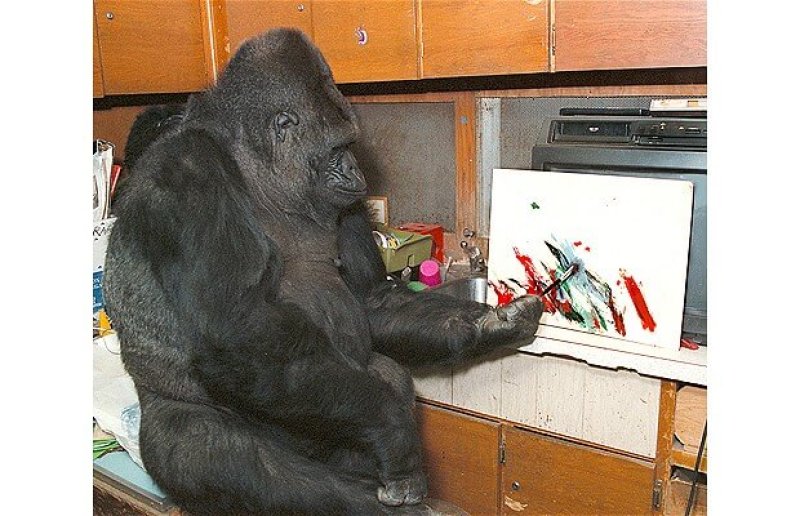

Last week, people around the world mourned the death of beloved actor and comedian Robin Williams. According to the Gorilla Foundation in Woodside, California, we were not the only primates mourning.
A press release from the foundation announced that Koko the gorilla—the main subject of its research on ape language ability, capable in sign language and a celebrity in her own right—“was quiet and looked very thoughtful” when she heard about Williams’ death, and later became “somber” as the news sank in. Williams, described in the press release as one of Koko’s “closest friends,” spent an afternoon with the gorilla in 2001.
The story is a prime example of selective interpretation, a critique that has plagued ape language research since its first experiments. Was Koko really mourning Robin Williams? How much are we projecting ourselves onto her and what are we reading into her behaviors? Animals perceive the emotions of the humans around them, and the anecdotes in the release could easily be evidence that Koko was responding to the sadness she sensed in her human caregivers.
But conceding that the scientific jury is still out on whether gorillas are capable of sophisticated emotions doesn’t make headlines, and admitting the ambiguity inherent in interpreting a gorilla’s sign language doesn’t bring in millions of dollars in donations. So we get a story about Koko mourning Robin Williams: a nice, straightforward tale that warms the heart but leaves scientists and skeptics wondering how a gorilla’s emotions can be deduced so easily.




Read the full, original story: What do talking apes really tell us?