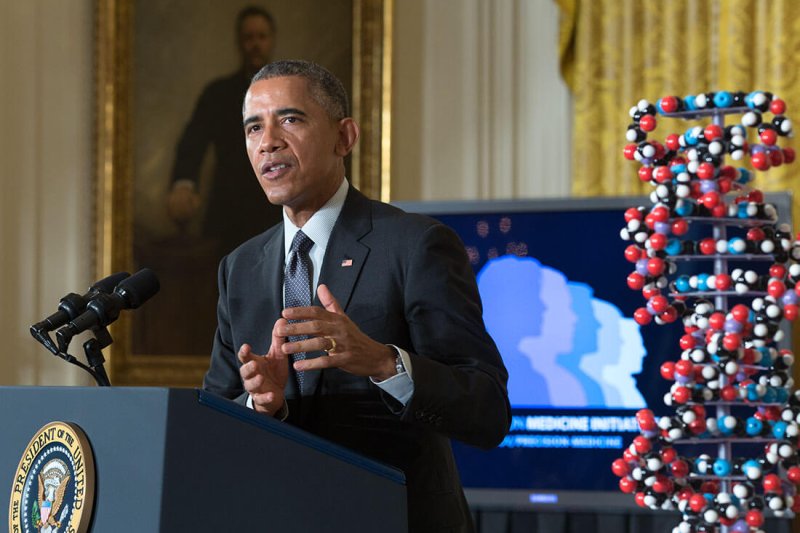
The precision medicine initiative proposed by President Barack Obama last week would center on a huge new biobank containing medical records and genetic information for perhaps a million Americans. It would not be created from scratch by enrolling new volunteers, however, but would instead pull together existing studies into one giant database.
That’s according to several scientists familiar with the broad outlines of the project who spoke on background with ScienceInsider. The biobank would be used for studies ranging from finding new disease-gene associations to working out how to use genomic and other molecular information in routine medical care. On Friday, the White House is expected to reveal details of the initiative, which will reportedly cost hundreds of millions of dollars.
Such a national biobank would put the United States in line with other countries, such as the United Kingdom, Iceland, and Japan, which have built large population databases for research and medical care. A similar U.S. biobank has long been on the wish list of National Institutes of Health (NIH) Director Francis Collins, who led the effort to sequence the human genome as director of the National Human Genome Research Institute (NHGRI).
The term “precision medicine,” however, is relatively new. It comes from a 2011 report from the National Academies’ National Research Council (NRC) that called for combining medical records and genetic and other molecular data for large groups of people into a single “knowledge network” that would be used for understanding diseases and tailoring treatments.

Some have questioned whether it is feasible to combine medical records from different sources for research—data are often missing or collected in different ways. “There’s a lot of fuzziness,” says cardiac disease researcher Dan Roden, who leads Vanderbilt University’s BioVU biobank in Nashville. But an NIH-funded project called eMERGE that combines medical records from Vanderbilt and eight other medical centers has shown that “it can be done,” Roden says.
One matter to be worked out for a megabiobank is which cohorts to include, says human geneticist David Goldstein of Columbia University, a member of the 2011 NRC panel. For example, “you absolutely must have recontactability,” or permission from patients to be called and asked to come into a clinic for further exams and tests. Some biobanks, such as Vanderbilt’s, do not have that consent from participants, Roden notes.
Read full, original article: Obama precision medicine plan would create huge U.S. genetic biobank