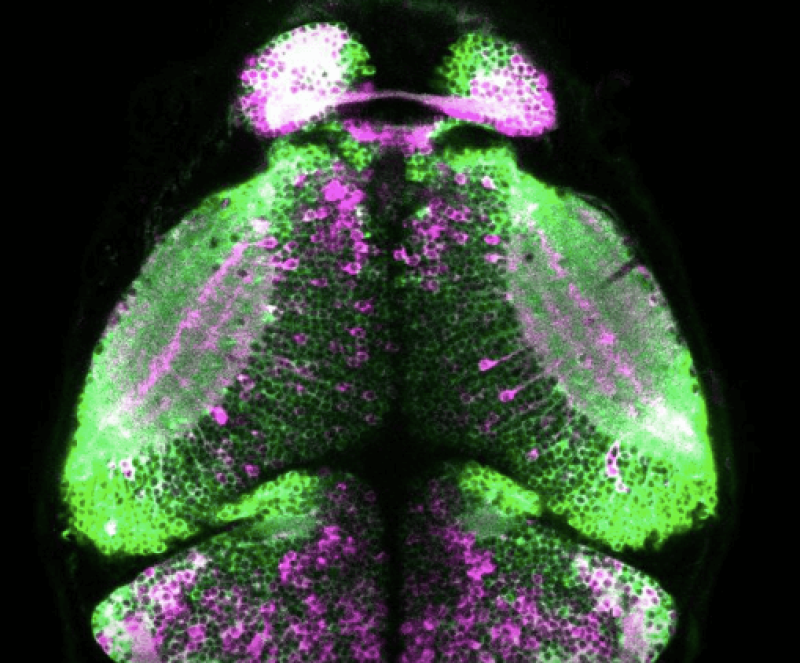

Neuron activity is used as everything from an indicator of our most fundamental impulses to a model for computers, but our understanding of it is basic at best. The methods we use to detect brain activity are limited as well — even when researchers know what they’re trying to track, the tools can only do so much, says Eric Schreiter, researcher at the Howard Hughes Medical Institute’s Janelia research campus and co-author of a study released today in Science. But his team thinks it’s found a way to help.
The most direct way to see what neurons are doing would be to just track the impulses as they fire. “It’s possible to measure that electrical signal, but it turns out to be really difficult,” Schreiter says. Instead, he cites two basic approaches, both of which come with a set of tradeoffs. One method uses fluorescent proteins — perhaps best known for producing glow-in-the-dark mice or rabbits — as sensors that get brighter when they bind to calcium and dim as it dissipates. Neuron activity is accompanied by a sudden spike in calcium, so if you introduce them into an animal and get a microscopic look at its brain, you’ll be able to see the proteins light up as it happens.
But your view is limited to small areas, and there’s no permanent record of it.
“As soon as you move your microscope or you turn your microscope off there’s no way to know where that activity was,” says Schreiter.




If you’re looking for a wider view, on the other hand, it’s possible to track a subset of genes that are expressed during brain activity, but this measures neurons only over longer periods of time. To address these limitations, Schreiter and his team split the difference between the two: you can get a permanent record of activity across a whole brain, but it can capture things that happen over a span of seconds, not tens of minutes or hours.
Read full, original article: A new protein looks like Christmas lights and helps us track brain activity