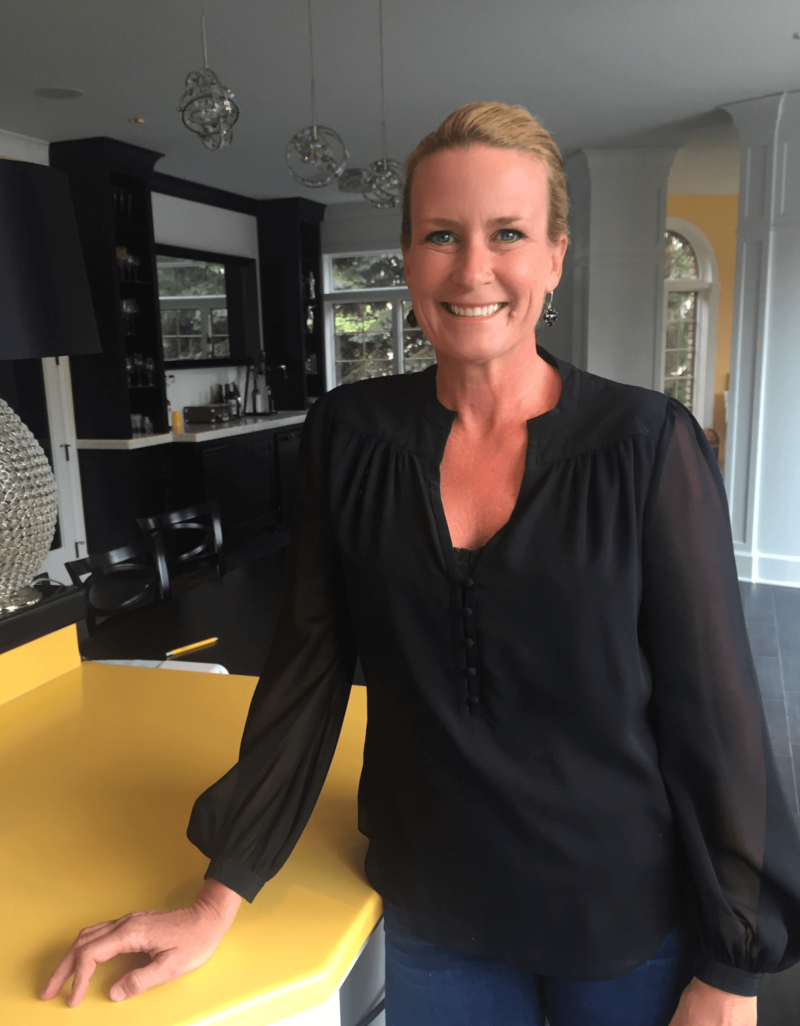
I’m a suburban mom. I became an accidental activist when I uncovered a nefarious corporate/government scheme to poison my tap water and confiscate my property.
Ok, not really. My journey is significantly less dramatic and unlikely to have any Hollywood screenwriters knocking down my door. But it’s an interesting story nonetheless. It began last year with MSNBC, the Wall Street Journal and celebrity chef Tom Colicchio.
A little background about me while I have you on the edge of your seat. After college graduation and an internship on Capitol Hill, I worked for more than a decade as a communications adviser and consultant in Illinois politics. Public policy is my first love; while I struggle with balancing a checkbook, I can nail down a 500-page government budget in no time. There are few areas of politics where I haven’t toiled, including canvassing precincts, registering voters, raising money, writing speeches, developing policy and my favorite – stealing opponent’s yard signs out of the frozen Illinois ground in March.
In my early 30s, my daughter was born and my husband and I decided that I’d quit working to raise our family (husband included). A few years later, we adopted – from Korea – our youngest daughter. I spent the next decade fully engulfed, engaged and enamored with being a stay-at-home mom.
Once my girls began school full-time, I returned to political consulting. After a few years back in the business, I got antsy and wanted to do something else. My husband encouraged me to teach cooking classes out of our home. I started my business – Now You’re Cooking – teaching busy moms like me how to cook. I also began writing a column for two local publications to offer advice about cooking techniques, recipes and meal-planning.
Which brings me back to Tom Colicchio, the celebrity chef who now appears regularly on MSNBC and NBC. I was one of his biggest fans, watching him for years on Bravo’s “Top Chef.” One day, I was getting ready to teach a class and listening to MSNBC when I heard that he was going to be on the next news segment. Great, I thought, maybe he will discuss some new cooking ideas or preview the next Top Chef show.
Not quite. Instead he went on a tirade about the 2014 farm bill and cuts to the food stamp program. He broadly attacked all Republicans, including two in tight races, just a few weeks before the general election. I was surprised and a bit appalled, thinking “Why is this cook lecturing me about politics and food stamps?”
I Googled his name to find out more about Colicchio’s political involvement. Turns out he is quite the activist. He had started a PAC called Food Policy Action that targets Republican lawmakers; he advocates for mandatory GMO labeling; and he had produced a movie about hunger in America (in which Ronald Reagan was blamed for the current “hunger crisis” in our country), among other things.
It didn’t take long for my own political instincts to kick in. I fired off an op-ed to the Wall Street Journal entitled “Tom Colicchio, please shut up.” I was surprised and thrilled that it was accepted. The Journal wisely renamed the piece “Tom Collicchio’s Overcooked Politics” and published it last October. It was a great personal moment for me, easing fears that motherhood had completely torched my brain.
What I didn’t expect was the backlash—and the “legs” as they say in the news business—of the piece. Shortly after the column was published, two nasty blogs about me were posted on Gawker and The Braiser. The Braiser piece mostly highlighted the Twitter exchange between Colicchio and me, one that would last for months until he finally blocked me (more on that in a moment).
The Gawker piece spurred comments from hundreds of people, most of whom didn’t like me very much. I was called everything from a “f*ing idiot” to a paid agent of Big Ag to Peggy Noonan (I loved that one). They mocked me as being an elitist myself. One example: “The author of the article picked apples with her nieces, nephews and a poodle once at an orchard in the Hamptons and it wasn’t very hard at all. In fact it was quite lovely and she paid for the privilege.”
The excitement and the furor quieted down and I didn’t think much more about until I was perusing Politico a few weeks later, in late November of last year. An article discussed the fate of the food movement’s political agenda after the Republican election sweep, including Colicchio’s recent trip to Capitol Hill to present a petition seeking support for mandatory GMO labels. About halfway through the article, my name was mentioned:
“Julie Kelly, a Chicago cooking instructor, argued the celebrity chef should stick to teaching Americans how to cook. “Culinary elites—like political elites—profess to want to help ordinary Americans, but their efforts often miss the mark as they aim to be the smartest guy at the food and wine festival,” she wrote, adding: “Tom, with all due respect, please stick to your pots and pans.”
Wow. Cool. This is fun.
I then came across a video of a conference sponsored by the New York Times known as “Food for Tomorrow”. It was an odd conference because it discussed the future of food but didn’t include any farmers or people who produced food, but mostly people who opined about food. The conference featured a panel with Colicchio and fellow celebrity chef Mario Batali. The moderator’s first question was about my WSJ op-ed: “To be truly useful, a food movement shouldn’t be about politics, wrote Julie Kelly. What on earth are you doing in politics, Tom Colicchio?”
Then it dawned on me: Was I the only person challenging the “culinary elite” and their impractical, “progressive” agenda, so detached from the lives of every day people who grow our food and hard-pressed consumers who prepare and eat it? From people in the developing world who worry where their next meal will be coming from?



The answer appeared to be “yes.” How was it that a little suburban housewife (ok, I’m 5’9”) had emerged as a lone voice challenging the popular chefs and foodie writers who comprise the “food movement”?
I’m sure Colicchio and his “gang” thought that maybe I should be the one to shut up?
Not a chance. That thought of not being heard only fueled my interest and activism. I began to learn more about federal food programs, genetic engineering, the condemnation of ‘industrial farming’, the organic industry, school lunch programs and other goals of the foodies’ lengthy agenda. I kept writing. The Chicago Tribune published a column by me criticizing Gwyneth Paltrow and her Food Stamp Challenge, the Hollywood celebrity’s lame attempt to live on food stamps for a week.
And I finally joined Twitter (much to the chagrin of my teen daughter, who begged me not to post anything embarrassing!)
My brother had urged me for years to start Tweeting, touting all the news and information available on social media. I refused, thinking it was just another outlet for celebrity worship: see #kanyeandnorth at the zoo! But after the Colicchio dust-up, it was time. The flood of information I received on a daily basis jump started my knowledge-seeking effort. I began following people influential people in the food movement. No, not just foodie commentators like Colicchio, Michael Pollan and Mark Bittman, but engaged scientists and public citizens who really knew the issues, like Kevin Folta, Leah McGrath, Mary Mangan, Robb Fraley and others—those who posted invaluable research about food science and biotechnology or pointed me to websites that actually discussed the science (this website in particular). I was welcomed as a #woofighter.
I learned mine wasn’t the only voice speaking out against the misinformation from the culinary elite. I connected with Jeff Stier, a senior fellow at the National Center for Public Policy Research, who had written about these issues for years. We recently co-authored two columns for National Review Online, one about Chipotle and another on Colicchio.
Back to Colicchio. After our first Internet run in last fall, he and I tweeted back and forth for months on issues as diverse as the cost of broccoli to the Benghazi scandal. Some days our exchanges were civil and somewhat humorous; other days, not so much. We traded reading material and continued to debate about GMO labeling and school lunches (he really got irritated when I suggested one solution to unhealthy school-provided lunches is that moms should pack lunches for their own children: “I hope you realize how you sound,” he snapped.. I thought I sounded pretty reasonable.)
Soon after, I saw him on MSNBC again (he just seemed to pop up everywhere) with Jeff Bridges to discuss food policy. He went on his usual rant against Republicans and ended his comments with something insipid, like, “It’s all about the children.” After a few glasses of wine that evening (I’ve since learned that a TUI – tweet under the influence – is a really bad idea), I snapped. I tweeted that he sounded like a “low level political operative.”
The next day, when I looked for his response, I got the news: Colicchio had blocked me. He was fed up with my defense of home-prepared lunches, GMOs and reforms to the school lunch program. While he is certainly entitled to block me, I found it pretty hypocritical that a liberal activist who spends a great deal of time criticizing national leaders and policies on national television was so sensitive when a suburban Chicago mom criticized him.
After a respite from our tweet fight, we just recently reconnected. I told him he wasn’t the most smug, sanctimonious and insufferable person in the food movement anymore, that the honor had been assumed by Gary Hirshberg, the founder of Stonyfield Organic and head of Just Label It, an anti-GMO group that supports mandatory labeling, which would guarantee sweeping financial gains for his small but growing organic empire.. Colicchio said he had listened to me on a radio interview and that my “knowledge of GMO wouldn’t fill up a thimble.” After a few more barbs, we discussed the Mayweather-Pacquiao fight then he wished me a nice weekend.
It’s hard to say – if we ever actually met – whether we would have a fight or a drink.
Regardless, my accidental activism continues. For me, it’s the perfect intersection of politics, policy, food and writing. I view my role as representing one side of what I call “ground zero” of this food fight: suburban moms. My main frustration: while we are clearly the target consumer of the food movement, our voices are strangely muted in this debate. And when we do dare to speak up, we get smeared on Gawker and The Braiser.
Going forward, I hope to lend a voice to this important discussion and encourage other moms like me to become more educated and involved. In my opinion, this debate about biotechnology is a defining moment, not just in terms of the American food supply but its potential to alleviate hunger, disease, malnutrition and poverty around the world. We need the full story and I hope, in a very small way, to contribute to telling it.
Julie Kelly is the owner of Now You’re Cooking in Orland Park, IL. She is a cooking instructor and food writer, but her biggest job is mom. She can be reached at [email protected] or on Twitter at @Julie_kelly2.