Your brain interprets the world differently from everyone else’s

Sometimes, other people interpret your words differently than you may have intended–like you’re not on the same wavelength. Turns out that the neuroscience backs up that idea; words elicit unique neurological responses in different people’s brains, according to a study published in the journal Neurocomputing. This revelation could lead to a whole new way for people to securely access their devices, no passwords required.

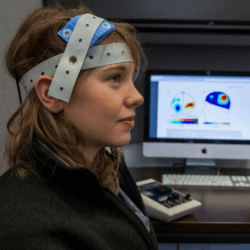
In the experiment, researchers hooked up electrical diodes on the scalps of 45 volunteers. While the researchers read various acronyms–such as DVD, CIA–to the participants, their brain waves were recorded with an electroencephalogram (EEG). Computer models then looked at the neurological responses and found key differences between individuals. When the researchers later repeated the exercise with the same volunteers, the computer was able to identify the participants based on their neurological responses with 94 percent accuracy.

The researchers think that these variations come from how words tap into subjects’ semantic memory, a part of long-term memory that contains general knowledge about the world (e.g., apples are round, red, and crisp). Even if the information itself is the same, words can bring up associations that vary slightly between individuals, creating a unique pattern of brain waves as the information taps into semantic memory. What’s more, semantic memory has been found to change only subtly over time, making it an interesting new biometric–a quantitative way to differentiate individuals.
The GLP aggregated and excerpted this blog/article to reflect the diversity of news, opinion and analysis. Read full, original post: You could one day be identified by your unique ‘brainprint’

Related Articles

Infographic: Global regulatory and health research agencies on whether glyphosate causes cancer

Infographic: Global regulatory and health research agencies on whether glyphosate causes cancer

Does glyphosate—the world's most heavily-used herbicide—pose serious harm to humans? Is it carcinogenic? Those issues are of both legal and ...

Most Popular

BEMT Lotion for Freckled Skin
Burned by FDA bureaucracy: Why Americans waited decades for cancer-preventing sunscreen
Nicotine Products on Gray Marble
Comparing vaping, nicotine patches and cigarettes: Not ‘safe vs. dangerous’  but ‘less harmful vs. more harmful’
Screenshot-2026-11-12-at-11.22.35-AM
The science of an orgasm: It’s a lot more varied and complex than you might think
Screenshot-2026-11-16-at-1.18.40-PM
‘Measles fiasco one of many healthcare failures’: Republican Sen. Bill Cassidy says it's time to fire RFK Jr.
Screenshot-2026-11-09-at-1.40.16-PM
As measles cases continue to surge, RFK Jr. blocks CDC scientists from issuing emergency alert warning unvaccinated pregnant women of significantly increased risks
Man in Green “Make America Healthy Again” Cap
Viewpoint: MAHA 2.0? Will the wellness grifters rescue RFK Jr.?
ChatGPT-Image-Mar-10-2026-01_39_01-PM
Viewpoint—“Miracle molecule” debunked: Why acemannan supplements don’t work
Screenshot-2026-11-13-at-11.57.01-AM
JAMA survey: Who’s most likely to embrace the RFK Jr.-fueled lie that vaccines cause autism? Men, adults 35–44, blacks and Republicans
Screenshot 2026-11-13 at 11.41
Viewpoint: Talent-crushing and mired in chaos: The unnerving story of how Trump cuts are driving out disillusioned young scientists
Screenshot-2026-11-13-at-10.02.02-AM
Viewpoint: Why it’s such a big deal that under Trump-RFK Jr., the U.S. has lost its ‘measles-free’ status  
Contrasting Portraits and Family Story
Congressional investigation targets RFK Jr.: Documents show HHS chief lied multiple times during his confirmation hearings
Glossy Chocolate in Glass Petri Dish
Chocolate-making cocoa beans are increasingly in short supply. There may be a biotech fix
glp menu logo outlined

Get news on human & agricultural genetics and biotechnology delivered to your inbox.