Corn? No. Why we need to cut down corn production

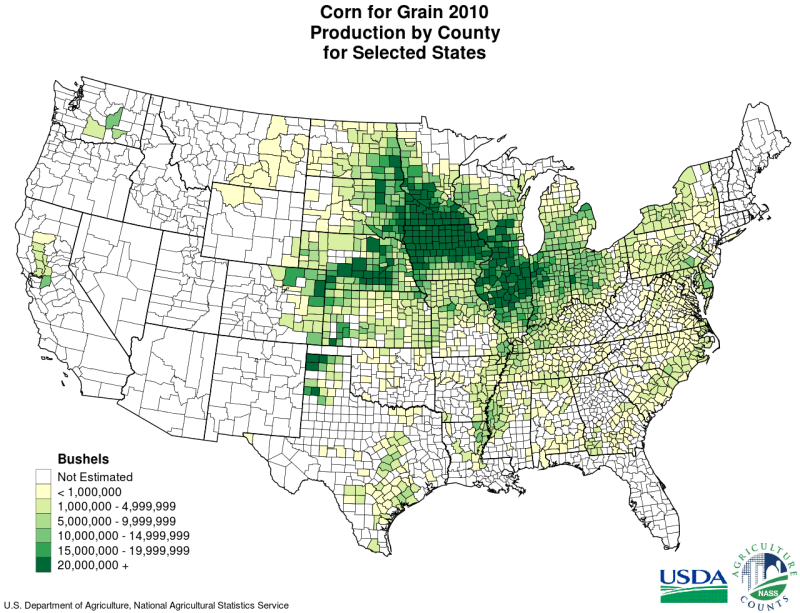
px Corn belt svg

Nowhere is the power and prowess of agricultural science so evident as in the Midwestern Corn Belt. Since the 19th century, when people of European descent settled the area that is now the Corn Belt (currently extending from western Ohio to eastern Nebraska), yields of the crop have more than quintupled per unit of land, and increased by more than eight times per unit of labor.

Pushing the accelerator on corn production

Most of this technological improvement accelerated with the introduction of corn hybrids in the 1930s, a scientific project by then half a century in the making. Mechanization followed, as did fertilizers, herbicides and insecticides, each investment in additional technology justified by the productive response of corn, the featured crop around which Midwestern agriculture specialized. Today the wave of technological development continues, with the adoption of packages of biotech seeds and herbicides, computerized field mapping, self-guided equipment and variable rate applicators that take their electronic directions from those maps coordinated with satellite positioning systems, and drones that facilitate field scouting.

It is time to rethink the Midwestern corn production machine

We have produced enough corn. In itself, the crop is noble, the crop is historical; it is economically significant and life-giving, but it is also at the core of the most significant issues we must resolve in agriculture as well as as a society. These problems, it turns out, are the problems of industrialization: labor exploitation, economic inequality, extraction, pollution, overconsumption and the inertia that flows from needing to preserve and protect investment in infrastructure.

As I continue to trace the continuing progress of the corn crop this production season, I’ll explore what it means to advocate for less corn production but not necessarily fewer farmers. The guide star in pursuit of these questions should be: “What do we need to do?” And not how to continue doing what we know to do so well, whether needed or not.

The GLP aggregated and excerpted this blog/article to reflect the diversity of news, opinion and analysis. Read full, original post: We’ve Got More Than Enough Corn

{{ reviewsTotal }}{{ options.labels.singularReviewCountLabel }}
{{ reviewsTotal }}{{ options.labels.pluralReviewCountLabel }}
{{ options.labels.newReviewButton }}
{{ userData.canReview.message }}

Related Articles

Infographic: Global regulatory and health research agencies on whether glyphosate causes cancer

Infographic: Global regulatory and health research agencies on whether glyphosate causes cancer

Does glyphosate—the world's most heavily-used herbicide—pose serious harm to humans? Is it carcinogenic? Those issues are of both legal and ...

Most Popular

ChatGPT-Image-Mar-10-2026-01_39_01-PM
Viewpoint—“Miracle molecule” debunked: Why acemannan supplements don’t work
afb-a-b
As the EU loosens restrictions on agricultural gene editing, it remains years behind the rest of the world on equally-safe GMO foods
ChatGPT-Image-Jul-8-2026-12_32_48-PM
Viewpoint: SCOTUS strikes a blow against junk science in Bayer glyphosate case. Will it deter mass tort litigators?
Screenshot-2026-07-10-at-2.02.54-PM
Viewpoint: In abortion-restricting Florida, misinformation abounds when Republican congresswoman faces an ectopic pregnancy
Screenshot-2026-07-10-at-3.10.50-PM
Snake-oil cures throughout history
ChatGPT-Image-Jul-7-2026-01_57_55-PM
Viewpoint: Europe’s rejection of air conditioning is the poster child for misunderstanding how to mitigate the impact of climate change
ChatGPT-Image-Jun-25-2026-12_23_17-PM
No, Bill Gates did not secretly engineer ticks to promote veganism
Screen-Shot-at-PM-pe-vra-kipgaprbdo-vd-ms-jpule-n-jqqaxf-l-e
Viewpoint: Will new breeding techniques help make European agriculture more competitive?
Screenshot-2026-07-10-at-12.55.21-PM
Cancer health facts are particularly susceptible to online misinformation
Screenshot-2026-07-10-at-3.25.10-PM
Using AI for health questions? Here are 4 tips for the most accurate answers.
Viewpoint: Consensus as truth? How ‘misinformation police’ control policy narratives
Which among war, weather and cyber attacks is the biggest world threat? None of the above. It’s misinformation, and here’s why.
ChatGPT-Image-Jul-1-2026-03_33_49-PM
‘Alternative’ cancer treatments that could kill you
Screenshot-2026-07-08-at-9.36.03-AM
Viewpoint: Long-contained diseases are on the rise in the U.S. Are Trump cuts to blame?
glp menu logo outlined

Get news on human & agricultural genetics and biotechnology delivered to your inbox.