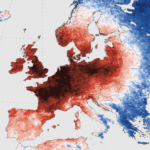
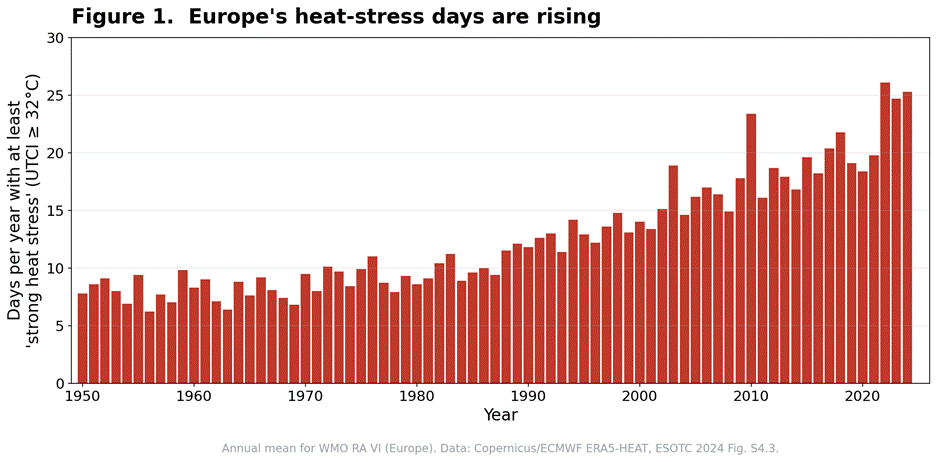
Europe is warming: ~0.5°C per decade since the 1980s. Figure 1 shows the continent’s annual count of days since 1950 with “strong heat stress” — a feels-like temperature of 32°C or higher. The trend was flat into the 1980s, then rose sharply: 2022 through 2024 rank as the highest on record.
Heat mortality has also been increasing in Europe: Summer 2022 saw an estimated ~68,000 heat-related deaths, 2023, ~50,800; 2024, ~62,800. The WHO European Region reports that heat mortality is up by about 30 percent over two decades.
This post shows that Europe largely chooses these deaths through a long resistance to a 1902 invention that the rest of the rich world treats as an incredible benefit of modern technology — air conditioning.
This post on the human toll of Europe’s aversion to air conditioning was motivated by three essays:
- Make Europe Cool Again by Kevin Kohler details how French and Swiss rules deter installed AC.
- How Europe Became the World Champion of Heat Deaths by Maarten Boudry traces the aversion to a deeper hostility toward energy.
- Air conditioning: saving lives and accelerating net-zero by Ed Hezlet and Lauren Gilbert explain how U.K policies “all but ban” air conditioning, despite its benefits.
I have discussed heat mortality in several posts here at THB:
- In Public Health and Climate Change, I walked through the Sheridan et al. (2021) data showing U.S. heat mortality falling dramatically across nearly every region over fifty years even as heat waves grew more frequent.
- In Truth Bombs, I showed how a consistent vertical scale reveals that cold still kills far more Europeans than heat — a point that Bjorn Lomborg has made for years.
In today’s post I ask and answer a straightforward question:
If Europe had air conditioner penetration approaching levels of the U.S. or Japan, what would we expect the effects to be on heat mortality?
Richest, coolest, deadliest
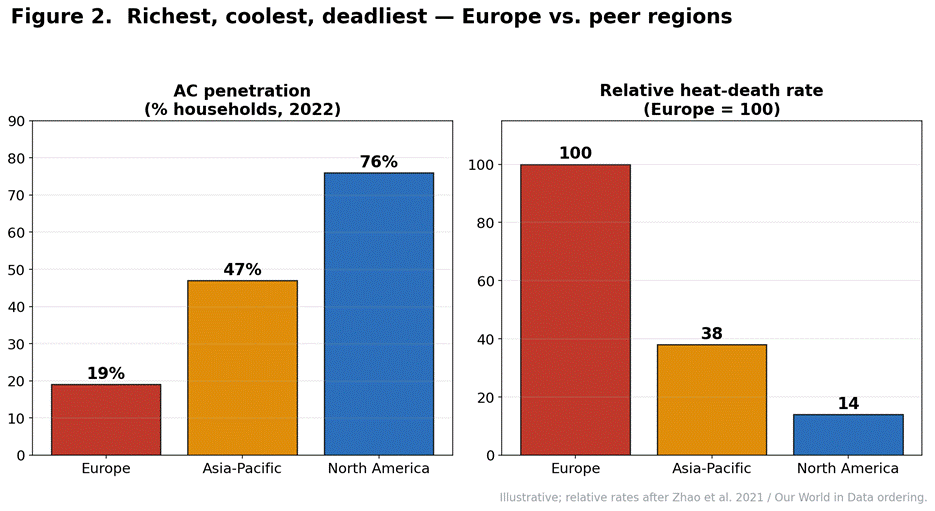
In his excellent post, Kohler well frames the issue: A continent that enjoys both comparative wealth and, by latitude, fewer hot days than most inhabited regions nonetheless records the world’s highest per capita heat-death rate. Age explains some of it — but the United States and Japan also have aging populations and yet have far fewer heat-related deaths.
A more important difference: air conditioning: European household penetration sits near ~19%, versus ~76% in North America and more than 90% in Japan.
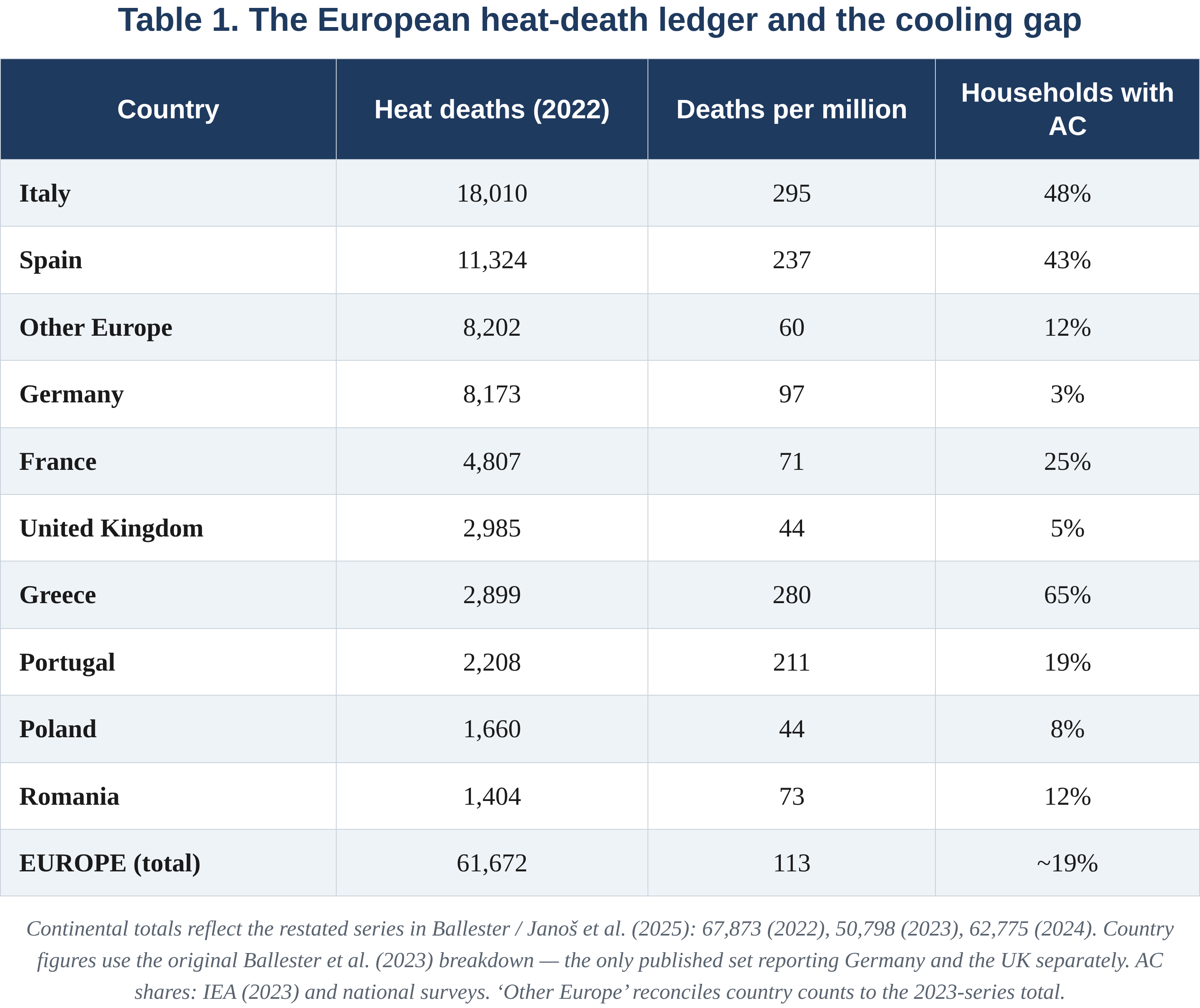
The continental average hides a wide spread in heat deaths, death rates and AC pentration, shown in Table 1 below.
The counterfactual
Here I use the results of Barreca and colleagues who tracked the same American states over time, before and after air conditioning spread, with the local climate held constant.1 That approach enables them to conclude that increased AC penetration caused the drop in the risk of dying on an extremely hot day by about three-quarters. I use that 75 percent as my central figure, and also test lower — 65 percent — and higher — 85 percent — values to assess the sensitivity of conclusions to that value.
The math is simple. Today’s heat deaths reflect today’s level of AC coverage. Raise the coverage, and a share of those deaths are eliminated — in proportion to how protective AC is and how many more households gain it.2
Table 2 and Figure 3 show the results.
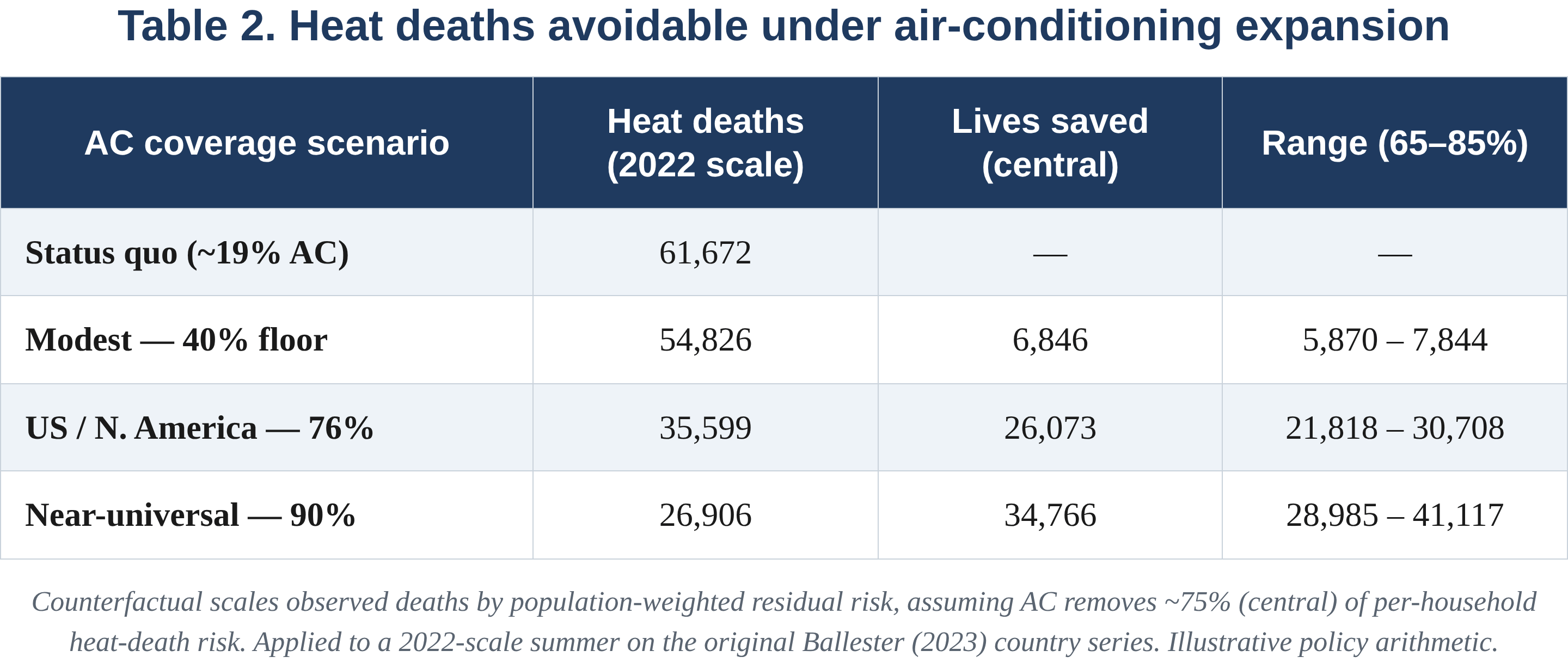
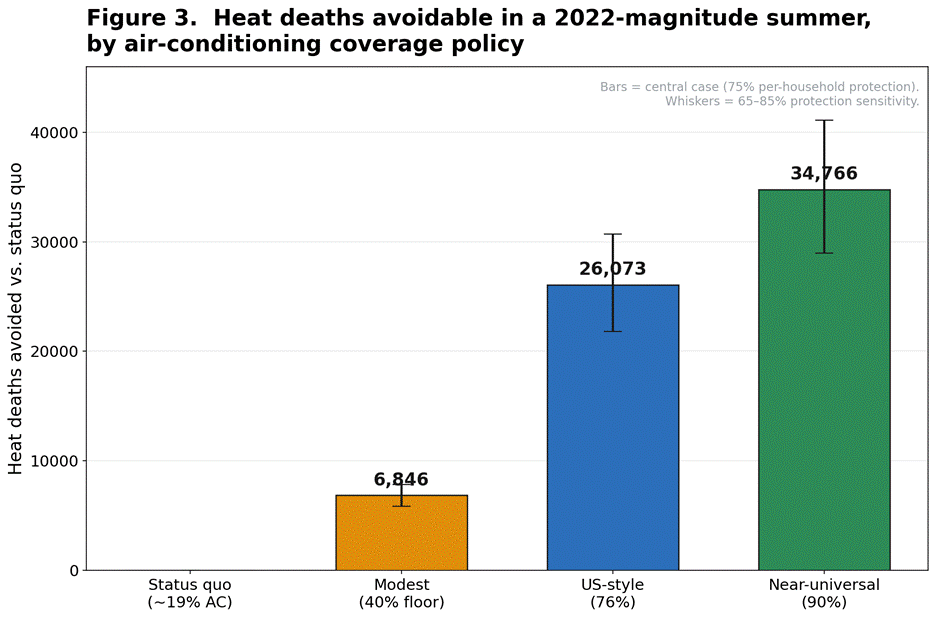
If Europe had AC penetration similar to North-America in the summer of 2022, then the continent would have avoided ~26,000 heat deaths in a summer like 2022 (range ~22,000–~31,000). Near-universal coverage is ~35,000. Even a 40 percent floor — below today’s Spanish or Italian levels — would save something like 6,000 to 8,000 lives a year.
Age matters
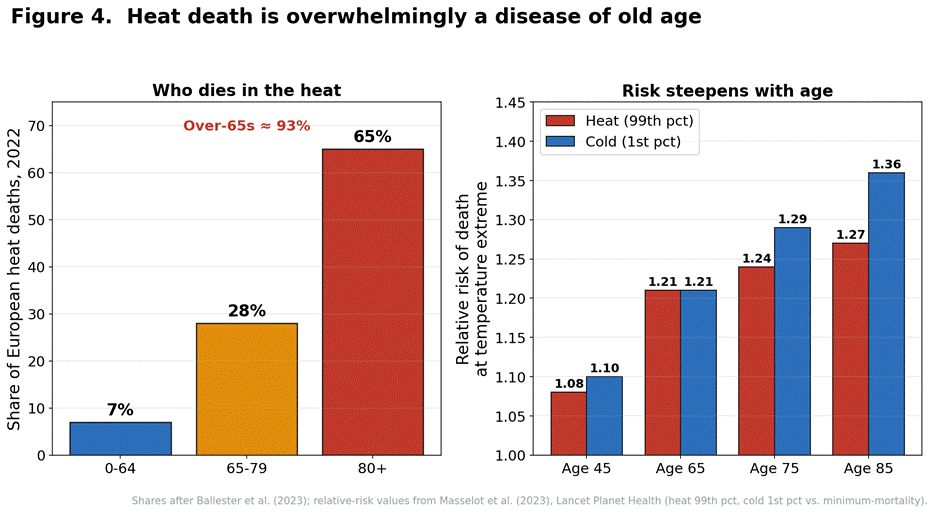
Heat deaths concentrate almost entirely among the old. Ballester et al. (2023) find the over-80s alone account for about two-thirds of European heat deaths, and the over-65s for about 93 percent.
The risk climbs steadily with age: Masselot et al. (2023) looked at 854 European cities and measured how much a stretch of extreme heat raises a person’s odds of dying compared with a normal day. For a 65-year-old, extreme heat lifts those odds by about 21 percent; for an 85-year-old, by 27 percent. Extreme cold is harsher still, raising the odds by 21 percent at 65 and 36 percent at 85.3
Figure 4 shows both the concentration and the age gradient.
Based on studies from the U.S. and Canada, the typical European heat victim is an older adult, often over 80, with cardiovascular or respiratory disease, living alone in poorly insulated housing. Most die indoors, at home.
- New York City’s health department, reviewing medical-examiner records of heat-stress deaths, found that 89 percent of decedents had at least one chronic health condition, most commonly cardiovascular disease.
- British Columbia’s coroners service, reviewing the 619 deaths from the 2021 heat dome, found that 98 percent occurred indoors, 67 percent of the dead were 70 or older, 56 percent lived alone, and 93 percent had no air conditioning.
- Barreca and colleagues study across the U.S. found that AC’s protective effect fell most heavily on the very groups most exposed — infants and the elderly.
In Europe, over-65s account for about 93 percent of heat deaths, so a focus on cooling that group first would capture nearly the entire avoidable death toll. Equipping care homes, hospital wards, and the homes of old folks would deliver most of the benefit in Table 2 at a small share of the cost of providing AC everywhere. Europe does not need air conditioning in every home or office to save the many thousands of lives.

Where lives can be saved
The cooler northern countries combine large populations, lower heat-death rates, and very thin AC coverage, so they supply a surprisingly large share of the avoidable deaths — it is not just the Mediterranean. Germany — at 3% household AC, the U.K. — at 5%, and France — at 25%, each show potential for more avoidable deaths than hotter Greece, with ~66% AC penetration.
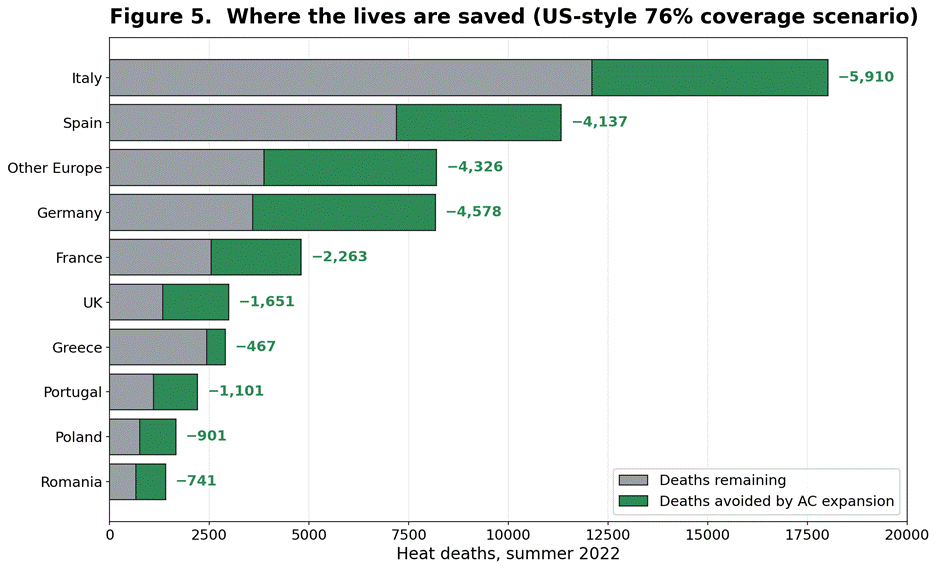
The countries with leaders that most loudly champion passive cooling and energy restraint — notably Germany, the U.K. and France — have the most potential for saving lives through expanding AC.
The policies that block AC
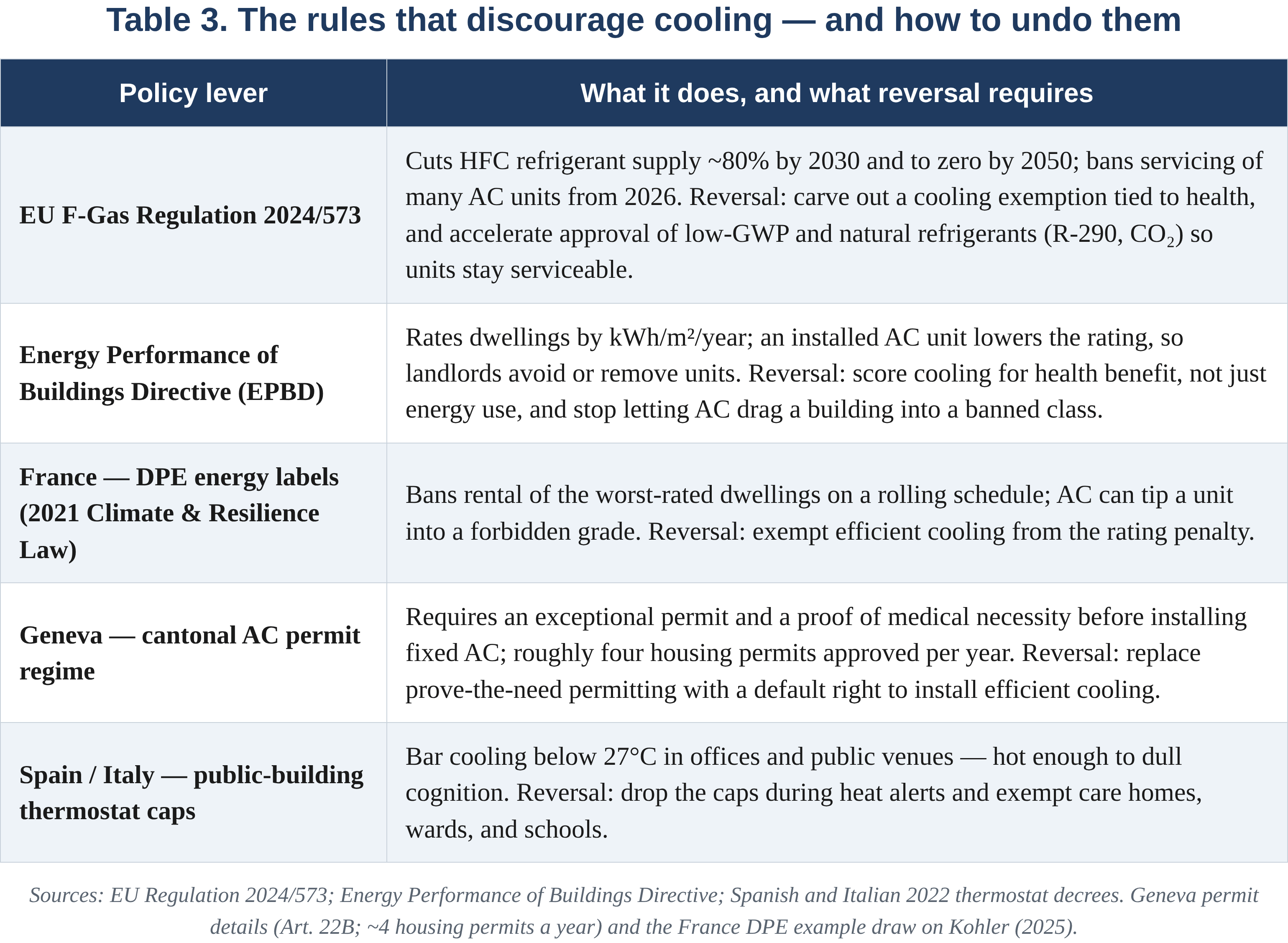
Europe high heat mortality risk and lower penetration of AC reflect policies that actively deter cooling. Some of these policies are at the EU level, and some are at the national or sub-national level.
In his post, Kohler describes these polices as reflective of an energy-degrowth ideology — one that treats every kilowatt-hour as a vice rather than a virtue for improving human lives:
These regulations have not happened by accident, but they come from an ideology that emphasizes energy degrowth as the only viable solution to climate change. What that means in practice is that Europe has heavily prioritized insulation and passive cooling. In contrast, active cooling through an AC, even if running on clean energy, has been disincentivized because it requires energy.
Table 3 lists the main levers and what reversal would take.
What about Europe’s commitment to climate goals?
Setting aside the benefits of saving lives, expanded penetration of AC would not necessarily undo the continent’s commitment to achieving net zero.
Air-conditioning demand peaks during the day and evening: during the 2025 heat waves the IEA found that France, with little AC, saw evening electricity peaks about 25 percent above its off-season average, while air-conditioned New York ran 90 percent higher. Higher, but not impossibly so. France already runs a grid that is largely decarbonized, it would simply need more of what it already has. And air conditioning demand matches well with the time of day when solar energy is most readily available.
Consider also that electrifying cars and home heating is projected to raise European electricity demand by ~1,500 terawatt-hours a year by 2050, lifting total demand by some 40 percent — what the EU has formally committed to under Fit-for-55 and REPowerEU. Increasing demand for electricity to power AC in the context of this huge buildout seems very doable.
The larger problem is not technology or cost, but the fact that among many, cooling technologies have taken on a moral framing as a vice.

The bigger issue: adaptation optimism
The issue of AC in Europe illustrate a broader argument that Matthew Burgess, Patrick Brown, Matthew Kahn, and I make in a new preprint, The Economics of Climate Adaptation Optimism.
Climate advocates have long disparaged adaptation — they cast it as an avoidable cost of failed mitigation, dismiss its effectiveness, and treat it as an obstacle to emissions cuts. We argue that this framing inverts reality.
Adaptation, especially through economic development, drives most climate-sensitive outcomes on the space and time scales that affect people living today. Crop yields, affluence, and death rates from climate hazards have improved across almost all regions over recent decades, despite climate change, because development and adaptation pulled them in beneficial directions faster than any growth in impacts from changes in climate.
Adaptation costs and benefits are typically close in time and space. Mitigation, by contrast, spreads benefits across regions and generations, and can even erode adaptive possibilities. Adaptation and mitigation are not trade-offs. Europe and its approach to AC might just be the poster child for getting this wrong.
Roger Pielke, Jr. is a climate science policy writer and a senior fellow at the American Enterprise Institute (AEI). Find Roger on X @RogerPielkeJr
A version of this article was originally posted at The Honest Broker and has been reposted here with permission. Any reposting should credit the original author and provide links to both the GLP and the original article. Find The Honest Broker on Substack