
Your brain has its own unique ‘fingerprint’

The GLP aggregated and excerpted this blog/article to reflect the diversity of news, opinion and analysis. 

Each person is unique. You can identify people by their DNA, fingerprints, personal preferences and behavior. But new research out of Yale University has shown we have another unique identifier: How our brains work.

“We all have this intuition that people are unique. We all have our own strengths and weaknesses, our quirks and personalities, what we’re good at and how we handle things,” says study co-first author Emily Finn, a pHD student in neuroscience at Yale. “It’s very easy to observe that from the outside … but it’s been pretty hard to find correlates in brain activities.”

And yet, it is the brain that makes all those differences possible. Knowing this, Finn and co-first author Xilin Shen, an associate research scientist at Yale, used functional magnetic resonance imaging (fMRI) scans to see if our brains each have a unique “fingerprint” that could distinguish one person from another.
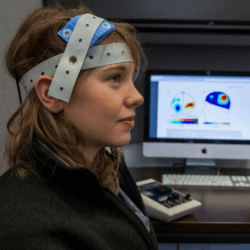

They scanned the brains of 126 participants in the Human Connectome Project while they performed several different tasks. They mapped the connections in the prefrontal cortex and parietal lobes — recently evolved parts of the brain involved in complex functions like attention and language — to develop connectivity profiles of each person. They found that each person’s bran activity profile was indeed unique.

Read full, original post: Connections in the Brain, Like Fingerprints, Can Identify Individuals

Related Articles

Infographic: Global regulatory and health research agencies on whether glyphosate causes cancer

Infographic: Global regulatory and health research agencies on whether glyphosate causes cancer

Does glyphosate—the world's most heavily-used herbicide—pose serious harm to humans? Is it carcinogenic? Those issues are of both legal and ...

Most Popular

Nurturing Care Beneath the Crunchy Moms Logo
Crunchy Moms disinformation flood: Zuckerberg's Facebook has opened floodgates on measles and vaccines
Screenshot-2026-11-19-at-7.54.57-PM
European General Court sides with scientists, dismisses activist claims that glyphosate is toxically dangerous
Screenshot-2026-11-16-at-2.37.32-PM
30 years of GMO farming: Is the boom in glyphosate and glufosinate use harming the environment? Data show they’re the most sustainable choice
Soybean Harvest in Cupped Hands
30 years of GMO farming: Defying cynics, we’ve had larger harvests, lower costs, and $385 billion in added global farmer income
gut health
Health vs. hype on gut health: We are flooded by misinformation
Stormlit Portrait Over Golden Mountains
Searching for life where no one thought to look: A renowned astrophysicist’s seemingly quixotic quest to explore Venus’s clouds
Screenshot-2026-11-17-at-12.18.09-PM
Challenging glyphosate fear-mongering: Statewide Nebraska study finds no link between weedkiller use and non-Hodgkin lymphoma
Screenshot-2026-11-18-at-2.44.24-PM
Why should thousands of Americans die every year waiting for a kidney transplant? There’s an easy fix to this morbid reality
Screenshot-2026-11-19-at-7.23.23-PM
Viewpoint: After a yearlong hiatus, the U.S. Preventive Services Task Force is back in business—gutted by RFK Jr. and promoting junk science
ChatGPT-Image-Mar-10-2026-01_39_01-PM
Viewpoint—“Miracle molecule” debunked: Why acemannan supplements don’t work
glp menu logo outlined

Get news on human & agricultural genetics and biotechnology delivered to your inbox.











