Is aging a ‘treatable disease’? Harvard geneticist faces accusations of ‘snake oil salesman’ as expert scientists refute claims

fea sinclair
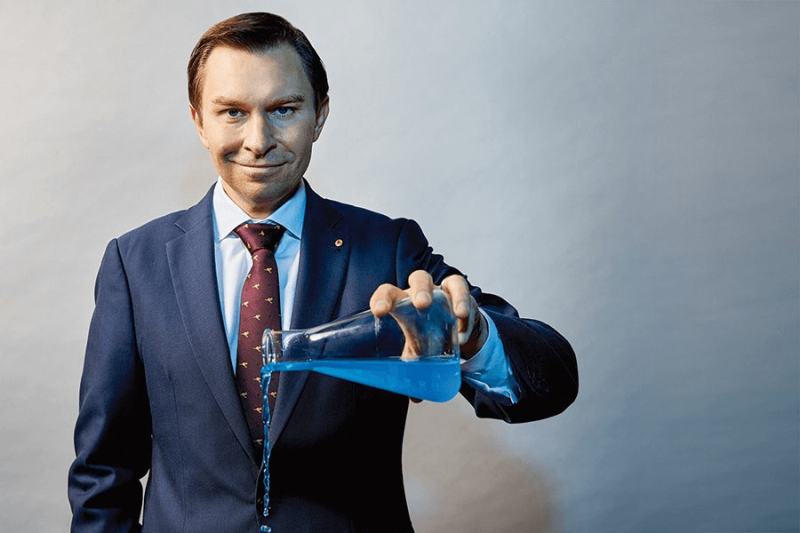
Credit: Ken Richardson/Boston Magazine

Harvard geneticist David Sinclair, who has said his “biological age” is roughly a decade younger than his actual one, has put forward his largely unlined face as a spokesman for the longevity movement.

Follow the latest news and policy debates on sustainable agriculture, biomedicine, and other ‘disruptive’ innovations. Subscribe to our newsletter.

His social-media accounts are a platform for assertions that his work is pushing nearer to a fountain of youth. He claimed last year that a gene therapy invented in his Harvard lab and being developed by a company he co-founded, Life Biosciences, had reversed aging and restored vision in monkeys. “Next up: age reversal in humans,” he wrote on X and Instagram.

On Feb. 29, in the eyes of many other scientists working to unlock the mysteries of aging, he went too far.

Another company he co-founded, Animal Biosciences, quoted him in a press release saying that a supplement it had developed had reversed aging in dogs. Scientists who study aging can’t even agree on what it means to “reverse” aging, much less how to measure it.


The response was swift and harsh. The Academy for Health and Lifespan Research, a group of about 60 scientists that Sinclair co-founded and led, was hit with a cascade of resignations by members outraged by his claims. One scientist who quit referred to Sinclair on X as a “snake oil salesman.”


This is an excerpt. Read the original post here

{{ reviewsTotal }}{{ options.labels.singularReviewCountLabel }}
{{ reviewsTotal }}{{ options.labels.pluralReviewCountLabel }}
{{ options.labels.newReviewButton }}
{{ userData.canReview.message }}

Related Articles

Infographic: Global regulatory and health research agencies on whether glyphosate causes cancer

Infographic: Global regulatory and health research agencies on whether glyphosate causes cancer

Does glyphosate—the world's most heavily-used herbicide—pose serious harm to humans? Is it carcinogenic? Those issues are of both legal and ...

Most Popular

Screenshot-2026-04-23-at-11.00.36-AM
Regulators' dilemma: Thalidomide, Metformin, and the cost of getting drug approvals wrong
Picture1-5
Science Disinformation Gap: The transatlantic battle over social media and censorship
ChatGPT-Image-May-13-2026-11_56_08-AM
After slashing global health aid by $19 Billion, Trump moves to tap $2.1 billion more—to cover shutdown costs
ChatGPT-Image-May-12-2026-08_39_41-PM
GLP podcast: Big Pharma, Big Ag, Big Food—health harming industries or life-saving innovators?
ChatGPT Image May 10, 2026, 08_16_59 PM 2
Overmedicalization? RFK Jr.’s antidepressant crackdown raises conflict questions over his fee stake in Wisner Baum, the tort firm built on suing drug makers
Screenshot-2026-05-12-at-9.58.31-PM
'He seems fine': Marty Makary out as FDA commissioner
Picture1-1
Cooling the planet with balloons: Could a geoengineering gamble slow global warming?
Screenshot-2026-05-01-at-1.29.41-PM
Viewpoint: What happens when whole grains meet modern food manufacturing? Labels don’t tell the whole story.
ChatGPT-Image-Apr-13-2026-02_20_22-PM
Viewpoint: Misinformation infodemic? Why assessing evidence is so challenging 
Screenshot-2026-05-11-104424
Hantavirus outbreak research: Trump administration shut down study last year on rodent-to-human transmission
S
As vaccine rejectionism spreads, measles may be taking a more dangerous turn
ChatGPT Image May 12, 2026, 10_19_00 AM 2
Viewpoint— 'Muscular governance': How authoritarianism is surging corporate-linked energy misinformation
glp menu logo outlined

Get news on human & agricultural genetics and biotechnology delivered to your inbox.