Every day, the same post appears in two places at once. A Facebook user in Munich sees it with a label attached — “False: rated by independent fact-checkers” — and most users never read past it. A Facebook user in Minneapolis sees the same post, unlabeled, and it moves freely through their feed. Same platform, same algorithm, same claim. Different internet.
That difference is no accident. It is the product of a policy divergence that has been quietly widening for years and broke into the open in January 2025, when Meta formally ended its third-party fact-checking program in the United States. The change affected Facebook, Instagram, and Threads, but did not apply to European users.
And Meta is far from the only platform running two different content standards simultaneously — one for users where regulators compel accountability, and another for users where they don’t. When Elon Musk’s X dropped its COVID misinformation policy in late 2022, the rollback was global in form, but its consequences collided with a much tougher European regulatory environment, which kept constraints in place for European accounts.
YouTube tightened content moderation for EU users under regulatory pressure while it relaxed policies in the U.S., particularly politically contested ones. TikTok, acutely aware of its political vulnerability in Washington, has been quieter about policy changes but operates under the same European obligations that constrain its peers. None of these companies has voluntarily extended stronger European protections to their American users.
The rollback is most prominent on Meta because of its explicit and far-reaching 2025 dismantling of professional oversight infrastructure in the U.S. — the most consequential test case of how mis- and disinformation, particularly in science, will be handled going forward. Under sustained pressure from conservative critics, Meta announced in January 2025 that it was formally ending its U.S. third-party fact-checking program for Facebook, Instagram, and Threads, framing it as a return to “free expression” and a correction to over-enforcement. The company replaced it with Community Notes — a crowd-based system in which users write and rate contextual labels.
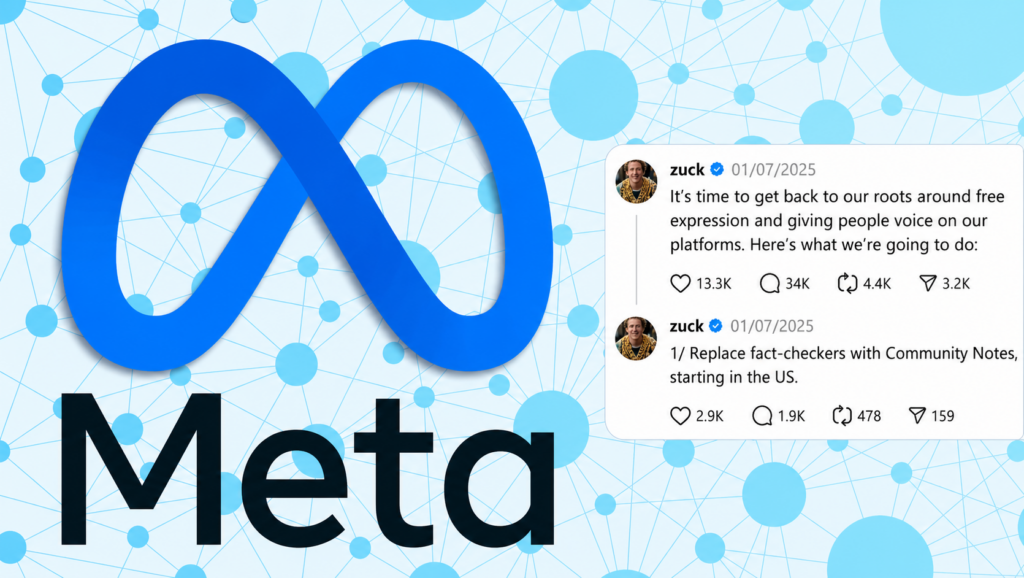
The change applied only to American users. Europe had already taken a more rigorous approach with the Digital Services Act (DSA). The law entered into force in November 2022, but its obligations did not apply to “Very Large Online Platforms” — services with at least 45 million monthly EU users, such as Meta — until August 2023. It was designed to make online platforms more accountable and imposed binding requirements on covered platforms. It did not directly order companies to adopt a particular definition of “truth” or “accuracy,” nor did it formally require professional fact-checkers by name.
What the DSA did require was that very large platforms assess and mitigate systemic risk — including disinformation risk — through proportionate measures. That obligation was mandatory, not voluntary. Meta and other social media companies that relaxed oversight standards remained subject to monitoring and must meet DSA obligations to identify, reduce, document, and audit systemic risks. In contrast, U.S. oversight increasingly relies on crowdsourcing, which has been shown to be slow to respond.
The biggest impact was on science information. In effect, the same false claim about vaccines, or GMOs, or a disease outbreak that would be flagged within hours in Munich, online users in Minneapolis wouldn’t see a correction for the better part of a day — or, more likely, never. That does not mean every European user received every correction instantly, or that every American user received none. The point is structural: Europe requires an auditable risk-management system; the U.S. largely leaves the design to the platform.
Real-world differences between the two approaches were already visible before Meta’s U.S. rollback. A wave of posts in 2023 claiming that COVID vaccines caused “sudden death” in young athletes spread across Facebook. In the U.S., the false claims went unaudited. In Germany and France, independent fact-checkers labeled the content false within hours. According to Meta’s own data, 95 percent of European users didn’t click through to content once a professional warning label was attached. In the U.S., when false claims circulated with no label, the crowd was slow to weigh in, and even when it did, it was often ineffective.
Europe imposes “expert” oversight while Meta adopts crowdsourcing
As European parliamentary elections approached in June 2024 — and with the transatlantic split widening — Meta announced an expansion of its existing fact-checking operation — extending coverage to AI-altered content and launching a “media literacy campaign to raise public awareness.” The change was framed as a strengthening of existing oversight, not a restructuring along U.S. lines, though skepticism about voluntary commitments remained widespread.
In January 2025, Meta went a step further, announcing that it was formally ending its third-party fact-checking program in the U.S. altogether, replacing it gradually across its platforms with Community Notes. Meta would no longer display professional fact-check labels as the central enforcement mechanism. According to founder Mark Zuckerberg, who expressed growing regret over “government pressure” in a landmark 2024 letter, Meta was “lifting restrictions on some topics that are part of mainstream discourse and focusing on illegal and high-severity violations.”
The changes were immediate and the consequences problematic. According to Meta’s data, between July and December 2023, more than 68 million pieces of content viewed on Facebook and Instagram in the EU carried fact-checking labels. Under the new U.S. system, much of that content would now go unlabeled for the most critical hours of its lifespan. Meta itself reported that when a professional fact-check label is placed on a post, 95 percent of users do not click through to view the flagged content — a friction metric that measures readers who make a conscious choice to disengage with disputed material.
Well before Meta’s January 2025 announcement, Brussels had already concluded that purely voluntary platform self-regulation was not working. Meta had promised to police disinformation, manipulative advertising, election interference, child-safety risks, illegal content and public-health falsehoods, but the Commission was not persuaded those promises were being kept. The EU therefore imposed transparency responsibilities, mitigation obligations, data access for regulators and researchers, and independent audits, with the threat of heavy fines for noncompliance.
The DSA does not contain a command that Meta or any other social media company must retain professional fact-checkers by name. But if Meta wants to dismantle its fact-checking infrastructure in Europe, as it had announced it was doing in the U.S., it will need to prove to the EU that crowdsourcing could do the job just as well.
What it does require is that very large platforms assess and mitigate systemic risk — including disinformation risk — through proportionate, effective measures. Brussels made its position clear: if Meta ever sought to formally dismantle its fact-checking infrastructure in Europe like it has in the U.S., it would have to prove that crowdsourcing strangers could do the job just as well. Even absent a simple statutory mandate, Europe requires Meta to collect data and conduct a risk assessment, actions they believe signal the media giant is taking illegal content and disinformation risks seriously. While Europe is not directly mandating “truth,” it requires platforms to convince the Commission that whatever system is adopted can manage foreseeable harms.
The transatlantic differences now in place are stark. In Europe, regulatory focus has shifted from voluntary commitments to enforceable obligations. Meta and other social media companies that relaxed oversight standards are monitored and required to meet their DSA obligations to identify, reduce, and audit disinformation risks. U.S. oversight is more overtly political and relies on crowdsourcing, which has been shown to be slow to respond and often ineffective during the early viral phase of misinformation spread.
Race to the bottom?
The regulatory floor determines the standard. Where it is lower, every major platform — X, YouTube, TikTok, and Meta — has followed it downward. None has voluntarily extended stronger European protections to American users.
This is more than a Meta policy quirk. It marks a fundamental split in how the Western world governs contested information. The American model leaves platform truth systems vulnerable to corporate preference, political backlash, and culture-war pressure. The European model is more constraining, treating the largest platforms as risk-generating infrastructure and forcing them to document how they manage the harms their own systems can amplify.
Initial studies suggest that Community Notes, the replacement system now handling corrections in the U.S., is not working as hoped. Research published in PNAS found that Community Notes does reduce engagement with false content once a note is attached. A 2025 analysis of health misinformation found that health-related Community Notes often face substantial delays: one study of more than 30,000 health-related notes found a median delay of 17.6 hours before warning notes began to influence online behavior. Separate research on viral spread suggests that by that time, most viral misinformation has already reached 80 percent of its total eventual audience. In the U.S. model, the “correction” posts far after the damage. In the viral world, revisions are dead on arrival.

Key friction point: Science
For many categories of viral content, a crowd of generalist users can reasonably evaluate accuracy. Science is the most challenging. Many scientific claims that have raced through social media are technical and easy to distort — vaccines, agricultural chemicals like glyphosate, nuclear energy and fracking, drugs like Tylenol and Gardasil, products like talc and aspartame — even without violating platform rules on illegal material.
While a false claim about a celebrity or a political event requires no specialist training to assess, claims about mRNA vaccine technology altering DNA, the alleged dangers of gene-edited crops or pesticide residues, or CRISPR off-target effects are more consequential. The mRNA-alters-DNA claim is not hypothetical — it was one of the most widely shared pieces of health misinformation of the pandemic era, and its path through social media looked very different depending on which country you were in. A professional fact-checker from a group like Agence France-Presse flagged the post within hours; in the U.S., such claims went unchallenged and viral.
The World Health Organization identifies online science misinformation as a direct public health threat, warning that it encourages vaccine hesitancy, which can translate into avoidable deaths. More recent WHO analysis describes it as a “contagion” capable of eroding decades of gains in immunization coverage and disease control. Studies of COVID-19 vaccination patterns find a measurable relationship between exposure to online misinformation and lower vaccination rates and vaccine hesitancy. Other analysis of vaccine-related content shows that low-credibility sources are reshared more frequently than authoritative ones, amplifying their reach despite weaker evidence.
The online science disinformation problem runs deeper than platform policy. A recent preprint analyzing hundreds of studies on social media published in leading interdisciplinary journals — including Science, Nature, and PNAS — found that corporations and activist organizations are covertly influencing what the online world views as “truth.” In roughly one-third of papers, authors had ties to the social media industry, received funding from a social media company, or had recently co-authored work with an employee at a company or organization. When editors and peer reviewers were factored in, the researchers estimated that only about one in five papers remained fully independent throughout the publication process. Industry- or organization-linked research is not automatically wrong — funding does not corrupt findings by definition — but the pattern of what those studies chose to examine and how they frame the issues raises harder questions.
Research on why individuals share misinformation was disproportionately common among affiliated work. Research into the role of the platforms themselves — how algorithmic design drives polarization, how recommendation engines amplify false content — was comparatively rare. The echo is familiar: the food and tobacco industries spent decades funding research that spotlighted consumer behavior rather than product harm, a strategy that bought them years of regulatory delay. But industry is far from the only interested party working the information environment. Environmental activist organizations and the tort lawyers who frequently partner with them have become aggressive and sophisticated users of social media, seeding platforms with alarming narratives about pesticides, chemicals, nuclear energy, GMOs, and pharmaceuticals — narratives that serve both ideological agendas and, in the litigation context, highly lucrative legal strategies. Studies linking glyphosate to cancer, claims about the dangers of aspartame or talc, or alarmist content about gene-edited crops often circulate on social media well ahead of — and frequently in contradiction to — the weight of peer-reviewed evidence. Like industry-funded research, activist-driven content is not wrong by definition; sometimes the alarm is justified. But the self-interest is equally real, and a correction system — whether crowd-sourced or expert-verified — that treats corporate speech as inherently suspect while waving through activist framing is not fact-checking, but baked-in bias.
This matters directly to the transatlantic debate. The research that regulators, fact-checkers, and platform executives cite when arguing about what “the science says” on misinformation is itself a contested object — shaped by corporate funders on one side and by ideologically motivated advocacy on the other. Neither oversight boards nor crowd voting is designed to interpret complex and controversial issues, in science or elsewhere.
This creates a predictable structural problem for both oversight models. The Meta Oversight Board — a semi-autonomous agency set up by the company to review difficult content decisions and policy questions that is often described as a kind of “Supreme Court” for Facebook, Instagram, and Threads — has warned that the blanket rollout of Community Notes risks missing technical, political, and cultural context in settings where bad information can produce “real-world harm.” If a platform’s primary correction mechanism shifts from expert verification to viewpoint consensus. The record of events ceases to reflect established facts and begins instead to echo whatever its users already believe.
Zuckerberg’s rebuttal is not without merit. “After Trump first got elected in 2016,” he said when announcing his crowdsourcing plan, “the legacy media wrote nonstop about how misinformation was a threat to democracy. We tried in good faith to address those concerns without becoming the arbiters of truth. But the fact-checkers have just been too politically biased and have destroyed more trust than they’ve created, especially in the U.S.”
The charge has some empirical grounding. Scientific misinformation is genuinely difficult to evaluate and divorce from ideology. Professional fact-checkers accredited under frameworks like the European Fact-Checking Standards Network are trained to spot the nuances on science issues that the crowd misses — but they bring their own biases. Europe’s own regulatory instincts about agricultural biotechnology, nuclear energy, and trace chemicals in the environment frequently diverge from scientific consensus. A fact-checking apparatus shaped by those views would carry institutional authority but hardly be more scientifically reliable.
And the research base they draw on is not clean. If a substantial share of the academic literature on social media and misinformation has been shaped — however subtly — by undisclosed industry ties on one side and by advocacy-driven framing on the other, then neither side of the transatlantic debate is arguing from a fully independent evidentiary foundation. Europe’s DSA requirement that platforms submit to independent audit is only as good as the auditors, and auditors steeped in the prejudices of a culture and trained in regulatory environments that are themselves skeptical of polarizing technologies introduce their own prior biases to the table, yet another dimension of disinformation.
Two models, one unresolved question
Zuckerberg’s skepticism about “politically biased” fact-checkers may be self-serving, but the counter-case for expert oversight rests partly on a body of science with its own entanglements. On questions where consensus and public opinion diverge — as they frequently do on agricultural technology, vaccines, and pesticide risk thresholds — both experts and the crowd may simply vote based on their political tribe rather than the peer-reviewed evidence. The academic research meant to guide the design of “more independent” systems is compromised — from multiple directions — by the interests it purports to study. This is the genuine conundrum Zuckerberg is pointing at, however self-serving it may seem; even if his company benefits from Meta’s crowdsourcing model, there is no neutral referee. Crowd correction is slow and tribalized; expert correction is faster but carries ideological risk of its own. Neither system is designed for the speed at which consequential misinformation travels.
What separates the two sides is not which model is better — neither is — but how much misinformation we are willing to accept. The American model treats the current trend as a regrettable but acceptable cost of open conversation, placing its faith in common sense and individual judgment. Europe treats it as a systemic risk requiring auditable, proportionate responses — not because Brussels has cornered the truth, but because the alternative, doing nothing measurable, has already proven costly.
Zuckerberg has signaled that Community Notes is not intended to remain a U.S.-only product indefinitely. But if Meta eventually seeks to extend it to Europe and dismantle its professional fact-checking program there, it will enter a legal framework the European Commission has deliberately made difficult to escape. The question will not be whether Meta prefers Community Notes — it clearly does. The question will be whether Meta can prove that Community Notes adequately mitigates systemic risk. That proof does not and will not ever exist: Community Notes is applied too late to blunt the earliest and most viral phase of misinformation spread — the hours when most of the damage is done. But how much independence are we willing to concede to what some consider a ‘board of censors’?
The deeper unease: where regulation is weak, every platform — X, YouTube, TikTok, and Meta — has embraced a low, less encumbering standard. Neither model has yet produced a system that is fast, accurate, independent, and trusted enough to function at the scale of modern viral misinformation. And so long as the research informing those models remains pulled in competing directions — by industry on one side, by advocacy and litigation interests on the other — we are not just arguing about platforms, but about who gets to define the problem. What’s ultimately chosen would not be a solution, but a barely-acceptable truce with a problem that won’t ever go away.
Jon Entine is the executive director of the Science Literacy Project/Genetic Literacy Project.
Dr. Joseph Maina is a Senior Lecturer in the Department of Earth and Environmental Sciences at Macquarie University, Sydney. His work integrates diverse disciplines, including macro-ecology, climate science, oceanography, remote sensing, hydrology, fisheries management, and decision science.