Genetically engineered ‘muscley’ dogs bred in China

Dogsincars pocket b

The GLP aggregated and excerpted this blog/article to reflect the diversity of news, opinion and analysis.

Two beagle puppies called Tiangou and Hercules were created to be extra muscley, with double the amount of muscle mass than typical by deleting a single gene called myostatin.

The team from the Guangzhou Institutes of Biomedicine and Health reported their results in the Journal of Molecular Cell Biology, saying the goal was to create dogs with other DNA mutations, that human diseases such as Parkinson’s and muscular dystrophy, so treatments could be tested on them.

The muscle-enhanced beagles were creating using a gene-editing technology called CRISPR-Cas 9 – a sort of cut-and-paste tool for DNA.

The researchers inserted this DNA-modifying tool into more than 60 dog embryos. Their objective was to knock out the myostatin gene which blocks muscle production, so that the beagles’ bodies would produce extra muscle.

In the end, of 65 embryos they edited, 27 puppies were born, but only two had disruptions in both copies of the myostatin gene.

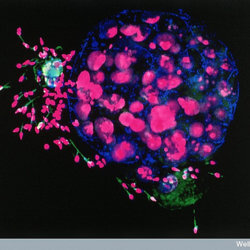
Since the technique is relatively simple, some fear humans could be next. In April another Chinese team reported altering human embryos in the laboratory, in an attempt to correct a genetic defect that causes beta-thalassemia disease.

“We have already modified embryos of both pigs and primates,” said Professor George Church of Harvard University, who is a pioneer in the field of genetic engineering. “It might actually be safer, and developmentally important to make corrections in a sperm or embryo, rather than a young child or an adult.”

For instance, he said, gene editing can be used to correct some forms of blindness, but it has to be done before neurons become solidified and more resistant to change in adulthood.

Read full, original post: Chinese scientists create ‘designer dogs’ by genetic engineering

Related Articles

Infographic: Global regulatory and health research agencies on whether glyphosate causes cancer

Infographic: Global regulatory and health research agencies on whether glyphosate causes cancer

Does glyphosate—the world's most heavily-used herbicide—pose serious harm to humans? Is it carcinogenic? Those issues are of both legal and ...

Most Popular

Nurturing Care Beneath the Crunchy Moms Logo
Crunchy Moms disinformation flood: Zuckerberg's Facebook has opened floodgates on measles and vaccines
Screenshot-2026-11-19-at-7.54.57-PM
European General Court sides with scientists, dismisses activist claims that glyphosate is toxically dangerous
Screenshot-2026-11-16-at-2.37.32-PM
30 years of GMO farming: Is the boom in glyphosate and glufosinate use harming the environment? Data show they’re the most sustainable choice
Soybean Harvest in Cupped Hands
30 years of GMO farming: Defying cynics, we’ve had larger harvests, lower costs, and $385 billion in added global farmer income
Stormlit Portrait Over Golden Mountains
Searching for life where no one thought to look: A renowned astrophysicist’s seemingly quixotic quest to explore Venus’s clouds
gut health
Health vs. hype on gut health: We are flooded by misinformation
Screenshot-2026-11-17-at-12.18.09-PM
Challenging glyphosate fear-mongering: Statewide Nebraska study finds no link between weedkiller use and non-Hodgkin lymphoma
Screenshot-2026-11-18-at-2.44.24-PM
Why should thousands of Americans die every year waiting for a kidney transplant? There’s an easy fix to this morbid reality
Screenshot-2026-11-19-at-7.23.23-PM
Viewpoint: After a yearlong hiatus, the U.S. Preventive Services Task Force is back in business—gutted by RFK Jr. and promoting junk science
ChatGPT-Image-Mar-10-2026-01_39_01-PM
Viewpoint—“Miracle molecule” debunked: Why acemannan supplements don’t work
glp menu logo outlined

Get news on human & agricultural genetics and biotechnology delivered to your inbox.