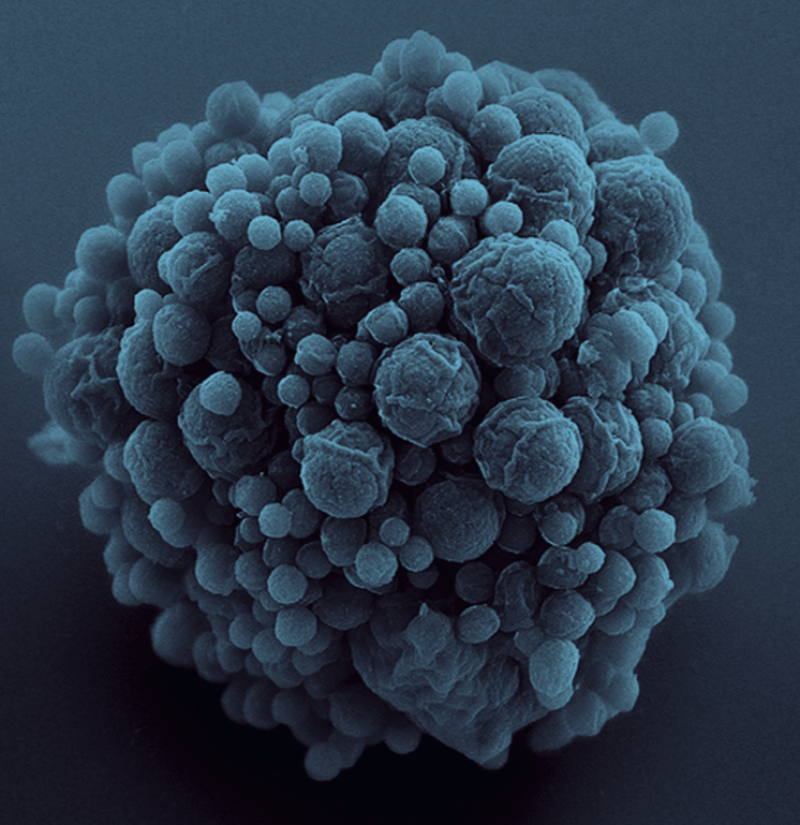
It’s the second smallest headline maker in history. A synthetic cell has been designed with the minimal combination of genes needed to sustain itself. And the geneticists that created it built it from the ground up, putting related genes together so that their template genome is more adaptable to design from other synthetic biologists.
The Venter Institute scientists took the tiny bacteria mycoplasma mycoides, chemically synthesized its genome, and inserted it back into the empty cells. To get there, they tested whether a cell would be viable gene by gene. The team ended up with a genome containing 437 genes, but amazingly they still don’t know what 149 of them do, just that they are completely necessary for the organism to survive.
An completely engineered genome might not seem like a very useful invention. But scientists around the world are interested in building new life forms. They could fight off other, noxious bacteria, or become tiny factories themselves turning out pharmaceuticals, biofuels or even plastics. All those eventual applications require a foundation, and Venter says he’s made one. Ed Yong writes at the Atlantic:
Why bother? Because they ultimately want to intelligently design new life-forms from scratch — say, bacteria that can manufacture medical drugs, or algae that churn out biofuels. And creation requires understanding. “We had to start with a system where we knew and understood all the components, so that when we added specific ones to it, we could do so in a logical design way,” Venter says. They needed a minimal genome — a vanilla model that they could later kit out with deluxe accessories.
The team of scientists was most surprised that nearly a third of the genes that their cell absolutely required remain cloaked in mystery. The were absolutely essential to the cell to survive and thrive, but their function is still unknown. The process of uncovering each of those functions continues. “Even with a cell that can barely support itself, it seems, the task of hunting out gene function will still be daunting,” Rachel Feltman wrote at the Washington Post.
This discovery is not the same as finding the essence of life or what genes are required for any organism to be alive. A cell with this minimal genome wouldn’t survive everywhere. Part of what determines life is its surroundings. The Venter institute’s minimalist cell can only exist in the specific conditions established before the experiment began. Put that cell at the bottom the ocean or in a commercial refrigerator and different genes might be necessary says Emily Singer writing at Quanta:





What’s essential in biology depends largely on an organism’s environment. For example, imagine a microbe that lives in the presence of a toxin, such as an antibiotic. A gene that can break down the toxin would be essential for a microbe in that environment. But remove the toxin, and that gene is no longer essential.
This is not the Venter Institute’s first foray into stand-along genomes. In 2010 they also produced mycoplasma mycoides cell that could survive on its own. But this version of the cell involved much more genome organization and design according to Christopher Voigt at MIT who commented to GLP’s sister site Genetic Expert News Service:
This work is a big leap forward from an earlier paper six years ago, when the same group showed that they could build a genome from scratch, to where they are now getting towards designing the genome. In the earlier work they rebuilt a genome found in nature. In the more recent work they start to apply the human concepts of design and organization in order to create a more easily understood genome.
Our knowledge of DNA has rapidly expanded and allowed us to view cellular organisms with a potential eye towards biological applications. By inserting specific genes, a cell can be compelled to manufacture lots and lots of a particular hormone, for example. Other groups are working to turn single-celled organisms like yeast and other bacteria into tiny factories to turn out chemicals, plastics and pharmaceuticals. Michael Eisenstein explains at Nature:
Groups around the world are engineering yeast, bacteria and other cells to make plastics, biofuels, medicines and even textiles, with the goal of creating living factories that are cheaper, simpler and more sustainable than their industrial counterparts. For instance, the biomaterials company Spiber Inc. in Tsuruoka, Japan, has reprogrammed bacteria to churn out spider silk for use in strong, lightweight winter clothing.
Some scientists questioned whether the custom-built model will hold up compared to genetic editing processes like CRISPR that can delete and insert genes as desired. CRISPR is cheap and fast, especially compared to building a genome from scratch. Venter said his synthetic genome would be a shortcut for scientists to build upon.
Meredith Knight is a contributor to the human genetics section for Genetic Literacy Project and a freelance science and health writer in Austin, Texas. Follow her @meremereknight.