Schizophrenics have fewer nerve cells in their brain due to genetic mutation

brainroadmap
Road Map of The Mind. Conceptual image, roads and streets making up a human brain.

Stem cells obtained from patients with schizophrenia carry a genetic mutation that alters the ratio of the different type of nerve cells they produce, according to a new study by researchers in Japan. The findings…suggest that abnormal neural differentiation may contribute to the disease, such that fewer neurons and more non-neuronal cells are generated during the earliest stages of brain development.

One of the best characterised mutations associated with the disease is a microdeletion on chromosome 22…Manabu Toyoshima of the RIKEN Brain Science Institute and his colleagues obtained skin cells from two female schizophrenic patients diagnosed with the chromosome 22 deletion and two healthy individuals, then reprogrammed them to generate induced pluripotent stem cells (iPSCs)….
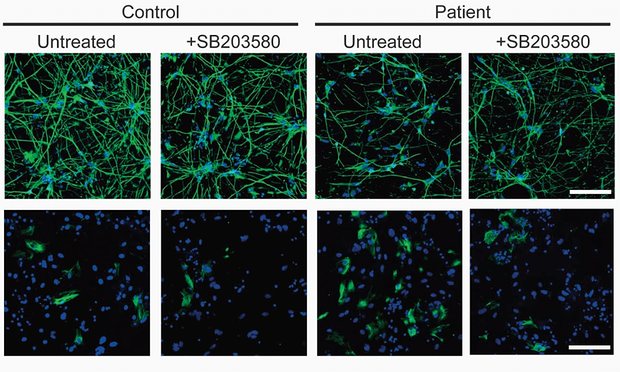
Differences in neurospheres between stem cells of two patients with schizophrenia and without schizophrenia. Credit: Takeo Yoshikawa/ RIKEN Brain Science Institute

Toyoshima and his colleagues immediately noticed that the neurospheres derived from iPSCs obtained from the schizophrenic patients were significantly smaller than those formed from iPSCs from the two healthy controls.

This revealed abnormal differentiation in the neurospheres derived from the schizophrenic patients. They formed significantly fewer neurons, and significantly more astrocytes, than the neurospheres derived from the iPSCs of the healthy controls.

The GLP aggregated and excerpted this blog/article to reflect the diversity of news, opinion, and analysis. Read full, original post: Stem cells from schizophrenics produce fewer neurons

{{ reviewsTotal }}{{ options.labels.singularReviewCountLabel }}
{{ reviewsTotal }}{{ options.labels.pluralReviewCountLabel }}
{{ options.labels.newReviewButton }}
{{ userData.canReview.message }}

Related Articles

Infographic: Global regulatory and health research agencies on whether glyphosate causes cancer

Infographic: Global regulatory and health research agencies on whether glyphosate causes cancer

Does glyphosate—the world's most heavily-used herbicide—pose serious harm to humans? Is it carcinogenic? Those issues are of both legal and ...

Most Popular

Screenshot-2026-05-01-at-1.29.41-PM
Viewpoint: What happens when whole grains meet modern food manufacturing? Labels don’t tell the whole story.
S
As vaccine rejectionism spreads, measles may be taking a more dangerous turn
Screenshot 2026-05-06 at 2.56
Singularity crisis ahead? Can super babies save us from rogue AI geniuses?
Screenshot-2026-03-13-at-12.14.04-PM
The FDA wants to make many popular prescription drugs OTC—a great idea. Here’s why it’s unlikely to happen
Screenshot-2026-05-06-at-2.07.43-PM
Manufacturing a conspiracy: The timeline of how  the White House embraced the fringe claim that scientists are being mysteriously murdered
Screenshot-2026-05-01-at-11.56.24-AM
‘Science moves forward when people are willing to think differently’: Memories of DNA maverick Craig Venter
Screenshot-2026-04-20-at-2.26.27-PM
Viewpoint — Food-fear world: The latest activist scientists campaign: Cancer-causing additives
Screenshot-2026-04-30-at-2.19.37-PM
5 myths about summer dehydration that could damage your health — or even kill you
Screenshot-2026-04-03-at-11.15.51-AM
Paraben panic: How a flawed study, media hype, and chemophobia convinced the public of the danger of one of the safest classes of preservatives
images
The never-ending GMO debate: Pros and cons
glp menu logo outlined

Get news on human & agricultural genetics and biotechnology delivered to your inbox.