New GMO could protect wheat and barley against deadly blight

FHB

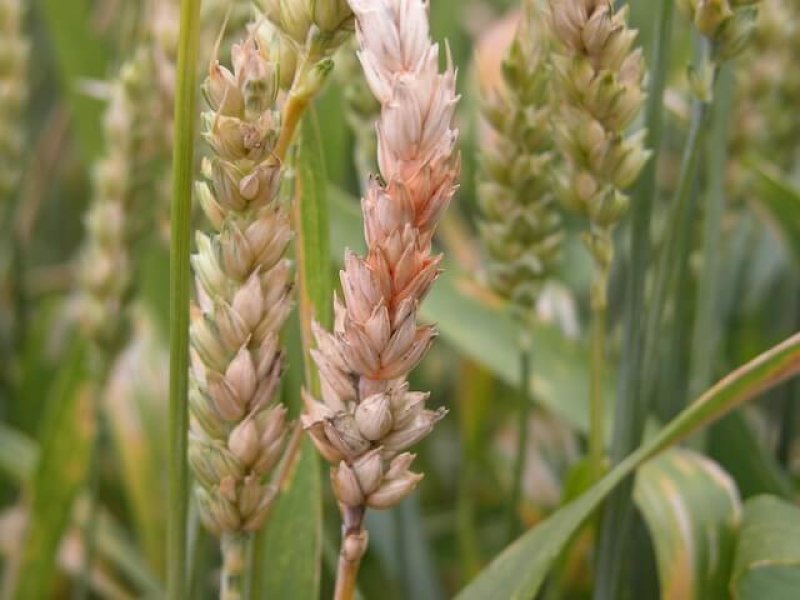
Fusarium head blight (FHB), caused by Fusarium graminearum, is a devastating disease of wheat and barley that leads to reduced yield and mycotoxin contamination of grain, making it unfit for human consumption. FHB is a global problem, with outbreaks in the United States, Canada, Europe, Asia and South America. In the United States alone, total direct and secondary economic losses from 1993 to 2001 owing to FHB were estimated at $7.67 billion1. Fhb1 is the most consistently reported quantitative trait locus (QTL) for FHB resistance breeding. Here we report the map-based cloning of Fhb1 from a Chinese wheat cultivar Sumai 3. By mutation analysis, gene silencing and transgenic overexpression, we show that a pore-forming toxin-like (PFT) gene at Fhb1 confers FHB resistance. PFT is predicted to encode a chimeric lectin with two agglutinin domains and an ETX/MTX2 toxin domain. Our discovery identifies a new type of durable plant resistance gene conferring quantitative disease resistance to plants against Fusarium species.

The GLP aggregated and excerpted this blog/article to reflect the diversity of news, opinion, and analysis. Read full, original post: Wheat Fhb1 encodes a chimeric lectin with agglutinin domains and a pore-forming toxin-like domain conferring resistance to Fusarium head blight


{{ reviewsTotal }}{{ options.labels.singularReviewCountLabel }}
{{ reviewsTotal }}{{ options.labels.pluralReviewCountLabel }}
{{ options.labels.newReviewButton }}
{{ userData.canReview.message }}

Related Articles

Infographic: Global regulatory and health research agencies on whether glyphosate causes cancer

Infographic: Global regulatory and health research agencies on whether glyphosate causes cancer

Does glyphosate—the world's most heavily-used herbicide—pose serious harm to humans? Is it carcinogenic? Those issues are of both legal and ...

Most Popular

Screenshot 2026-05-06 at 2.56
Singularity crisis ahead? Can super babies save us from rogue AI geniuses?
Screenshot-2026-03-13-at-12.14.04-PM
The FDA wants to make many popular prescription drugs OTC—a great idea. Here’s why it’s unlikely to happen
Screenshot-2026-05-01-at-1.29.41-PM
Viewpoint: What happens when whole grains meet modern food manufacturing? Labels don’t tell the whole story.
Screenshot-2026-05-01-at-11.56.24-AM
‘Science moves forward when people are willing to think differently’: Memories of DNA maverick Craig Venter
Screenshot-2026-04-20-at-2.26.27-PM
Viewpoint — Food-fear world: The latest activist scientists campaign: Cancer-causing additives
Screenshot-2026-04-03-at-11.15.51-AM
Paraben panic: How a flawed study, media hype, and chemophobia convinced the public of the danger of one of the safest classes of preservatives
S
As vaccine rejectionism spreads, measles may be taking a more dangerous turn
Screenshot-2026-05-06-at-2.07.43-PM
Manufacturing a conspiracy: The timeline of how  the White House embraced the fringe claim that scientists are being mysteriously murdered
images
The never-ending GMO debate: Pros and cons
Screenshot-2026-04-12-135256
Bixonimania: The fake disease scam that AI swallowed whole
Screenshot-2026-04-30-at-2.19.37-PM
5 myths about summer dehydration that could damage your health — or even kill you
glp menu logo outlined

Get news on human & agricultural genetics and biotechnology delivered to your inbox.