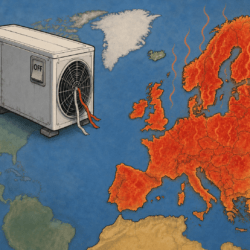
Is Europe’s ideological aversion to air conditioning quietly killing thousands of people? A surprising body of evidence suggests that the continent’s green activism and energy degrowth mindset have turned a solvable public health challenge into a deadly political failure. As climate policy expert Roger Pielke Jr. explains in his recent analysis, Europe has warmed about 0.5°C per decade since the 1980s, driving clear increases in extreme heat stress days and summer heat mortality, with 68,000 deaths in 2022 marking a recent high point.
Yet Europe largely chooses these outcomes. Household air conditioning penetration sits at just 19% across much of the EU, compared to roughly 76% in North America and over 90% in Japan. Rigorous U.S. data show AC deployment cuts the risk of dying on extremely hot days by roughly 75%, despite more frequent heat waves. Indeed, northern European countries with relatively temperate climates and low AC rates (e.g., Germany 3%, UK 5%) contribute surprisingly large shares of avoidable deaths alongside hotter Mediterranean nations.
Pielke estimates that matching North American AC use could avert roughly 26,000 heat deaths in a particularly hot summer like 2022. Near-universal coverage could save some 35,000 lives annually. And the gains would concentrate among the elderly—over-65s comprise roughly 93% of deaths—making targeted cooling in homes, care facilities and hospitals effective and affordable.
This could be done without compromising the EU’s climate goals, since countries like France already have largely decarbonized electrical grids; more energy use does not necessitate higher CO2 emissions.
The core problem lies in ideological policies that treat energy consumption itself as a vice: EU building directives, national thermostat rules, permitting barriers, and a broader cultural hostility to “active” cooling all elevate heat-death risk. These policies are reversible with sufficient political will.




As with most sustainability debates, balancing environmental protection with adaptation is not only possible in this case but necessary since lives are on the line. Europe’s experience stands as a cautionary tale against letting degrowth dogma override public health. Evidence-based pragmatism protects the vulnerable. Symbolic technophobia costs lives.
Podcast: Play in new window | Download
Subscribe: RSS
Cameron J. English is the executive vice president at the American Council on Science and Health. Follow him on X @camjenglish