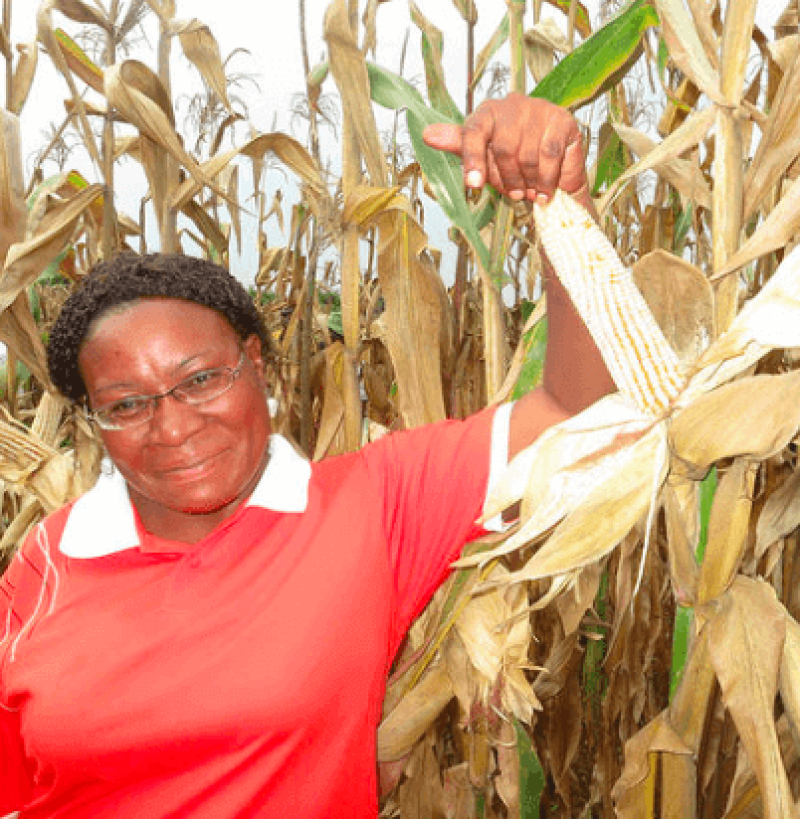
Uganda promotes new drought tolerant, disease resistant maize varieties

Screen Shot at AM
Photo by Tsedeke Abate, CIMMYT/Flickr

Earlier this year, the Ministry of Agriculture , Animal Industry and Fisheries (Maaif) released four new maize varieties. It was part of the Water Efficient Maize for Africa (Wema) initiative, which aims at coming up with maize that withstand stresses of drought and insect pests.

The effort was a collaboration with scientists, farmers, national research organisations and other stakeholders in five countries. These are Uganda, Kenya, Tanzania, Mozambique and South Africa under a public-private partnership. Thus, the varieties are improved conventional white maize hybrids with the desirable qualities—drought tolerance, high yield and disease resistance.

. . . .

As the varieties are tolerant to conditions of drought, they have been tested to have a yield advantage of 20-30 per cent over the other commercial varieties.

[They give] an average yield of three tonnes in moderate drought and eight tonnes in good seasons and thus help farmers increase their productivity.

. . . .

It is expected that farmers will adopt the drought tolerant maize varieties because they can withstand the increasingly regular effects of climate change especially drought and greater disease pressure.

Against this backdrop, the new varieties would lead to increased production, improve food security, wealth creation and therefore improve farmer livelihoods.

The GLP aggregated and excerpted this blog/article to reflect the diversity of news, opinion and analysis. Read full, original post: Growing maize when there is drought

{{ reviewsTotal }}{{ options.labels.singularReviewCountLabel }}
{{ reviewsTotal }}{{ options.labels.pluralReviewCountLabel }}
{{ options.labels.noReviewsLabel }}
{{ options.labels.newReviewButton }}
{{ userData.canReview.message }}

Related Articles

Infographic: Global regulatory and health research agencies on whether glyphosate causes cancer

Infographic: Global regulatory and health research agencies on whether glyphosate causes cancer

Does glyphosate—the world's most heavily-used herbicide—pose serious harm to humans? Is it carcinogenic? Those issues are of both legal and ...

Most Popular

ChatGPT-Image-Mar-10-2026-01_39_01-PM
Viewpoint—“Miracle molecule” debunked: Why acemannan supplements don’t work
Screenshot 2025-09-17 at 12.41
Misinformation alert: No, glyphosate use in Canadian forests is not spurring more wildfires
Screenshot 2026-07-11 094410
Growing animal muscle and fat cells inside rice grains and calling it beef: One of numerous genetically engineered products shaking up our ecosystem
ChatGPT-Image-Jun-25-2026-12_23_17-PM
No, Bill Gates did not secretly engineer ticks to promote veganism
Screenshot 2026-07-16 at 8.49
Pete Hegseth’s bizarre Viagra commercial as Trump administration endorses ‘hormone replacement therapy’
file-f-d-d-
Facts & Fallacies Podcast: Europe's AC debacle underscores fatal flaw in green activism
Screenshot-2026-07-16-at-11.32.12-AM
Viewpoint: Trump appoints climate change hoax promoter to head influential government policy project
ChatGPT-Image-Jul-9-2026-02_39_22-PM
Viewpoint: Polyphenols or NAD+ supplements to combat aging: No, Gwenyth Paltrow and followers, don’t waste your money.
afb-a-b
As the EU loosens restrictions on agricultural gene editing, it remains years behind the rest of the world on equally-safe GMO foods

Sorry. No data so far.

glp menu logo outlined

Get news on human & agricultural genetics and biotechnology delivered to your inbox.