Nanoparticles: Parkinson’s, cancer, heart disease treatments boosted by DNA ‘barcodes’

dnabarcoding
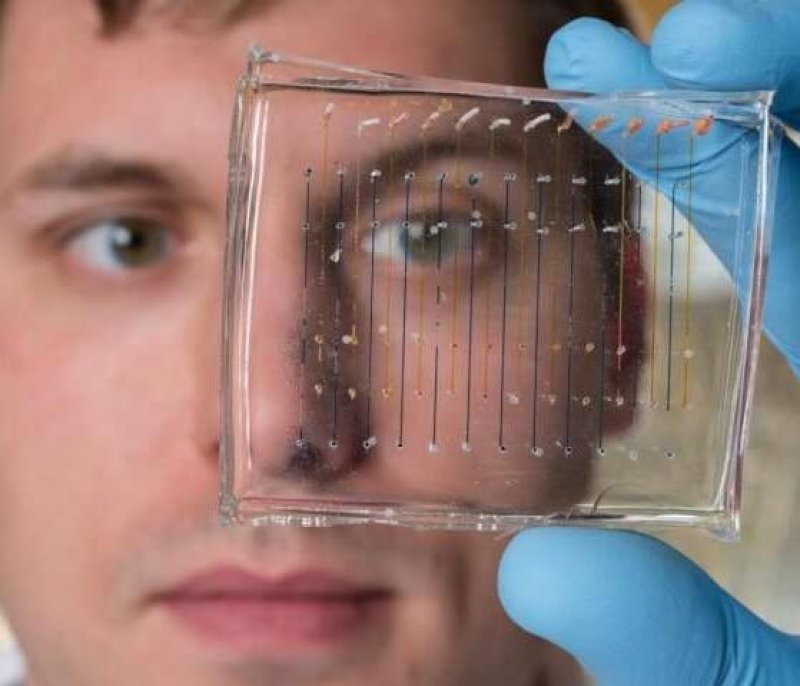
James Dahlman holds a microfluidic chip used to fabricate nanoparticles that could be used to deliver therapeutic genes. Credit: Rob Felt/Georgia Tech.

Using tiny snippets of DNA as “barcodes,” researchers have developed a new technique for rapidly screening the ability of nanoparticles to selectively deliver therapeutic genes to specific organs of the body. The technique could accelerate the development and use of gene therapies for such killers as heart disease, cancer and Parkinson’s disease.

Genetic therapies…are hard to deliver into the right cells in the body. For the past 20 years, scientists have been developing nanoparticles made from a broad range of materials…[but with] millions of possible combinations, identifying the optimal nanoparticle to target each organ was highly inefficient.

[R]esearchers from the University of Florida, Georgia Institute of Technology and Massachusetts Institute of Technology have developed a new testing technique that skips the cell culture testing altogether—and could allow hundreds of different types of nanoparticles to be tested simultaneously in just a handful of animals.

…

“We hope this technique will be used widely in the field, and that it will ultimately bring more clarity to how these drugs affect cells,” said [James Dahlman, an assistant professor in the Wallace H. Coulter Department of Biomedical Engineering at Georgia Tech and Emory University].

dnabarcoding
A microfluidic chip used to fabricate nanoparticles that could be used to deliver therapeutic genes to specific organs of the body. Credit: Rob Felt, Georgia Tech
[The study can be found here.]

The GLP aggregated and excerpted this blog/article to reflect the diversity of news, opinion, and analysis. Read full, original post: DNA ‘barcoding’ allows rapid testing of nanoparticles for therapeutic delivery

Related Articles

Infographic: Global regulatory and health research agencies on whether glyphosate causes cancer

Infographic: Global regulatory and health research agencies on whether glyphosate causes cancer

Does glyphosate—the world's most heavily-used herbicide—pose serious harm to humans? Is it carcinogenic? Those issues are of both legal and ...

Most Popular

ChatGPT-Image-Mar-10-2026-01_39_01-PM
Viewpoint—“Miracle molecule” debunked: Why acemannan supplements don’t work
Screenshot-2026-09-17-at-1.07.08-PM
'We are dangerously addicted to antidepressants': Should we heed RFK Jr.’s sobering warning?
Screenshot-2026-09-03-at-10.51.20-AM
Viewpoint: Why do online health lies outlive the evidence that debunks them? Read "Everyone Else Is Lying to You"
ChatGPT-Image-Sep-23-2026-01_52_03-PM
Viewpoint: 4 very real AI doomsday scenarios
ChatGPT-Image-Sep-2-2026-02_03_32-PM
How much of a problem is AI’s water use?
Screenshot-2026-09-23-at-11.55.01-AM
How can we know if social media bans actually help teens?
Screenshot-2026-09-23-at-3.15.09-PM
Anti-GMO activists in Pakistan rev up their campaign of dire warnings
Screenshot-2026-09-22-at-11.40.28-AM
After Idaho criminalized abortion providers in 2022, one-third of obstetricians fled. Health care advocates are making rural health the case for repealing the ban
ChatGPT-Image-Aug-26-2026-12_46_16-PM
Viewpoint: The fake controversy over whether combining childhood vaccines is dangerous— a debate science resolved 25 years ago
ChatGPT-Image-Sep-22-2026-10_32_46-AM
There has been a slew of recent reports of food recalls and foodborne outbreaks. Do we face an escalating problem?
Screenshot-2026-09-17-at-12.00.30-PM
Investigative group ProPublica finds links between ectopic pregnancy deaths and abortion bans
Screenshot-2026-09-10-at-12.20.19-PM
'Jet fuel didn't melt the steel': 9/11 conspiracy theories debunked
glp menu logo outlined

Get news on human & agricultural genetics and biotechnology delivered to your inbox.