Autism could be detected as early as 1 year old, with MRI scans

mri
Magnetic resonance imaging of the brain with no visible abnormalities. MRI in different views

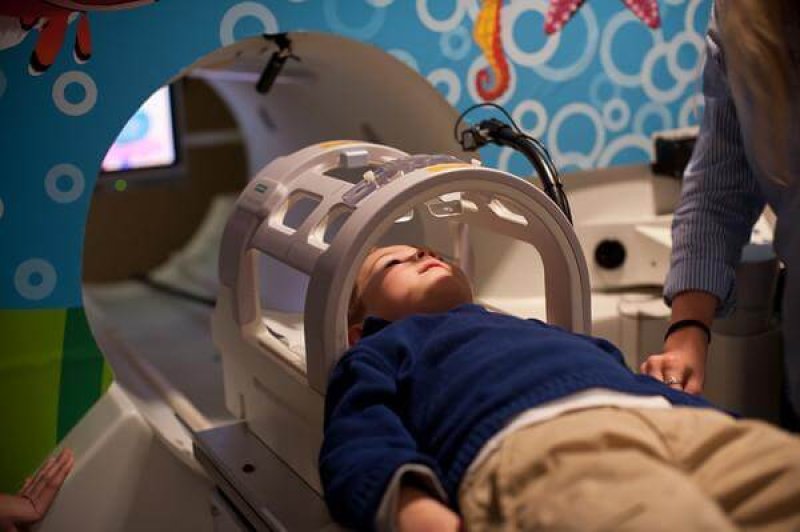
Children with autism tend to be diagnosed around age 4, after a child begins to socialize and speak. But the earlier a child is diagnosed, the better…Now, new research shows such a diagnosis could be predicted as early as one year old — based on scans of infants’ brains.

A team of researchers…enrolled 106 infants in the study, some of whose siblings had been diagnosed with autism. They performed MRI scans when the children were six months, one year, and two years old. They then noted which children had been diagnosed with autism….

The key differences were in how a child’s brain grew in the first year of life. Enlarged brain volume has previously been observed in children with autism. 

If the algorithm predicted that the child would be diagnosed with autism, it was correct just over 80 percent of the time.

[The researchers] agree that “it would not be practical” to routinely scan infants with such a technology if the screening tool moves to the clinic. But children in groups with higher rates of autism — like those who have affected siblings or who carry genes linked to autism — might benefit the most from it.

[The study can be found here.]

The GLP aggregated and excerpted this blog/article to reflect the diversity of news, opinion, and analysis. Read full, original post: Brain scans show potential to diagnose autism in infancy

{{ reviewsTotal }}{{ options.labels.singularReviewCountLabel }}
{{ reviewsTotal }}{{ options.labels.pluralReviewCountLabel }}
{{ options.labels.newReviewButton }}
{{ userData.canReview.message }}

Related Articles

Infographic: Global regulatory and health research agencies on whether glyphosate causes cancer

Infographic: Global regulatory and health research agencies on whether glyphosate causes cancer

Does glyphosate—the world's most heavily-used herbicide—pose serious harm to humans? Is it carcinogenic? Those issues are of both legal and ...

Most Popular

Screenshot-2026-04-22-at-12.21.32-PM
Viewpoint: Why the retracted Monsanto glyphosate study doesn’t change the science—the world’s most popular herbicide is safe 
Picture1
The FDA couldn’t find a vaccine safety crisis, so it buried its own research
ChatGPT-Image-May-1-2026-11_42_59-AM-2
Viewpoint: NAD is the wellness grifters latest evidence-lite longevity fad. At least the mice are impressed.
ChatGPT-Image-Apr-16-2026-02_56_53-PM
Financial incentives, over diagnosis, and weak oversight: Autism claims are driving up Medicare costs
ChatGPT-Image-May-12-2026-11_27_01-AM-2
AI likely to improve health care, research shows—but not for blacks and ethnic minorities
ChatGPT-Image-May-7-2026-01_23_27-PM-2
Viewpoint: Will AI democratize personalized cancer treatment or fuel medical misinformation?
vax-misinformation-main
Facts & Fallacies Podcast: Limit free speech to blunt social media misinfo?

Sorry. No data so far.

glp menu logo outlined

Get news on human & agricultural genetics and biotechnology delivered to your inbox.