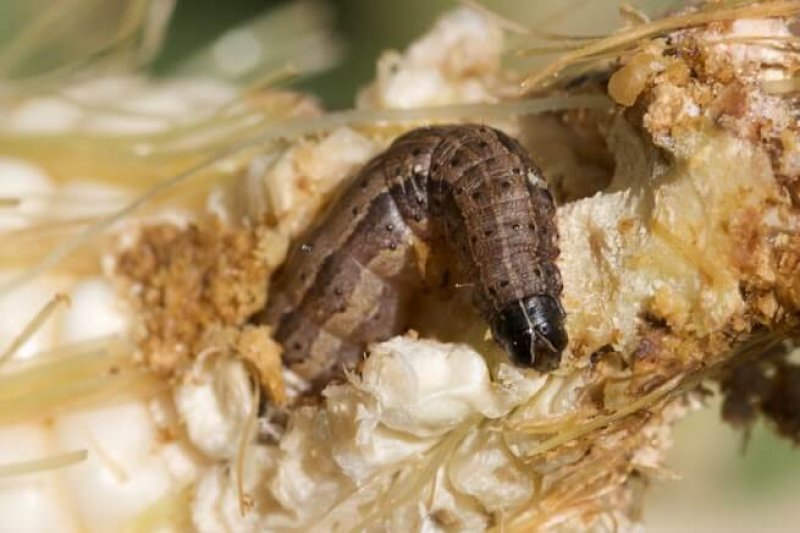
Field trial shows insect-resistant GMO corn could help African countries fend off armyworm outbreak

FAW head corn

Scientists have warned that the armyworm currently ravaging parts of Uganda could enter Kenya anytime, spelling doom for its stressed food security.

They said the worms, known for destroying anything in sight, are the latest threat to the perennial food shortages, which they warned could get worse unless the government became more receptive to innovative solutions.

[T]he scientists, drawn from organisations dealing with food security, said the solution lay in the government allowing the planting of a variety of maize that is resistant to the fall armyworm.

“The worm is already in neighbouring Uganda and successful tests have proven that the genetically modified plant is resistant from attack as compared to traditional hybrid varieties,” said Dr Sylvester Oikeh, the project manager at Water Efficient Maize for Africa….

The tests were carried out on the maize containing the Bacillus thuringiensis (Bt) gene variety….

“The potential of the Bt maize to control fall armyworm is quite evident on the trials going on in Uganda and this is quite exciting for our farmers,” Dr Oikeh said.

“When the fall armyworm attacked it had negligible effect on Bt variety, while destroying the traditional hybrids used for assessment in the research,” he added.

The GLP aggregated and excerpted this blog/article to reflect the diversity of news, opinion, and analysis. Read full, original post: Food disaster imminent as experts hint at armyworm invasion

For more background on the Genetic Literacy Project, read GLP on Wikipedia

{{ reviewsTotal }}{{ options.labels.singularReviewCountLabel }}
{{ reviewsTotal }}{{ options.labels.pluralReviewCountLabel }}
{{ options.labels.newReviewButton }}
{{ userData.canReview.message }}

Related Articles

Infographic: Global regulatory and health research agencies on whether glyphosate causes cancer

Infographic: Global regulatory and health research agencies on whether glyphosate causes cancer

Does glyphosate—the world's most heavily-used herbicide—pose serious harm to humans? Is it carcinogenic? Those issues are of both legal and ...

Most Popular

Screenshot-2026-04-13-at-1.39.26-PM
Viewpoint: ‘Safer for children?’ Stonyfield yogurt under fire for deceptive organic marketing
Screenshot-2026-04-22-at-10.46.29-AM
Viewpoint: How to counter science disinformation? Science journalist offers 12 practical tips
ChatGPT-Image-May-7-2026-12_16_37-PM-2
Viewpoint: Are cancer rates ‘skyrocketing’ as RFK, Jr. and MAHA claim? The evidence says mostly the opposite
Picture1-14
When superbugs threaten vulnerable children: Can AI help solve antibiotic resistance?
ChatGPT-Image-May-12-2026-08_39_41-PM
GLP podcast: Big Pharma, Big Ag, Big Food—health harming industries or life-saving innovators?
Screenshot-2026-04-23-at-11.00.36-AM
Regulators' dilemma: Thalidomide, Metformin, and the cost of getting drug approvals wrong
Picture1-1
Cooling the planet with balloons: Could a geoengineering gamble slow global warming?
png-pill-omega-Supp-fish-oil
Millions take omega-3 fish oil for brain health. New research suggests it may do the opposite.
glp menu logo outlined

Get news on human & agricultural genetics and biotechnology delivered to your inbox.