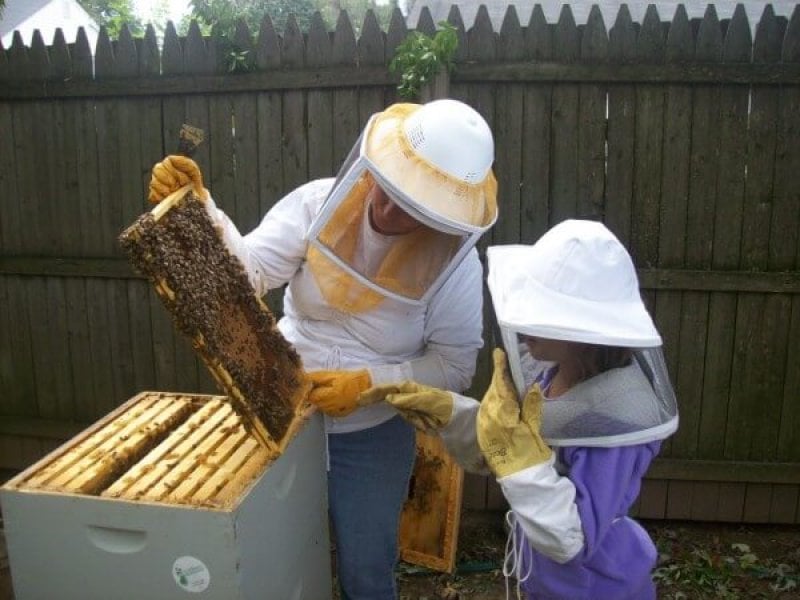
Inexperienced hobbyist beekeepers ‘major driver’ of honey bee colony losses in Europe

b db cf a fdb a dc c

Reports of honey bee population decline has spurred many national efforts to understand the extent of the problem and to identify causative or associated factors.

[T]he impacts of beekeeper knowledge and beekeeping management practices have often been overlooked, despite honey bees being a managed pollinator.

Here, we established a standardised active monitoring network for 5 798 apiaries over two consecutive years to quantify honey bee colony mortality across 17 European countries.

[M]odels revealed that hobbyist beekeepers with small apiaries and little experience in beekeeping had double the winter mortality rate when compared to professional beekeepers. Furthermore, honey bees kept by professional beekeepers never showed signs of disease, unlike apiaries from hobbyist beekeepers that had symptoms of bacterial infection and heavy Varroa infestation.

Our data highlight beekeeper background and apicultural practices as major drivers of honey bee colony losses.

Our results show that the main factors protecting honey bee colonies are beekeeper background and practices. More efforts are needed in beekeeper training to promote good beekeeping practices and achieve early identification of clinical signs of disease.

The GLP aggregated and excerpted this blog/article to reflect the diversity of news, opinion, and analysis. Read full, original post: A pan-European epidemiological study reveals honey bee colony survival depends on beekeeper education and disease control

For more background on the Genetic Literacy Project, read GLP on Wikipedia

{{ reviewsTotal }}{{ options.labels.singularReviewCountLabel }}
{{ reviewsTotal }}{{ options.labels.pluralReviewCountLabel }}
{{ options.labels.newReviewButton }}
{{ userData.canReview.message }}

Related Articles

Infographic: Global regulatory and health research agencies on whether glyphosate causes cancer

Infographic: Global regulatory and health research agencies on whether glyphosate causes cancer

Does glyphosate—the world's most heavily-used herbicide—pose serious harm to humans? Is it carcinogenic? Those issues are of both legal and ...

Most Popular

Screenshot-2026-04-13-at-1.39.26-PM
Viewpoint: ‘Safer for children?’ Stonyfield yogurt under fire for deceptive organic marketing
Screenshot-2026-04-22-at-10.46.29-AM
Viewpoint: How to counter science disinformation? Science journalist offers 12 practical tips
ChatGPT-Image-May-7-2026-12_32_36-PM
Viewpoint: The state of U.S. vaccine policy? Dismal nationally, but some states are stepping up.
ChatGPT-Image-May-7-2026-12_16_37-PM-2
Viewpoint: Are cancer rates ‘skyrocketing’ as RFK, Jr. and MAHA claim? The evidence says mostly the opposite
Screenshot-2026-04-23-at-11.00.36-AM
Regulators' dilemma: Thalidomide, Metformin, and the cost of getting drug approvals wrong
ChatGPT-Image-May-12-2026-08_39_41-PM
GLP podcast: Big Pharma, Big Ag, Big Food—health harming industries or life-saving innovators?
Picture1-14
When superbugs threaten vulnerable children: Can AI help solve antibiotic resistance?
Picture1-1
Cooling the planet with balloons: Could a geoengineering gamble slow global warming?
ChatGPT-Image-May-7-2026-01_23_27-PM-2
Viewpoint: Will AI democratize personalized cancer treatment or fuel medical misinformation?
bigstock opioids on chalkboard with rol
GLP podcast: 'Safe injection sites': enabling drug addiction or saving lives?
Defense_Secretary_Ash_Carter_tours_the_Microsoft_Cybercrime_Center_in_Seattle_March_3_2016
How criminals are using AI to target social media users and steal their money and confidential data
the magic of mRNA
Viewpoint: Anti-vax fake ‘turbo cancer’ claims threaten cancer treatment breakthroughs
glp menu logo outlined

Get news on human & agricultural genetics and biotechnology delivered to your inbox.