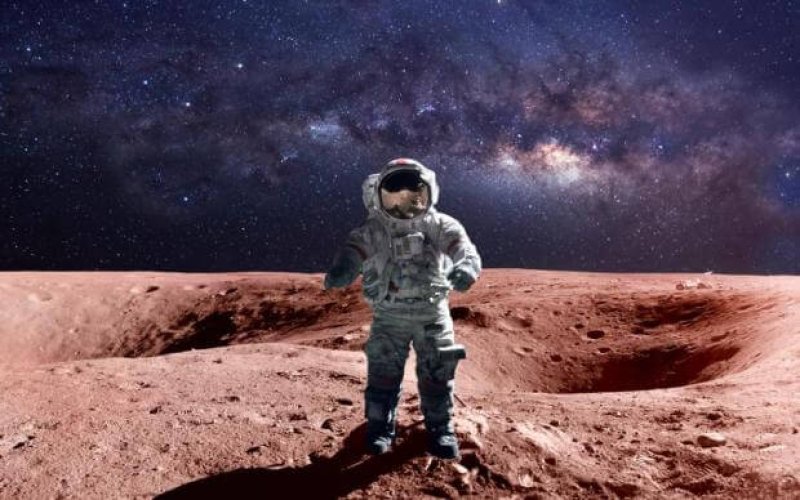
Should we use genetically modified astronauts to reach Mars?

astronaut

At the International Astronautical Congress last September, in Guadalajara, Mexico, Elon Musk convinced many die-hard space engineers he could get a fleet of private rockets filled with thousands of people to Mars.

Recently, a few scientists have started to explore whether we might be able to do a little better if we created new types of humans more fit for the travails of space travel. That’s right: genetically modified astronauts.

No one is trying to grow an astronaut in a bubbling vat somewhere. But some far-out ideas once relegated to science fiction and TED Talks (here and here) have recently started to take concrete form. Experiments have begun to alter human cells in the lab. Can they be made radiation-proof? Can they be rejiggered to produce their own vitamins and amino acids?

Creating astronauts able to make their own essential nutrients would obviously be immensely complicated. Yet as complex as it is, it might be less challenging than the alternatives, such as terraforming a planet or bringing along a space ring complete with an atmosphere, plants, and livestock grazing overhead.

The GLP aggregated and excerpted this blog/article to reflect the diversity of news, opinion, and analysis. Read full, original post: Engineering the Perfect Astronaut

For more background on the Genetic Literacy Project, read GLP on Wikipedia

{{ reviewsTotal }}{{ options.labels.singularReviewCountLabel }}
{{ reviewsTotal }}{{ options.labels.pluralReviewCountLabel }}
{{ options.labels.noReviewsLabel }}
{{ options.labels.newReviewButton }}
{{ userData.canReview.message }}

Related Articles

Infographic: Global regulatory and health research agencies on whether glyphosate causes cancer

Infographic: Global regulatory and health research agencies on whether glyphosate causes cancer

Does glyphosate—the world's most heavily-used herbicide—pose serious harm to humans? Is it carcinogenic? Those issues are of both legal and ...

Most Popular

ChatGPT-Image-Jul-17-2026-12_42_10-PM
Viewpoint: RFK, Jr. is setting up a panel to compensate people who claim they were injured by a COVID vaccine–no proof needed 
Screenshot-2026-07-17-at-12.55.22-PM
Viewpoint: Is bagged salad a dangerous science experiment? Challenging an online misinformation campaign
ChatGPT-Image-Mar-10-2026-01_39_01-PM
Viewpoint—“Miracle molecule” debunked: Why acemannan supplements don’t work
ChatGPT-Image-Jul-6-2026-02_25_26-PM
40 million Americans take glucosamine. If you have memory loss, it could accelerate cognitive decline.
Screenshot-2026-07-01-at-2.49.48-PM
Dr. TikTok and male fertility: Viral claims tout GLP-1 drugs as fertility boosters. What does the science say?
px-Minced-beef-meat-cow-cattle
Can we trust Trump’s USDA to accurately report farm data? Beef export numbers suggest ‘no’.
vitamin k refuse genai
More and more babies are developing uncontrollable bleeding—linked directly to vaccine deniers' rejection of vitamin K shots
Screenshot 2026-07-11 094410
Growing animal muscle and fat cells inside rice grains and calling it beef: One of numerous genetically engineered products shaking up our ecosystem
UK scientists support loosening restrictions limiting embryo research
Are we edging closer to precisely, and safely, editing human embryos?
reverse-aging
Rapamycin: Here’s the skinny on the anti-aging pill that increases the lifespan—of mice by 10%
ChatGPT-Image-Jul-9-2026-02_39_22-PM
Viewpoint: Polyphenols or NAD+ supplements to combat aging: No, Gwenyth Paltrow and followers, don’t waste your money.
ma art page image
‘It’s time to have a conversation’: Once adamantly opposed to human gene editing, UK’s The Guardian acknowledges likely benefits
file-f-d-d-
Facts & Fallacies Podcast: Europe's AC debacle underscores fatal flaw in green activism
ChatGPT-Image-Jun-17-2026-03_29_08-PM
Viewpoint: What’s the impact of the U.S. abandoning support for global health?
glp menu logo outlined

Get news on human & agricultural genetics and biotechnology delivered to your inbox.