Six times a day, Katrin pauses whatever she’s doing, removes a small magnet from her pocket and touches it to a raised patch of skin just below her collar bone.
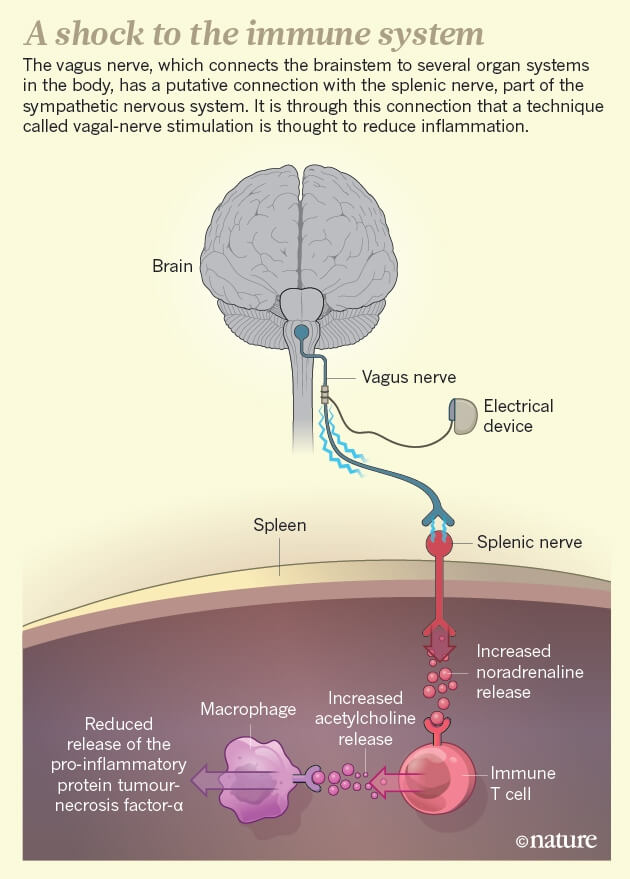
The magnet switches on an implanted device that emits a series of electrical pulses — each about a milliamp, similar to the current drawn by a typical hearing aid. These pulses stimulate her vagus nerve, a tract of fibres that runs down the neck from the brainstem to several major organs, including the heart and gut.
The technique, called vagus-nerve stimulation, has been used since the 1990s to treat epilepsy, and since the early 2000s to treat depression. But Katrin, a 70-year-old fitness instructor in Amsterdam, who asked that her name be changed for this story, uses it to control rheumatoid arthritis…
Several pharmaceutical companies are investing in ‘electroceuticals’ — devices that can modulate nerves — to treat cardiovascular and metabolic diseases. But [Kevin Tracey’s, a neurosurgeon at the Feinstein Institute for Medical Research in Manhasset, New York] goal of controlling inflammation with such a device would represent a major leap forward, if it succeeds.

The GLP aggregated and excerpted this blog/article to reflect the diversity of news, opinion, and analysis. Read full, original post: The shock tactics set to shake up immunology